
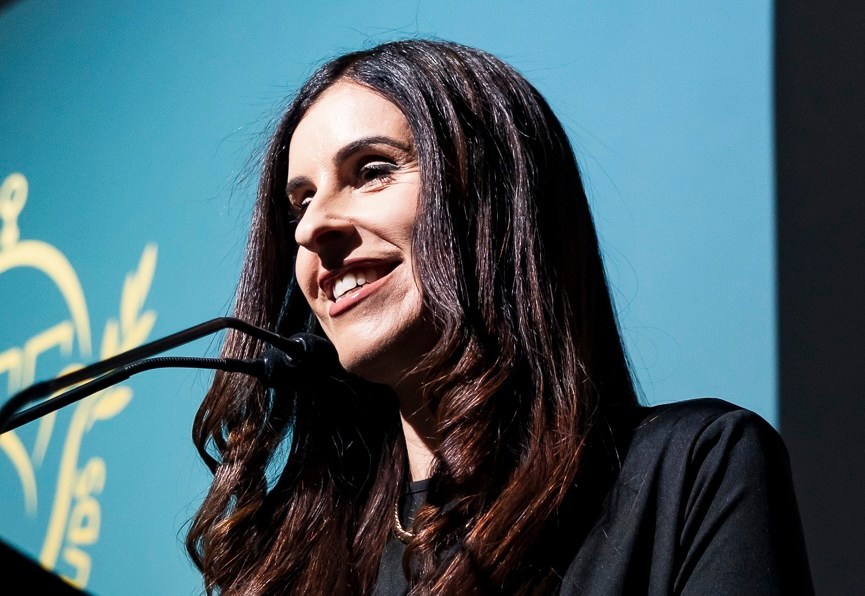
Dr Randa Abdel-Fattah is very talented, very smart – and very dangerous. She is an academic, sociologist, lawyer and novelist, born in Australia to a Palestinian father and Egyptian mother. She is the darling of the Australian luvvies set, feted on university campuses and a fixture on the Australian writers’ festival circuit. She is highly articulate, very telegenic and sought-after media talent. She was a regular panellist on the Australian version of the BBC’s Question Time.
Academically, she specialises in what it means to be Muslim in Australia, and Islamophobia. She had benefited from several taxpayer-funded major research grants, and her institution, Sydney’s Macquarie University, is arguably the most ideologically progressive in Australia’s extremely ideologically progressive university system. She is very much at home there.
In April 2024, she took a group of children to an anti-Israel protest camp at the University of Sydney, and led them in a chant of ‘intifada’
But Abdel-Fattah is also an outspoken activist for the Palestinian and Gaza cause, and a sworn enemy of the state of Israel.
In Australia, Abdel-Fattah has used her celebrity and media dexterity to amplify her outspokenness on the October 7 Hamas terrorist atrocities, and Israel’s conduct during the conflict in Gaza. Most notoriously, as news broke of the attacks on that dreadful 2023 day, Abdel-Fattah changed her social media avatar to a paraglider in Palestinian colours, keeping it there for several months (she claims she is not active on Facebook and did not realise the image had been up for months). On Australian television she refused to describe Hamas as a terrorist organisation.
Indeed, Abdel-Fattah’s Twitter feed is a stream of denunciations of Israel, ‘genocide’, and opponents of her pro-Gaza cause, right up to condemning Ed Sheeran for not opposing the cancellation of his support act, Macklemore, for on-stage Palestinian activism. In April 2024, she took a group of children to an anti-Israel protest camp at the University of Sydney, and led them in a chant of ‘intifada’.
She has consistently refused to change her views in the face of the conclusive proof of Hamas’s barbaric actions on 7 October and in Gaza, including after December’s Islamist outrage at Bondi beach in December. ‘In the context of the wholesale slaughter of my people, who Israel has trapped under bombs in Gaza, [the paraglider] image that represented a moment of freedom is not something I will apologise for’, she wrote earlier this year.
In January, the premier of South Australia, the Labor party’s Peter Malinauskas, called for her to be removed from the line-up of the Adelaide Writers’ Festival, funded by his government, while the wounds of Bondi were so raw. The organisers complied with the premier’s request, which Abdel-Fattah denounced as ‘censorship’. This led to most of the other invitees walking out, the resignation of the festival director – who, although herself Jewish, personally sided with Abdel-Fattah – and the cancellation of the entire event.
Curiously, however, when Jewish and pro-Israel writers were disinvited from similar events after October 7, there was silence from Abdel-Fattah. Nor did she criticise the doxxing of hundreds of Jewish creatives in 2024, who were targeted by activists simply because they are Jewish. As far as Abdel-Fattah is concerned, it seems free speech is for me and not for thee.
Her latest novel, Discipline, was written after 7 October, and revolves around the Israel-Hamas conflict in Gaza. It was this book Abdel-Fattah was to promote in Adelaide; now she is coming to Britain on a promotional tour for it. It just so happens her planned 3-9 October visit coincides with the third anniversary of 7 October, a time of bitter pain for Jews not just in Israel and Britain, but throughout the West.
Randa Abdel-Fattah is a divisive figure in Australia, and revels in her profile and notoriety. Should she come to Britain, especially at the painfully sensitive time of 7 October, she would be equally divisive.
Shadow home secretary, Chris Philp, is aware of Abdel-Fattah’s reputation and track record. This week he wrote to his counterpart, Shabana Mahmood, urging her to block the Australian from entering the United Kingdom, and rightly so.
‘The timing makes this visit particularly concerning. Abdel-Fattah’s tour falls around the anniversary of the October 7 atrocities, at a time when British Jewish communities continue to face acute security concerns’, Philp said in his letter to the Home Secretary.
‘The government cannot say that it is determined to confront extremism while failing to scrutinise overseas speakers whose rhetoric appears to celebrate or excuse the events of October 7 and refuse to describe a proscribed terrorist organisation for what they are.’
Philp is absolutely right. Abdel-Fattah has celebrated the events of 7 October, and has sought to excuse both the terrorism of Hamas, and the barbarism of its Islamist fanatic adherents. Besides her book tour, Abdel-Fattah is highly media-friendly and likely would readily repeat her views given the opportunity.
The anniversary of October 7 is no time for platforming outspoken extremism, and certainly not for platforming those with the intelligence and eloquence to express their views powerfully and destructively.
The most talented activists are the most dangerous. As a Home Secretary of Muslim background, Shabana Mahmood can show she respects her duty of care to all British citizens and residents by not importing extremism in any form, especially at a time of great grief and pain for Britain’s Jews. She should act decisively to deny the right of entry to Randa Abdel-Fattah.




Comments