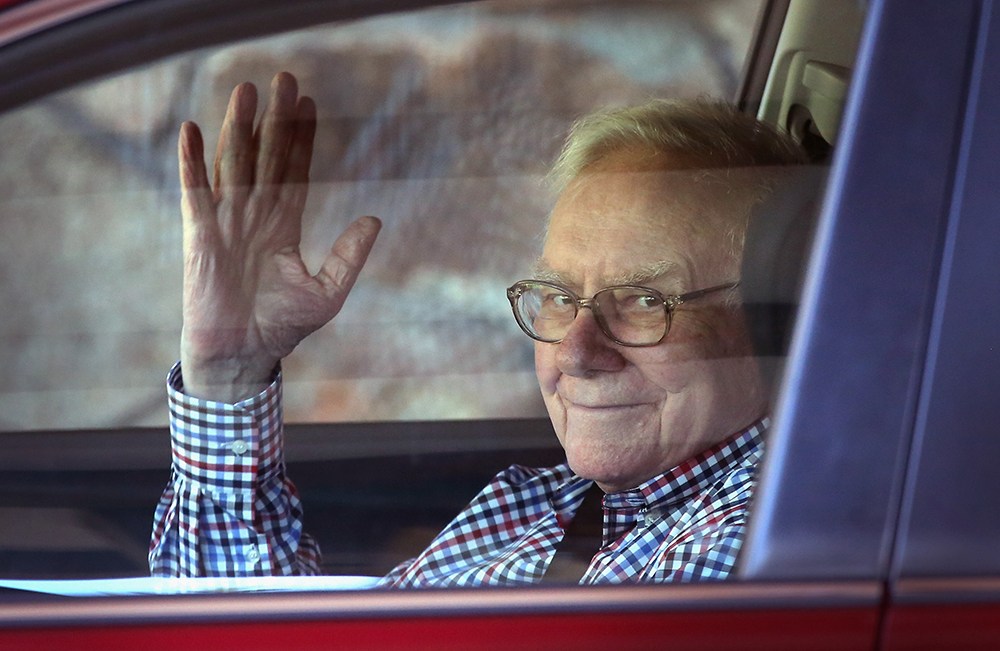


‘Father Time always wins,’ 96-year-old Warren Buffett told shareholders as he retired last week from the chair of Berkshire Hathaway, the investment juggernaut he led for six decades. ‘He has, however, been generous with me.’ Buffett himself has been generous too, in the wisdom he dispensed and in the spectacular long-term return on capital he delivered.
One hundred dollars invested with him in 1965 would have become $6 million today, at a compound annual growth rate close to 20 per cent; the same bet on the S&P 500 share index, compounding at 10.5 per cent, would have made just $45,500. Except of course that for Buffett, investment was never a bet. It was a deeply considered process of picking and holding companies with exceptional strengths and prospects, from Coca-Cola to the Chinese car maker BYD, which he talent-spotted in 2008.

As for the Berkshire shareholders who revered him, ‘From the beginning, Charlie [Munger, his business partner who died in 2023, aged 99] and I looked for owners who thought in decades rather than quarters’. By ‘owners’ they meant like-minded co-investors, not the fast-buck punters who dominate today’s US investment arena.
Buffett never used his wealth for political influence and will leave almost all of it to charities for health, education and social justice. He has been a benign antidote to the grotesqueries of Donald Trump and Elon Musk. And financial columnists should regularly recite his mantra that ‘money can’t change how many people love you’.
Sci-fi hype
One of Buffett’s observations on AI earlier this year was, ‘Even the people that are smartest about it say they don’t know where it’s going.’ Since then, people who do say they know where it’s going have told us AI is already swarming beyond control and will soon have the capacity to wipe out the human race. Sceptics might think such sci-fi hype is designed both to encourage regulation that would protect early movers against later disruptors and to keep AI in the forefront of public attention – boosting the potential value of AI businesses, however opaque, in the way so many doubtful dotcoms shot briefly into orbit a generation ago.
On which theme, my eye is caught by Emulate, a British AI fledgling incorporated only last month. Dealroom.co says this start-up by three former Google DeepMind researchers will ‘build models which forecast real-world physics’ but is currently ‘in stealth’ with no product and no website. Yet it is also in advanced talks to raise $700 million from venture funds against a company valuation of $3.7 billion.
Would Buffett buy Emulate? On that summary I doubt it, though Berkshire has AI interests through stakes in Apple and Alphabet, the parent of Google. Should investors with more youthful risk appetites buy mixed bundles of AI shares in the hope that one of them will be the next Nvidia, the chipmaker that has been the rocket stock of the AI boom so far? Maybe. But it’s also worth listening to Eben Upton, a Jason Statham lookalike half Buffett’s age and the founder of the UK’s bestselling computer brand, Raspberry Pi, who I expected to enthuse for AI when I lunched with him this week.
In fact (as he also told the Financial Times recently), Upton thinks today’s AI models are ‘brutally limited’ and could plateau in development long before they achieve super-intelligence. My own interim conclusion is that our lives will be changed by AI – as they were by the wheel, the steam engine and the internet – in ways we don’t yet know, but civilisation probably won’t be destroyed by it. On current form, we’re quite capable of doing that by ourselves.
Keynesian hole-digging
In any case, as John Maynard Keynes pointed out, ‘In the long run we are all dead.’ The quote recurs in James Graham’s new play, The Standard of Living, at the Haymarket Theatre, as justification for the great economist’s belief in urgent government action to revive limp economies, in contrast to the credo of Friedrich Hayek (who’s also on stage and to whom Keynes was gracious in real life) that state intervention merely misdirects resources, limits freedom and postpones necessary market correction.
Naturally Keynes wins the argument, aided by a closing photomontage of the supposed brutalities of Thatcherism. But we’re not reminded of his evidence-based flexibility (‘When my information changes, I alter my conclusions’), nor are we treated to his suggestion in The General Theory that if the Treasury filled old bottles with banknotes and buried them for private enterprise to dig up again, ‘There need be no more unemployment and… the real income of the community… would probably become a good deal greater.’ That hole-digging sounds painfully like the HS2 rail project, today’s prime evidence that Keynesian stimulus can’t work if government is utterly incompetent.
Ideal lunch
As reimagined by James Graham and the actor Rory Kinnear, Keynes is an anxious number-cruncher with a cottaging habit rather than a dazzlingly sophisticated uber-intellect. But still I’d invite him to an all-time ideal lunch with Buffett and Hayek, and perhaps J.K. Galbraith and Milton Friedman, who also got on well despite polar economic differences, and Denis Healey and Nigel Lawson, who probably didn’t.
Lunch conversation, after all, is one thing AI will never replace. And I also had that pleasure this week – at Camille in Borough Market, since you ask – with Piers Pottinger, best known as the co-founder, with Margaret Thatcher’s confidant Tim Bell, of the once-ubiquitous PR firm that bore both their names. To me, however, Piers is still the mischievous City clerk who showed me how to process bills of exchange as a summer intern in 1975. Then as now, we had not the slightest clue what the future would look like; then as now, we laughed long into the afternoon.




Comments