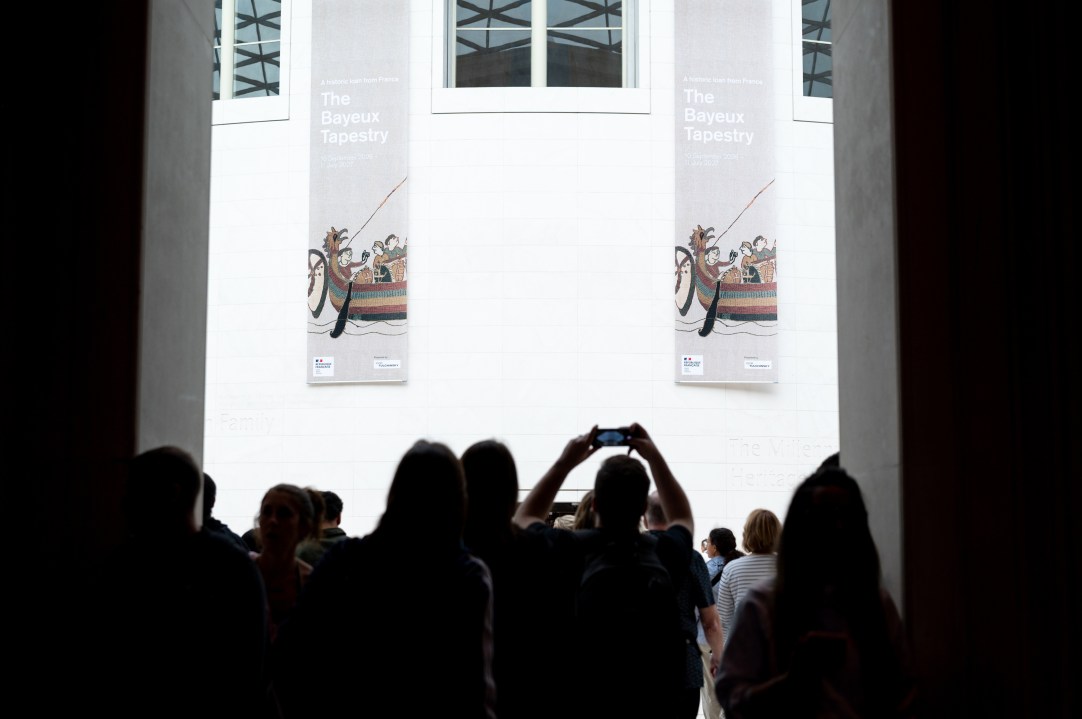
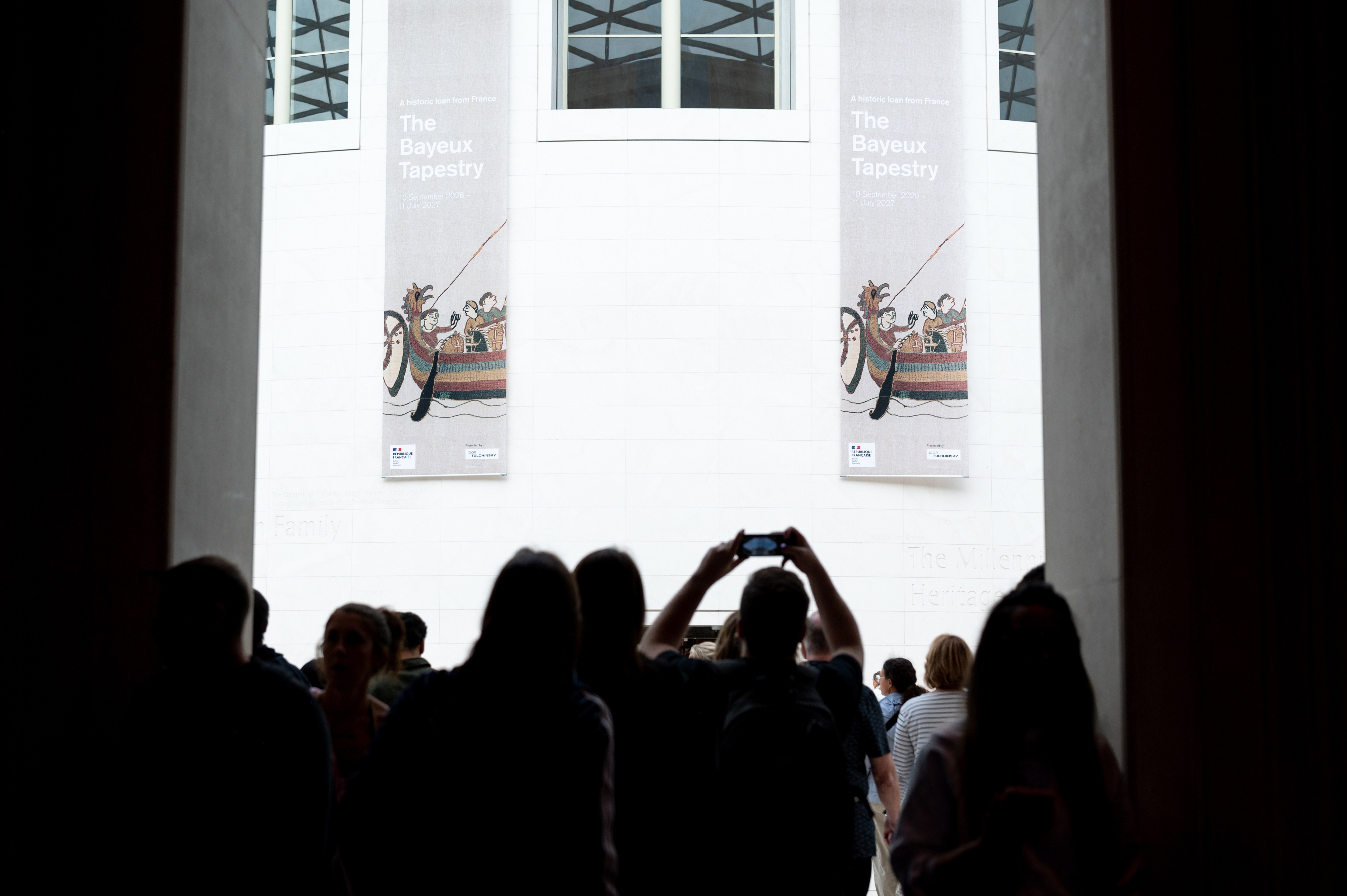
There is no denying the wonders of the Bayeux tapestry. Seeing the Norman Propaganda in the flesh, rather than on a smartboard in a history lesson, is an arresting experience. You notice, perhaps for the first time, the fables and strange beasts of the lower margins giving way to a brutal carpet of dead bodies – decapitated heads, severed limbs and blood – as the Normans win at Hastings.
Unfortunately, the British Museum appears to be doing everything in its power to prevent the public from actually looking at it. Most art critics and journalists will have first visited the embroidery at a press evening or media breakfast. Consequently, most reviewers have successfully traversed the ‘Bayeux Tapestry Experience’ without incident. And, crucially, they appear to have been permitted by museum marshals to stop and appreciate the thing.

The rest of us commoners will have no such luck. If you wish to see the embroidery in London, you must first sit in an online queue for several hours. Then, if you’re lucky, you will be permitted to pay £33 for a ticket (I’m reliably informed that had I simply popped over to Bayeux before the Tapestry came to London then the viewing would have cost me just €12 – with an audio guide thrown in.)
Upon arrival at the British Museum, things seemed to operate with reassuring efficiency. As we queued at the entrance with our exhibition group, I was informed by our guide that we would be going inside in precisely 32 seconds. A large countdown clock was displayed on an iPad while we waited.
Once it reached zero, we were ushered in. For a brief moment, I was impressed by the military coordination behind the exhibition. Then things began to fall apart. The crowd was directed towards a display board where we were introduced to a cartoon bird who would guide us through our ‘experience’. British twee at its finest.
It was at this point that I realised we were still very much in a queue: the sort that Disney Imagineers design to stop people noticing that they have spent two hours waiting to ride a log flume. A long line of visitors stretched through a dark corridor. Some had evidently been there for quite some time. The Bayeux Tapestry itself was nowhere to be seen.
Instead, a short series of projections played across the walls to entertain us as we waited. They offered a brief biography of Bishop Odo and brilliant insights including the revelation that, before the Bayeux Tapestry could be stitched, preparations had to be made.
Unfortunately, reading these slides took at most five minutes. We would stand there for more than an hour. By the end, I confess I had developed some rather murderous plans for the cartoon bird, which is apparently intended to act as a pacemaker for the crowd but was, at this point, merrily flapping through our holding pen while we remained completely static.
The crowd was directed towards a display board where we were introduced to a cartoon bird who would guide us through our ‘experience’
At long last, you are directed down some steps and towards the Tapestry’s enormous bespoke display case. The embroidery is lying flat because, after nearly two centuries of displaying it vertically, the French have suddenly discovered that this is actually a harmful means of presentation.
I have no criticism at all of the work itself. Its sheer length is astonishing. Spread across 70 metres, its extraordinary detail is impossible to do justice in photographs. You find yourself wanting to lean closer: to examine individual expressions, the horses, the ships, the tiny creatures in the borders, the gradual descent into carnage.
Unfortunately, the gallery guards seem determined to ensure that the awe-inspiring nature of the object does not distract visitors from our primary purpose: getting through the exhibition hall as fast as humanly possible.
Every couple of minutes, a pre-recorded announcement sounds over the loudspeaker in English and French: ‘You must keep moving along the Tapestry. Do not stop.’ I pity the Frenchman who wasted 183 years of opportunity to visit the piece in its purpose built (and I’m informed usually empty) museum and has now braved the Eurostar to see it here.
If the announcements weren’t enough to keep the crowds filing through, the walls are lined with attendants ready to usher along anyone momentarily distracted by Halley’s Comet. ‘Please fill the space in front of you,’ we were repeatedly instructed. If you are unfortunate enough to be standing behind someone who does briefly pause, your whole group is frogmarched through the next few feet of the exhibition – past sections you are yet to see – to ensure that absolutely no space is wasted.
Towards the end of the ‘experience’ I took a brief pause to admire the final stages of the battle. A guard quickly rushed over. ‘Are you looking for Harold? There he is,’ and I was promptly ushered away towards the door. The message is clear: your time in this room is over. Leave the hall, do not pass Go, do not darken our doors for any more time than necessary.
I am sympathetic to the British Museum. Hundreds of thousands of people want to visit. They need to find a way to get us all through. And the embroidery is simply a huge distraction from that crowd management process.The British Museum has reportedly banned photos in a bid to speed up crowds. Maybe they need an airport-style travelator to eliminate the risk of congestion at all. I’m grateful to have seen such an important piece of English history. But I’d have been even more grateful if I had been allowed to properly look at it.



Comments