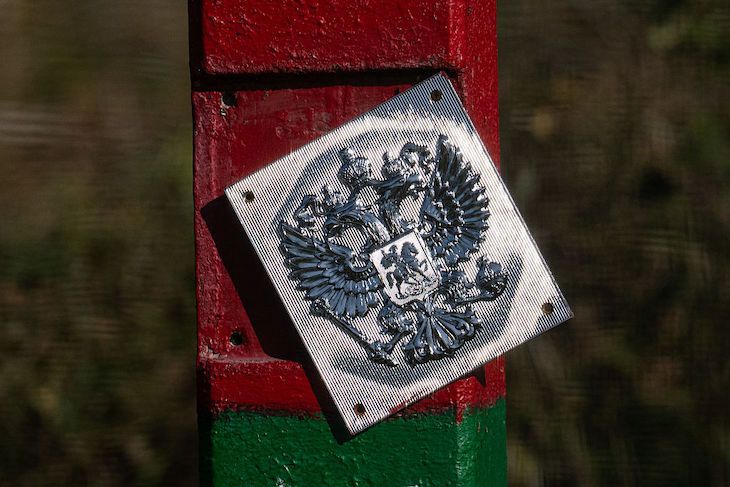
‘Prepare for war,’ was the message from Estonian EU foreign policy chief Kaja Kallas to the European Defence Agency last year. And Estonia has: its 2026 defence expenditure is 5.4 per cent of GDP, the second highest in Europe. Citizens are advised by the government to keep an emergency supply of 21 litres of drinking water per person permanently on hand. A survival checklist has also been published, including ready-to-eat, high-energy foods, prescription medications, a bank card, mobile phone with charger and a stock of ready cash. The country’s authorities don’t mince their words.
Estonians are not the most optimistic of peoples
But, as the saying goes, money talks – and many Estonians are choosing to keep their cash in a country that some suggest might soon be on the front line. Despite recent reports that Vladimir Putin may be planning to test Nato’s resolve – not to mention Poland’s prompt shutdown of airports last week in response to a nearby Russian drone attack and Lithuania’s recent confirmation that it has evacuation plans – one message seems to be coming from the country’s money-institutions: ‘Everything is normal.’
In just two years, Estonians’ investments through international platforms have roughly quintupled, which to an outsider might look like funds being moved rapidly abroad. But while this is no small sum (roughly 500 million euros, or £420 million), Kilvar Kessler, former Chairman of Estonia’s Financial Supervision Authority, points out it’s only a small percentage of Estonian household deposits (over 14 billion euros, or £12 billion) that are still being held inside the country. While the government may be alarmed, finance professionals clearly are not.
Financial assets might commonly be held outside the country through Estonia-based online platforms like Wise and Lightyear. Yet Kristjan Mäe, an economist with the Bank of Estonia, doesn’t see it as capital running away from anything, simply running towards a better product.
‘I don’t think,’ he says, that ‘use of these platforms is due to a security issue. I think it’s mainly that these are younger people, freelancers. It’s cheaper to get paid on those platforms. Financial literacy is also growing in Estonia. We still see deposit growth in Estonia, and mortgage growth is over 10 per cent per year now. There is investment confidence here’. But should there be?
Lightyear founder and CEO Martin Sokk admits the war may have introduced another aspect to investing, but it’s not the main one. ‘The previous problems were, “If I lose my job, how many months’ salary do I need saved?” Now, it’s “If there’s a war, have I saved enough?”’ Sokk, whose company operates in 25 markets, recognises this is happening more in nations that border Russia and where media coverage brings home the need for financial security. ‘But it’s scarier from outside the country. Here, life isn’t going to stop because you have a bad neighbour.’
This last comment was one I heard so often from Estonian finance professionals it sounded like they were trying to convince themselves. Is this plucky realism or are they getting high on their own supply? Was everyone sticking to the same cheery script because a Russian invasion is something they just don’t dare to contemplate? Perhaps, too, they’re just trying to avoid rocking the markets. But it sounded to me like they genuinely believed it – even if it didn’t quite jibe with Kallas’s ‘Prepare for War’ rhetoric.
One prominent Estonian investment banker I spoke to admitted to me that ultra-high-net-worth individuals have indeed taken part of their assets outside the country. But he was also quick to note that they’ve also kept substantial amounts here to invest locally. Commercial real estate in the capital, Tallinn, he pointed out, can still yield nearly twice that of a similar property in Helsinki, and he believed that the risk profile of a Russian invasion was similar.
Residential real estate in Spain, however, tells a different story: Since the war, property sales to eastern Europeans have been booming. Carol Ojasoo, an Estonia-born estate agent in Marbella, has been selling property on the Costa Del Sol for ten years. She tells me there’s been an upsurge in purchases by citizens of countries sharing a border with Russia, including Estonians. Many buyers, she adds, ‘make it clear that it has to do with diversifying their investment portfolio for security reasons. For the first time ever we’re seeing Poles listed in the top ten. They didn’t even register in the statistics before.’ Was Ojasoo the only one giving me the straight scoop? Did moving to Spain afford her the luxury of candour?
Having lived in Estonia over 20 years, I can testify that Estonians are not the most optimistic of peoples. They are quick to describe their country’s ugly past to newcomers and long-term residents alike, a history which shows that when the shit hits the fan, rules, processes, and understandings go out the window.
So why the apparent complacency when it comes to finance? Not one Estonian professional working in the field would admit to me losing sleep over a possible Kremlin invasion. Have the governments of Western Europe, alerting their citizens to a Russian danger, got it radically wrong? Or have Estonians become so Westernised in the past thirty years they’ve lost touch with their suspicious, sullen ancestors? And why do I feel, asking around, like the turd in the punchbowl?
An investment banker I talked to explained it this way: ‘We’re a pragmatic people. For us, “it could be worse” is a compliment. But what are we going to do? We live here. Our families are here. If things go very bad, like in 1940, I’ll take my boat and try to get to Finland or Sweden. But I’m not going away when there’s no immediate threat.’
He was more optimistic than I could be, but I felt he was sincere. All of us, regardless of nationality or geography, tell ourselves the stories that we need to hear.
The Estonians have a saying, “Lootus on lollide lohutus.” Hope is the consolation of fools. We must ourselves hope, both for Estonia’s sake and our own, that the saying this time turns out to be just a cynical old adage.




Comments