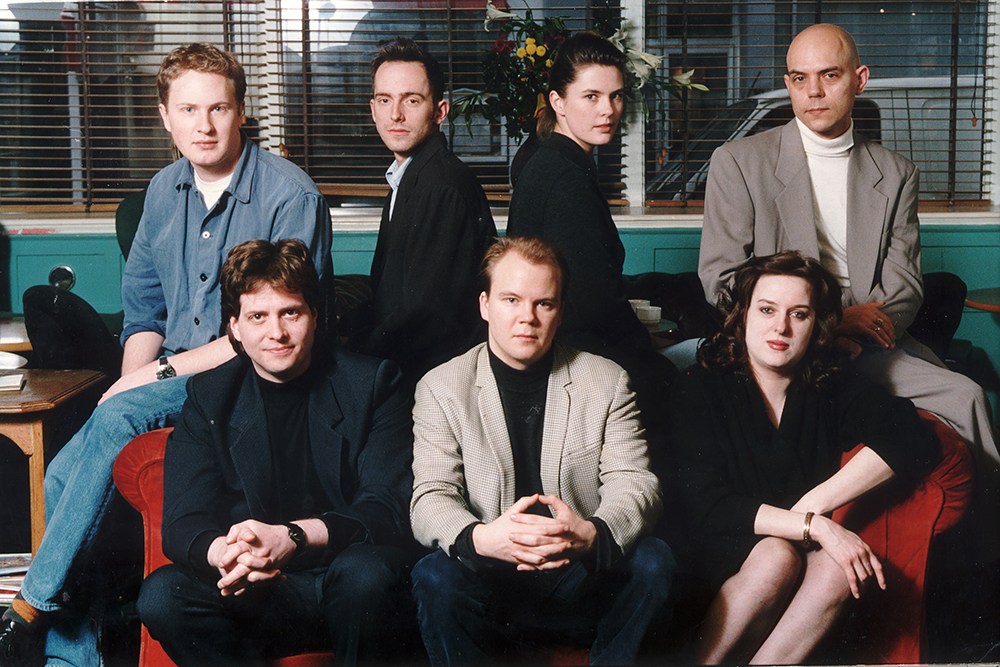


Thirty-five years ago this month, I launched a magazine with Julie Burchill and Cosmo Landesman that, despite going belly up four years later, had quite an impact. The Modern Review, edited by me, published long, scholarly articles about icons of 1990s pop culture like Arnold Schwarzenegger, the Spice Girls and Noel Edmonds – our motto was: ‘Low culture for highbrows.’ Today that doesn’t sound particularly remarkable, but such material was then considered below the salt and insofar as the broadsheets covered it at all, was the object of humorous disdain.
The fact that mass culture is now taken more seriously by critics – too seriously, some would say – is partly due to the influence of the Modern Review. The writers we published, some for the first time, such as Nick Hornby, Louis Theroux and Will Self, went on to successful careers as experts on hitherto neglected subcultures, and the Sunday Times relaunched its arts supplement in homage to our little periodical (and poached many of our best writers in the process).

The magazine almost blew up on the launch pad. To get the first issue out, we needed to produce camera-ready pages – and to do that we needed access to an A3 laser printer. This meant a midnight visit to the offices of the European, where our literary editor, Tom Shone, was a trainee. We managed to escape undetected at 6 a.m., but I made the mistake of thanking Robert Maxwell, the European’sowner, on the contents page and when he realised why he went ballistic. ‘That’s like burglars leaving a calling card,’ he told the editor. He threatened to apply for an injunction, report the ‘theft’ to the police and sue for damages if we didn’t hand over all copies of the first issue and agree never to publish the Modern Review again.
I told him to get knotted and he duly set about trying to destroy us. The police took no interest and his effort to injunct the first issue failed. But his civil suit was proceeding through the courts when my friend Aidan Hartley called me in the middle of the night to repeat what he’d read on the wires: ‘Robert Maxwell missing at sea.’ That meant the end of our legal troubles, but we’d racked up £20,000 in costs and there was now no chance of recovering them in spite of the courts ordering Maxwell to pay up. This drained our bank account of the money I’d raised to cover our first year’s bills.
Luckily, the magazine sold enough copies and advertising to limp on. It helped that it was produced from the kitchen of my flat, with staff and contributors providing their labour in exchange for booze and chicken risotto. In time, our circulation increased to 35,000 and we produced a US edition, but that meant we had to start paying people. By summer 1995, we had run out of money and our efforts to find a buyer had come to nought.
The trigger for the magazine shutting down was Julie leaving her husband, Cosmo, for Charlotte Raven, a young assistant editor, and deciding she wanted Raven to replace me as editor. Instead of going quietly, I assembled members of staff loyal to me and we produced a ‘greatest hits’ issue, announcing the magazine’s closure. In the accompanying editorial I broke the news that Fleet Street’s most famous Glenda Slagg had become a lesbian, and our spat ended up on the front pages, with one commentator calculating it got almost as many column inches as Bosnia that week. I’m pleased to say we’ve made up since.
The Sunday Times relaunched its arts supplement in homage to our periodical
The fact that the magazine began and ended in a blaze of controversy overshadowed the quality of the writing. I recall a brilliant piece by David Runciman, who became a professor of politics at Cambridge, speculating on the causes of Paul Gascoigne’s bizarre behaviour and headlined: ‘Wazza Mazza Wiz Gazza?’ A review of Terminator 2 by Oliver Morton, science editor of the Economist – ‘A General Theory of Terminators’ – has stood the test of time, and we published an increasingly vituperative exchange between Julie and Camille Paglia that has become a classic of the genre.
Happily, you can now read all of them as John Power and I have put the entire Modern Review archive on Substack (modernreview.substack.com). Some of it is free, but to access the whole lot you’ll need to pay a nominal fee, with the money raised helping to pay for a new annual journalism prize. In the ‘greatest hits’ issue I threw down the gauntlet to the next generation of Young Turks, challenging them to produce a periodical of the same quality. Alas, the era of the little magazine has passed, but there are still some hugely talented writers out there, raging at our complacent elites. We hope to find them with our prize. Send your entries to modernreviewprize@gmail.com.




Comments