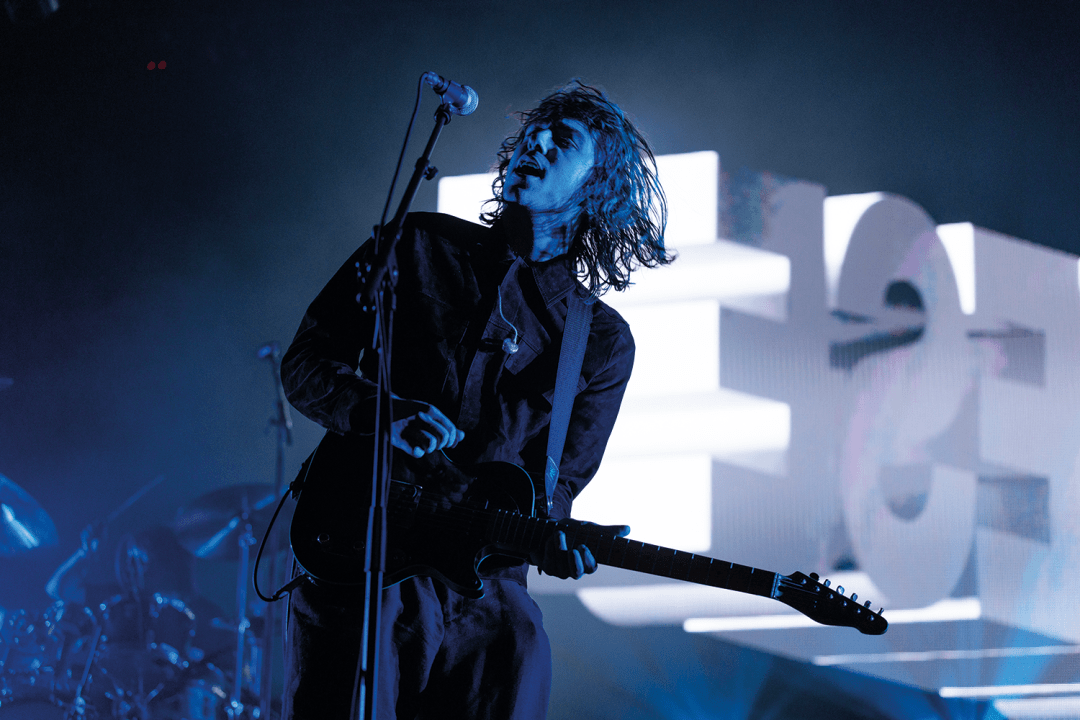
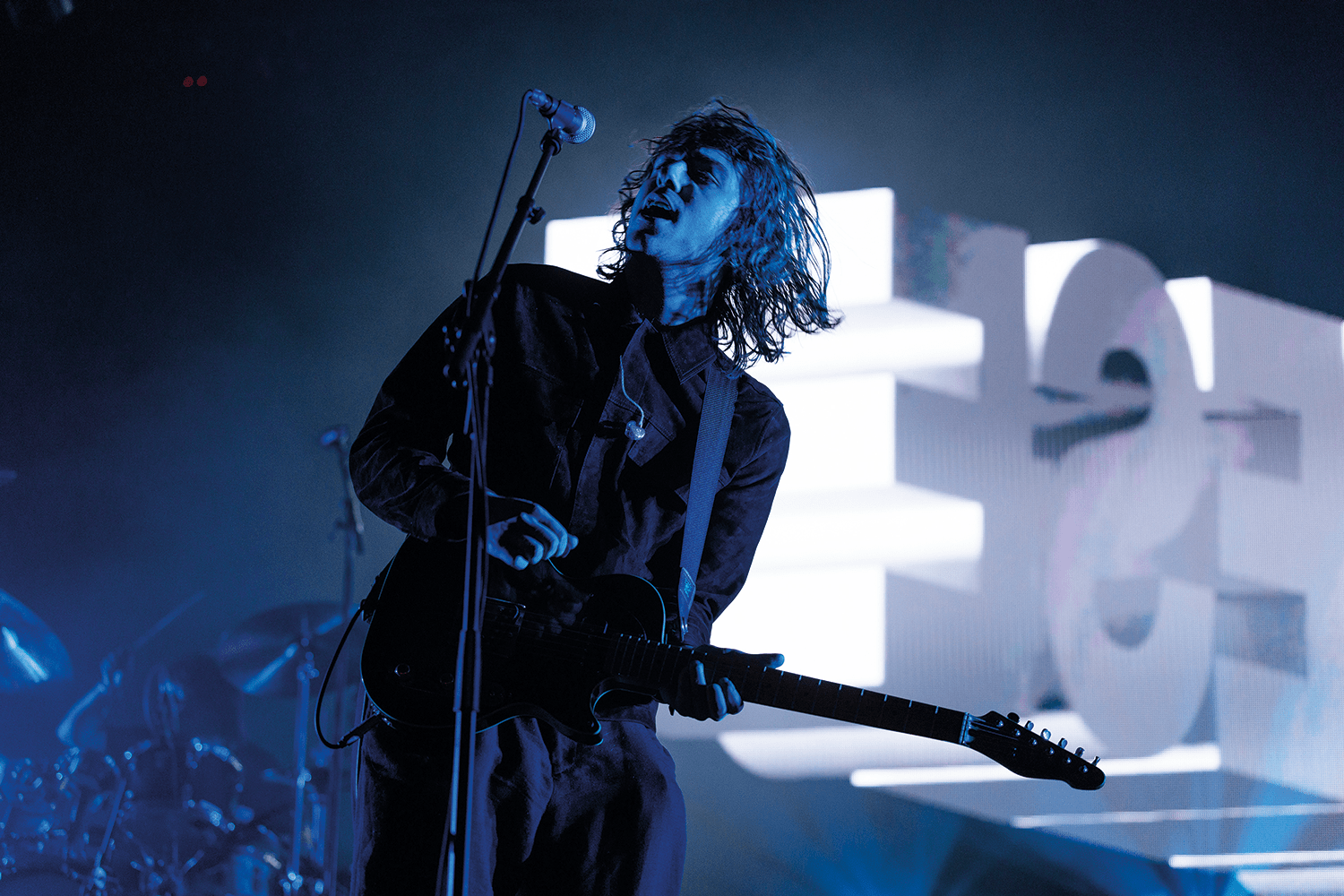
It’s a measure of Geese’s rise – their flight? – that, on Thursday night, the social media accounts of End of the Road were receiving requests for refunds from ticket-holders stuck in traffic somewhere near Shaftesbury who feared missing the first-night headliner. For many the four-day event would have been rendered meaningless without a glimpse of the New York quartet.
For those who didn’t make it, well, you missed a treat. I entered a Geese-sceptic. I really enjoyed their first album from 2018, but they had become a completely different band in the intervening years. Their debut had been a charming, youthful indie-pop record made by actual kids in their mid-teens. But by 2026 they had become the leading contenders for Band To Define A Generation, thanks to their 2025 album Getting Killed, and lead singer Cameron Winter’s 2024 solo album Heavy Metal.
Angine de Poitrine dress like understudies for Mr Blobby on Noel’s House Party
Getting Killed had felt cold and unwelcoming to me – a surfeit of idiosyncrasies concealing a lack of melody. But now I realise that I had listened lazily – through laptop speakers a couple of times, rather than at volume through good speakers repeatedly. You might counter that almost every band benefits from being heard at great volume through a state-of-the-art PA. It’s why album playbacks are held in studios, not through phones on the back seats of buses. But some groups really do require loudness and fullness to work.
Anyway, Geese were epic at End of the Road. They delivered a vast wave of music that united the largest Thursday crowd I’ve ever seen at the festival. What became clear was that beneath the spiky modernity lurked a band with a very clear idea of the dynamics of the classic rock bands of the past – bands who all knew how to work large crowds after emerging from the underground. They were perhaps acknowledging as much by inserting a couple of minutes of Pink Floyd’s ‘Interstellar Overdrive’ into ‘2122’. Either way one could quite clearly hear the antecedents, even if Winter’s drawl stopped them coming close to being facsimiles. ‘100 Horses’ was Stonesy; ‘Getting Killed’ was Zeppelinesque; ‘Bow Down’ was funk rock in the mould of a stripped-back War.
The sense of gloom that Winter brought was very now, though his mouth moved so little that he barely enunciated anything. He could have been repeating ‘Gottle o’ geer’ half the time for all I could make out, but when he had a lyric indisputably worth hearing – ‘They may say our love was only half-real/ But that’s only half-true’ – he made sure everyone took note. Winter’s an interesting, if not great, lyricist, but he’s a frontman for sure – and Geese are a great band.
End of the Road was marking its 20th anniversary with a bill that offered plenty for both the elders and their kids. The former got a staggering Saturday-night headline set from Pulp. The latter got one of this year’s most unexpected success stories, the Canadian duo Angine de Poitrine – as unlikely an entry into the pop mainstream as the Mike Flowers Pops Orchestra 30 years ago. At heart what they offer is instrumental progressive rock, played berserkly fast, constructed by looping guitar riffs with a pedal, then piling them on top of each other in microtonal layers.
It’s the kind of thing Frank Zappa or Robert Fripp might have done. The crucial difference being that Fripp and Zappa never dressed like understudies for Mr Blobby on Noel’s House Party. Angine de Poitrine also understand how to entertain, encouraging the crowd through hand gestures and electronic squawks. They’re fun to watch but, as with the Mike Flowers Pops Orchestra, one wonders whether they will sustain this level of interest after everyone’s seen them once.
Honourable mentions go out to CMAT, uniting young and old on Sunday night; to Caroline’s strange and unnerving folk pop; to Lily Seabird, who defied her twee-adjacent name with a set that posited her as the successor to Neil Young and Crazy Horse; to Big Long Sun, who couldn’t have been so clearly from Brighton had they started handing out leaflets for juggling school, and who converted their squat-hippy-mod aesthetic into glorious sunny pop. Also the weather held. What a wonderful festival.



Comments