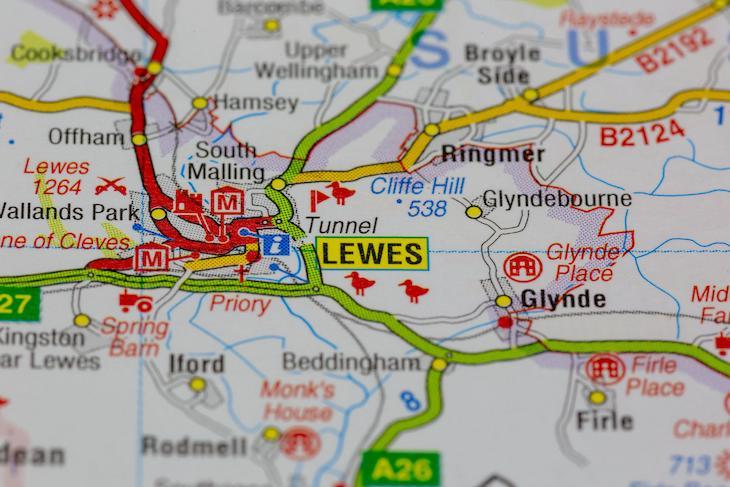
Anyone who has ever lived in Lewes won’t be surprised to hear that the East Sussex town has become the first in England to recognise the rights of trees. A motion, which was passed by the local council last week, declares that: “Trees have the right to flourish and to maintain their natural life cycles, ecological functions and evolutionary processes”.
Lewes has morphed into a place where your £5 oat-milk latte has probably been served to you by a trustafarian named Tabitha
Lewes is, of course, dominated by the Green party: 18 out of 41 councillors on Lewes District Council are Greens. The town’s well-heeled denizens have long prioritised ecological issues. Perhaps as a result, Lewes looks like a lovely place to live. It is also one of the strangest.
I spent nearly five years living in Lewes between 2014 and 2019, and I realised, from the outset, that I was looked at with scorn by the locals as a ‘DFL’ or ‘Down From London’. I deserved their contempt. Over the past two decades or so, Lewes has gone from being a beautiful and largely unspoilt town, once home to the likes of Virginia Woolf and, of all people, the American founding father Thomas Paine, to becoming a tiresome and self-regarding hotbed of all things hard-left.
To be sure, it has always had a radical spirit, best expressed in its annual, internationally famous bonfire celebration, when giant effigies of unpopular figures in the news are burnt and the town is essentially closed to outsiders for the night, with the train station shut. But there is a difference between the radicalism of Paine, or even the feminist innovation of Woolf, and the smug bohemianism that now dominates the town. Lewes has morphed into a place where your £5 oat-milk latte has probably been served to you by a trustafarian named Tabitha slumming it in the £2 million family home for a few months before she heads down to Brighton, there to ‘find herself’ amongst her similarly well-heeled people.

Lewes today undoubtedly retains the picturesque charms that attracted artists like Eric Ravilious and the notorious Eric Gill, who lived, worked and practiced his beastliness in nearby Ditchling, thanks to its stunning setting amidst the South Downs. But its beauty is its downfall: it has largely been taken over by the kind of strident, blinkered types who not only think that Zack Polanski is the future of our nation, but would take to the streets to complain about every single social or political issue in predictable fashion. Of course, the town has an active Lewes 4 Palestine group; of course, it is a place where Donald Trump has been burnt in effigy on the bonfire.
Those visitors who come to the town to see an opera at nearby Glyndebourne, or to see that hotbed of bed-hopping bohemianism at Charleston are seeing the best of it, or at least the least offensive aspects. Those who live there who are not fully paid-up members of the left-wing brigade swiftly find themselves out of favour.
During my ill-fated residence in the town, I had a drink with someone who seemed genuinely offended when I remarked that I thought Jeremy Corbyn was a no-hoper who hadn’t changed his political views since the Seventies. For him and his friends, Corbyn was the future of the country, just as, for the next generation, Polanski and his ilk represent a new kind of hope.
This sentiment is not unique to Lewes – it is found in even stronger form in nearby Brighton – but it is also a place that is dominated, increasingly, not by writers and artists but by wealthy DFL types who have sold their expensive houses in Queen’s Park or Putney, and come down to Sussex in order to ‘find peace’ for their families.
To do so, they buy up the town’s most desirable property, which inevitably sends the local prices skyrocketing. This, in turn, creates resentment amongst those who were born and bred in Lewes, who spit the word ‘London’ as if it is an insult, and are forced out to the unseemlier towns and villages nearby if they want a home. These people, it should be said, are not the ones going on anti-Israel marches or putting up Green placards in their gardens. They do not have the luxury of such views, and so it would be little wonder if most of them ended up voting Reform.
The town’s catchphrase, which is said to embody its rebellious spirit, is “we won’t be druv”. Whenever I see that Lewes is in the news, I always wonder what right-on, left-wing stunt or initiative has been attracting attention. All too often, it is something that usually smacks of the kind of privilege dreamt up by people who have long since ceased to worry about money. For the rest of us, who are decidedly ‘druv’ by one thing or another, the bohemian idyll, backed by millions in the bank, is rather less easy to aspire to. The Lewesian left-wing fantasy seems more resistible with every year that passes. Lewes’s wealthy residents might care for their trees but all too often they don’t give a hoot for those who disagree with their politics.





Comments