
It was one of those lines that probably felt like a zinger at the time, but may come back to haunt him. In response to a question from Kemi Badenoch on defence at Wednesday’s PMQs, Andy Burnham declared that “we do everything to support our national security, but it can’t come at the expense of social security.” The irony of twenty-first-century conflict is that he was both terribly wrong to draw this dichotomy and also quite right.
In a few years’ time, Russia will be rearmed, with all the lessons it has learned from Ukraine
On the one hand, the defence of Britain – like most of Europe’s – is in pretty threadbare shape. Despite the regular litany of “Putin is coming to get us next Wednesday” claims from some quarters, there is no evidence the Russians do have wider imperial goals and, more to the point, they are in no shape to tangle with the West, especially not until the Ukraine war is over and they have spent years reconstituting their forces.
Don’t take my word for it. US general Alexus G. Grynkewich, Nato’s Supreme Allied Commander Europe earlier this year said “I’ve watched the intelligence very closely. Russia is not looking for a conflict,” adding “they do understand that we have a number of asymmetric advantages.”
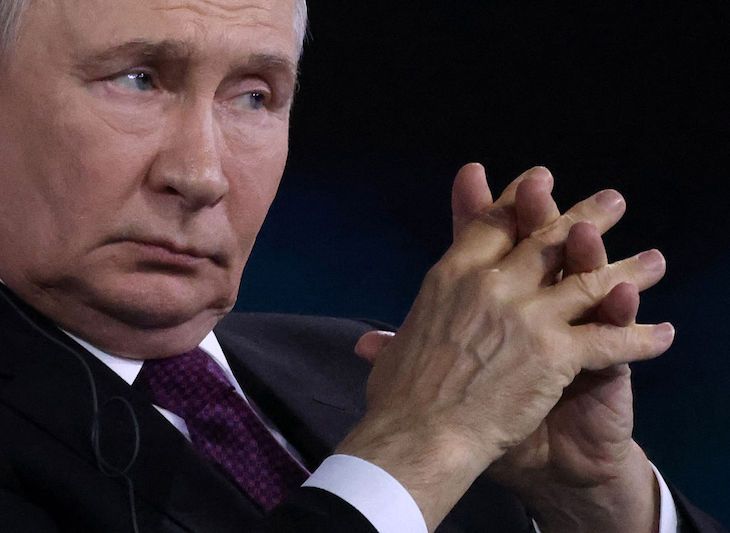
Putin certainly seems to feel that Europe is the one waging a war against Russia, albeit a proxy war. When drones and missiles made in Europe or paid for by Europeans are hitting targets across his country, both military and civilian, using Western targeting data, then on this, at least, he has something of a point.
Hence his campaign of what is generally called “hybrid war” operations (arguably not a very helpful term, although the alternatives, from “grey zone activity” to “political war” also all have their limitations). As I explore in my book The Weaponisation of Everything, this mix of subversion, disinformation, intimidation and outright sabotage is not a prelude to open war, but in this case an alternative, an attempt to get us to back away from our support for Kyiv, or at least amplify the divisions within and between countries so that we lose our unity of will and effort.

This is not a call of complacency. In a few years’ time, Russia will be rearmed, with all the lessons it has learned from Ukraine. An ageing Putin may be tempted into some risky act of escalation in a desperate bid to redeem his historical reputation, or he may have been replaced by a younger, smarter hawk. Given just how long rearmament can take, one has to spend now to prepare for future potentialities.
At the same time, there is a certain irony when, every time there is some new hybrid war scare, the usual regiment of retired generals and armchair strategists emerge to argue that this proves the need for more defence spending. Of course, it is the deterrent power of military capability that keep war in the hybrid “grey zone.” There are also some ways in which defence spending does buy capabilities which can defeat, deter or disrupt hybrid operations, from jamming drone guidance systems to tracking foreign powers mapping our undersea cables and pipelines.
In the main, though, these are two very separate kinds of defence. There is a sharp limit to what the Royal Navy can do to prevent a trawler “accidentally” dragging its anchor across a cable. More to the point, soldiers cannot guard every railway junction box or electricity substation that could be firebombed, let alone audit flows of dirty money supporting disruptive fringe movements or challenge radicalising disinformation.
The truth of the matter is that alongside military defence is the need to invest in non-military forms, too. What hybrid war attacks demonstrate is not the need for more F-35 jets or Challenger 3 tanks so much as spending in other realms.
First, the police and the intelligence and security services. In the past five years, spending on both has increased. The Single Intelligence Account (SIA) has grown from around £3.4 billion to £4.6 billion, up 35 per cent, while police spending has increased from £26.1 billion to £31.6 billion, up 21 per cent in nominal terms (not adjusted for inflation). Few would argue that the police are over-resourced these days, though, and much of the SIA is consumed by GCHQ: maintaining a world-class electronic and cyber intelligence capacity is excruciatingly expensive.
Yet hybrid operations, even ones involving physical attacks, are essentially political. They are trying to push narratives and degrade national cohesion. The presence of communities which feel marginalised and unheard, socially or economically disadvantaged, lied to, or taken for granted, these all create the ideal breeding ground for this kind of hostile activity. They are more likely to be recruited to carry out attacks on the ground. They are more willing to believe narratives that challenge mainstream views. More willing to vote for populists, and march behind the banners of those who would break the status quo.
They do so for their own reasons, but in the process become much more receptive to foreign efforts to radicalise and amplify disruptive forces. After all, Putin’s Russia is essentially non-ideological, and will as happily encourage extreme left as extreme right, secessionists and nationalists, libertarians and neo-fascists, all in the name of chaos.
To deal with this, governments also have to focus on community cohesion, on credible messaging, on media literacy, on a range of topics that lack the sex appeal of a new missile, but seek to deny Putin – and all the others who would use hybrid warfare in the interconnected modern world – these opportunities. And, yes, in part that does mean social security, so long as it can be made properly to support and uplift the genuinely deserving without hollowing out the treasury and alienating the rest of society.
It’s usually said that defence is any government’s first priority, and to a point this is true – so long as anything is left to defend. Otherwise, we are in “we had to burn the village to save it” territory (from a US soldier’s defence of the bombing and flattening of Bến Tre during the Vietnam war). Social security is important, both to minimise vulnerabilities to political warfare and also as an expression of the system the armed forces are there to defend. Yet in this respect it is part of a comprehensive twenty-first-century security package, not an alternative.





Comments