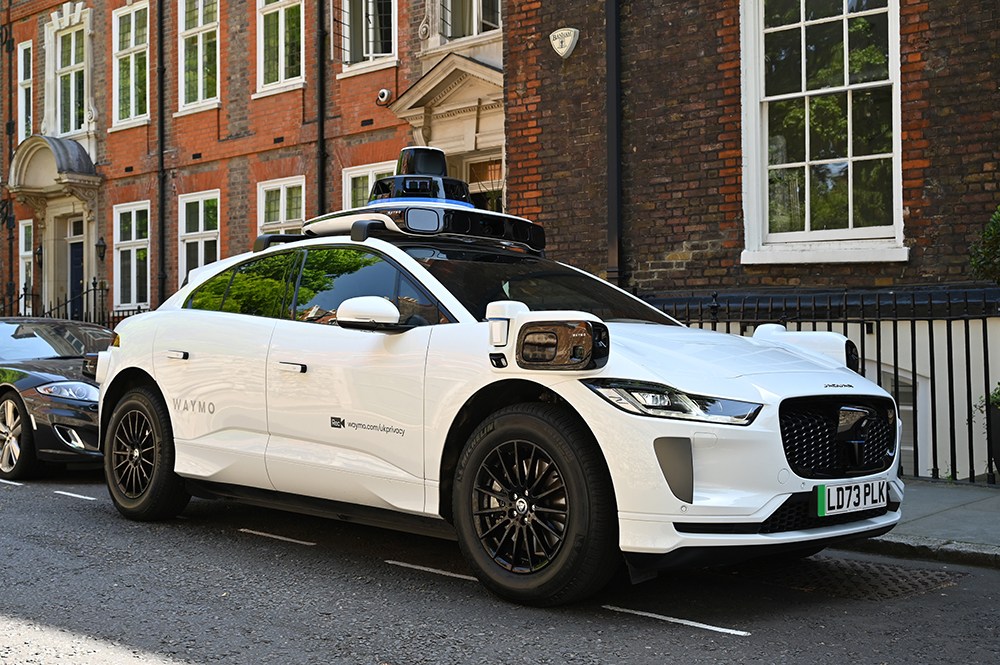


I’ve ridden in Waymo driverless taxis in both Miami and Austin and it is, as you would expect, a slightly surreal experience. When an empty vehicle turns up, displays your glowing initials on the roof, then invites you to unlock the doors via your phone, you feel as if you’re in a science-fiction film. Once you drive off, it feels doubly weird.
Yet what’s most surprising is how quickly it ceases to feel strange. After three minutes, you pay scarcely more attention to the progress of the vehicle than you would when riding in a car driven by any competent human driver. A colleague of mine who has used Waymo on faster roads tells me you experience another burst of unease when the car first hits 50mph, but this, too, rapidly dissipates.
Waymos don’t only need to learn to drive in Britain, they need to learn to drive like Brits
You may have noticed a few Waymo cars, with their rooftop rotating scanners, tootling around London, carrying no rear-seat passengers but with only a human behind the wheel. This is a necessary training process for London roads. Ideally, some of the time will be spent observing the car as it autonomously drives itself; at other times the software will record the driving behaviour of an expert human driver. Waymo relies heavily on copying human driving data – rather than learning to drive solely from first principles or by pure trial and error.
This is vital because, for the foreseeable future, autonomous cars need to share the road with human–driven cars. In a world of purely autonomous vehicles, you wouldn’t even need traffic lights – cars could crisscross each other at 70mph, ten feet apart. But while there’s at least one human driver left on the roads, it would be unwise to try this. For now, autonomous cars need to anticipate the behaviour of human drivers and, equally, the behaviour of driverless cars needs to be reasonably predictable and comprehensible to carbon-based motorists.

To make things more complicated still, driving culture varies by region. If you’ve ever ridden in a taxi driven by a recent immigrant to the UK (and – to avoid getting cancelled – let me add that they could be Somalian or German), it is sometimes alarming: not necessarily because they’re bad or inexperienced drivers, but because they’re driving according to a different, imported set of traffic norms.
In the United States, Bostonians, known as ‘Massholes’, are famously inconsiderate drivers. The Dutch practise something called a zipper merge – instinctively taking turns whenever two lanes merge into one; Germans don’t. In Japan, if you turn up early at your workplace, it’s customary to park far from the entrance. Why? Well, charmingly, it’s to leave parking spaces closer to the entrance free for people arriving later who may be in a hurry. Tailgating, the propensity to drive insanely close to the car in front, also varies hugely by country, as you’ll know if you’ve driven in Italy. In short, Waymo cars don’t only need to learn to drive in Britain, they need to learn to drive like Brits.
Happily, the need to introduce driverless cars here is less of an imperative than in the United States. In 2023, there were 1,695 deaths from road traffic accidents in the United Kingdom. In the same year in the United States, there were 40,901 – a figure so eye-wateringly high, I checked it several times.
There are multiple reasons for this discrepancy. But I would like to introduce one factor which receives insufficient attention: the availability of public transport – specifically for people who dislike driving and who consequently don’t drive well. I’d roughly divide my friends 50:50 into slightly dodgy drivers and those who are at least capable. The former enjoy driving less and drive less frequently; many gravitate towards public transport, often eschewing car ownership. Through natural self-selection, British drivers tend to be drawn from the more competent half of the population. In the US, no matter how bad you are, driving is effectively compulsory.
This is, when you think about it, the right-wing Darwinian case for investing heavily in public transport: let’s subsidise buses, and keep rubbish drivers off the roads.





Comments