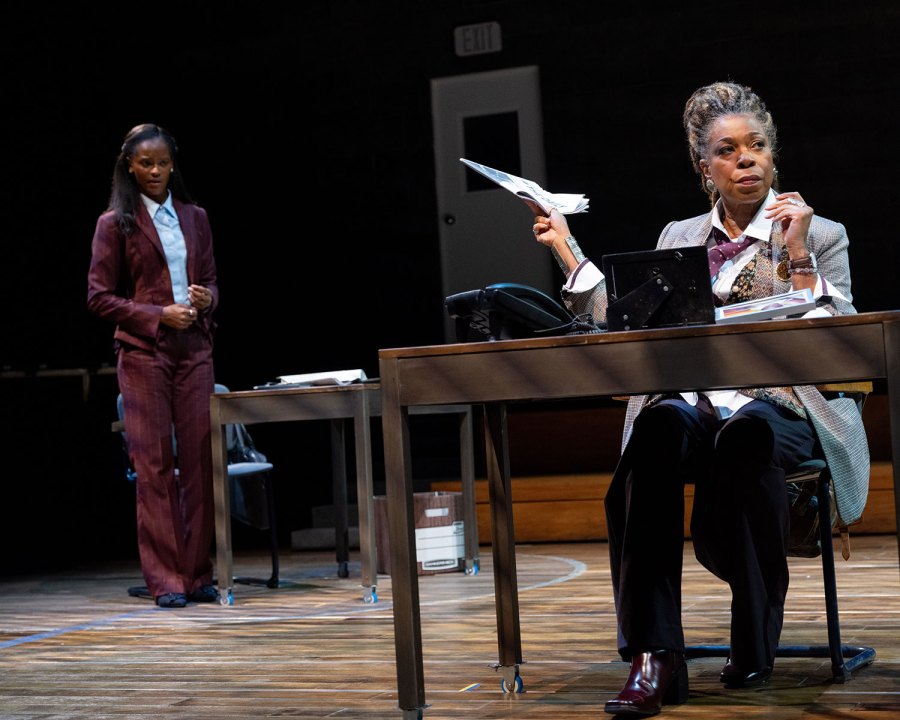


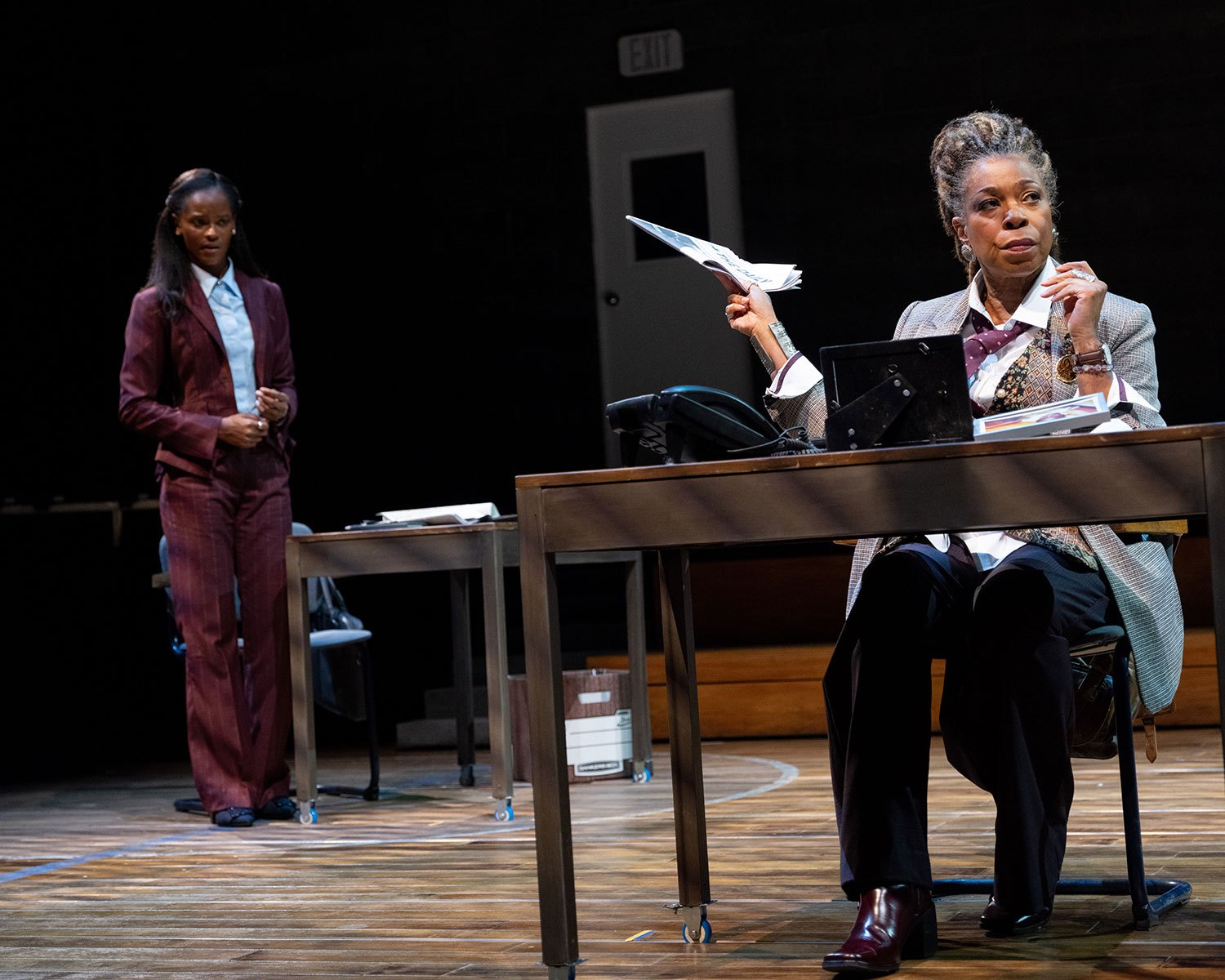
The National Theatre’s latest show, written in 2003, has bundles of energy and ideas. A thrusting young reporter, Yvonne, investigates the shooting of a yuppie in a rundown part of a teeming US metropolis. She learns that the murder was committed by a cross-dressing gang of all-female muggers, known as AOBs, whose leader, Latisha, is a teenage genius. Her parents were alcoholic derelicts and yet she taught herself several European languages while growing up in poverty.
Yvonne, who also happens to be multilingual, banters with her in Italian and German. But will Latisha confess and give the newspaper an exclusive? To complicate matters, Yvonne is secretly entangled with the paper’s super-wealthy owner but this doesn’t stop her flirting with a camp colleague, Neil, who takes her out to expensive bars. ‘Bitch has no sense of humour,’ mutters Neil as he buys her yet another cocktail. He’s dead right about Yvonne who seems earnest, manipulative and smug.

This far-fetched yarn sounds like a novel dreamed up by an over-educated East Coast professor of creative writing. Sure enough, the CV of the author, Tracey Scott Wilson, includes a list of the five universities that benefit from her wisdom as a literary guru. But her version of underclass America seems unreliable. Do criminal gangs have post-modern names that allude to bureaucratic procedures? She struggles to create a character who doesn’t possess wealth, ambition or top academic grades. And her script feels like a TV show with dozens of short, jumpy scenes that flit from this location to that. It has no centre.
At the opening of Act Two, Yvonne gets sliced up with a cutlass by a mystery assailant who may or may not be a member of Any Other Business. After this, the script devours itself. The facts presented in Act One are called into question. Has Yvonne fabricated her past? Does Latisha exist? Was the stabbing fake? The investigative sleuths start to investigate each other and the show turns into a mega-rant about journalistic honour, social responsibility and lots of other stuff.
The cocky, selfish characters become nastier, preachier and harder to like. In the middle of one rowdy scene, Yvonne’s irascible editor announces that she was raped by a pop star while a teenage member of a Marxist cell. That’s a great scoop. Why not break the story in her own newspaper? But she can’t explain her wish to protect her rapist. She says that in the 1960s, female communists were treated as sexual chattels by the revolutionary leaders who were happy to perpetuate the structures of oppression they ostensibly sought to destroy. Fair enough, but her testimony belongs in a different show.
The estimable director Clint Dyer works hard to turn this cumbersome script into a piece of theatre. He designs a community hall and divides the space into a dozen separate locations which make the production look like a television drama during dress rehearsals. Stylish lighting and well-placed sound effects keep the audience from dozing off.
Is Britain crying out for a scholarly crime drama written by a boffin from the creative writing circuit?
At times, the show flips on its head and the characters’ prattle becomes a background accompaniment to the wonderfully skilful light show by Paul Anderson. This is an odd choice for the National Theatre’s main stage. Is Britain crying out for a scholarly crime drama written 23 years ago by a pretentious boffin from the creative writing circuit? A commercial producer would hesitate to mount this show without a major celeb in the cast. Prices are steep. The pickings may be thin.
Mammy’s House is a drama by Amy Clarke about exiled Irish folk struggling to survive in Camden during the 1980s. Great subject. To add street cred, it has a gay flavour and the characters are all trying to escape religious persecution. The safe house is overseen by Barry, also known as Mammy, who encourages romance at all times. In scene one, a pair of handsome chaps flirt heavily in the kitchen. Niall sports a skimpy T-shirt and a pink tutu as he pirouettes around the table making eyes at Shay who lives in New York. Shay admits that he donates all his food to friends who have HIV. Hence his weight loss. Uh oh. What will happen next? As always with Aids dramas, the prettiest male characters are struck down in their prime.
The atmosphere of the house is a bit too cosy for a drama. More friction is needed. No one seems to care that the hard-working Mags does all the housework. And no one complains. The show catches fire when Niall’s diagnosis comes under scrutiny. Did Barry know that Shay was infected, and might he have warned the love-struck Niall to keep away? Or should Niall have taken more responsibility? In the hands of Terence Rattigan, the dilemma could have become a classic. This is a spirited effort but it’s unlikely to last.






Comments