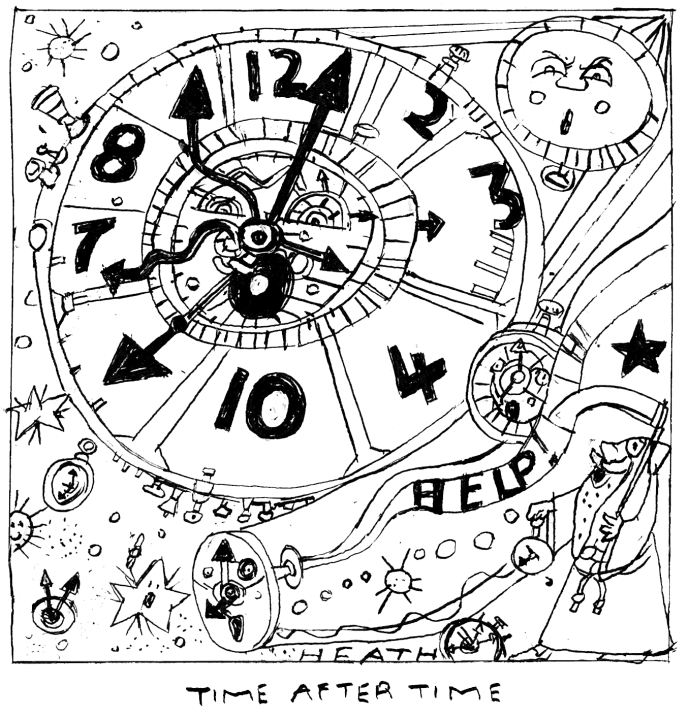

Most of us say we instinctively understand what time is, but struggle to describe it. We clearly live our lives in the flow of time, with the past gone and our perception of the present moving toward an undetermined future. It’s been described as the fire in which we burn. But what actually is it? This occupies the minds of cosmologists and philosophers, and recent research, far from clarifying the concept, makes it even stranger. Time, it seems, may not be fundamental but a by-product of the base structure of the cosmos.
For Isaac Newton, time was set in motion by God and was the universal backdrop in which all events occur. It was unchanging and ever-present; it regulated and set the pace for the clockwork universe, living out the laws of science.
Albert Einstein changed all that. After Einstein, time was considered to be entwined with space, with its rate of passage altered by speed and gravity. Time slows as you speed up, and when gravity is stronger. The astronauts onboard the International Space Station age more slowly than those of us on Earth. It’s a very tiny effect, but measurable. Navigation satellites have to account for this time dilation. If they didn’t GPS systems would be useless. Einstein showed us that time is relative and that there is no cosmic “now” across the universe.
Black holes are creatures of curved space and warped time. Once inside, there is no escape. If you were to witness an unfortunate companion falling into one, their tragic image would appear forever frozen and fading as they reached the so-called event horizon, whose gravity freezes time. Another consequence of Einstein’s time is that for a particle of light – a photon – time does not exist. It trades its ability to move through space at nature’s upper speed limit for the inability to move through time. It seems that the speed of light and its timelessness is an axis around which the universe turns.
Because time slows with speed, it’s theoretically possible to glimpse the future using near-light-speed travel. You could return to Earth having aged only a few years to find several millennia have passed. Time travel to the past, however, is a different matter. Recent research suggests it’s theoretically possible using something called a “closed timelike curve,” a theoretical loop in which an object moves through spacetime and ends up back at its original starting point. But this would involve conditions unlikely to be possible – and besides, there are the paradoxes: what if you traveled back in time and killed your own father before you were born? Perhaps not even God can alter the past.
Some scientists have imagined what they call a “block universe,” meaning that time exists all lumped together. If you were somehow outside of time, you might then observe all points of time: past, present and future existing together, all real at once. Seen this way, the future is fixed and is already waiting for us. But then what does this say about free will? Or is that also an illusion?
One of the most disturbing things about looking into the nature of time, and at the tiny things that zip around in it, is that they show us we are built of things that barely exist. Deep down, particles pop in and out of existence, can be in two places at once and two time zones at once. This is the bedrock of reality, in which the future affects the past and where an infinite pool of vacuums underpin everything. But “reality” is a word and a concept we have to use carefully.
The high strangeness of “reality” occurs when we conceive of the universe coming into being without time, and that time is perhaps a product of the interaction of quantum particles in a process called emergence. Let me give you an example of emergence: water is wet and yet a water molecule isn’t. Its wetness is emergent, not fundamental. Time might well be an emergent property.
It is through studying the weirdness of time that we achieve new insights into the universe
Another recent idea is that time is linked to the curvature of space. When the universe was smaller and moving faster, space was more highly curved, This theory posits that time will weaken and decrease as the curvature of space flattens out. Another idea suggests that time emerges from a strange phenomenon called entanglement, in which particles separated across space and time are nonetheless connected. Entanglement seems to give space and time its structure, showing us, as Leonardo da Vinci once wrote, that everything connects to everything else.
It is through studying the weirdness of time that we achieve new insights into the fundamental questions of the universe. Even if time itself was created with the Big Bang, few scientists believe there was nothing before it. But what is “before” without time? And how can there be change without time?
Many years ago I spent a day with John Wheeler, friend and colleague of Einstein, Richard Feynman and J. Robert Oppenheimer, the man who championed the concept of black holes and invented the word “wormhole.” Inevitably the conversation came around to time. Wheeler paused and said the scientific interpretation of time was in trouble, adding that someday a new structure for the foundations of physics will be discovered that does away with time.
For us, and for all the atoms, stars and galaxies, time is our reality. But Wheeler was, I believe, on to something. We must begin to think that there might be a universe without time, existing in a realm outside eternity.





Comments