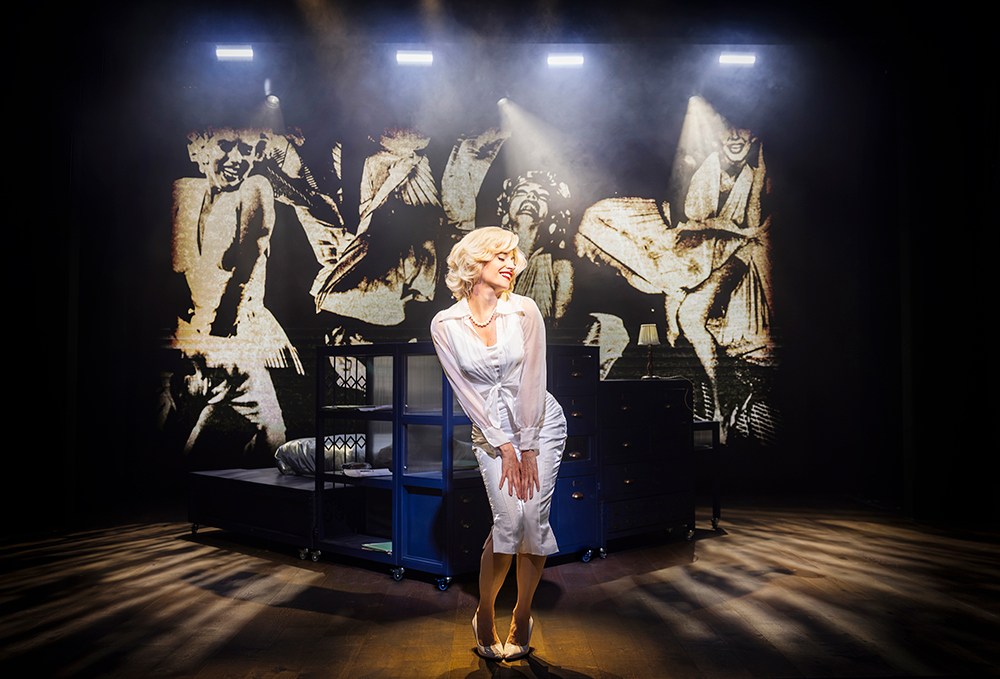


Who Killed Marilyn? is a new show about an old subject. Sharleen Cooper Cohen’s play examines the circumstances surrounding Marilyn’s suspicious death in 1962.
Three possible culprits emerge. The mob, the Feds and the Kennedys. Bobby and Jack were desperate to hide any trace of their romantic links with Marilyn. The mob may have rubbed her out by order of the Feds whose boss, J. Edgar Hoover, paid gangsters to conduct irregular assassinations. Hoover hated JFK, we’re told. And Marilyn kept a secret diary that might have ruined JKF’s career. But that gives Hoover a reason to protect Marilyn and to use her testimony against the Kennedys. The mob also hated JFK because he failed to oust Fidel Castro from Cuba. So they had a powerful motive to keep her alive as well. Two out of the three possible suspects seem to be innocent. Never mind.
The star, Pixie Lott, sports Marylin’s famous hairdo but doesn’t trouble to impersonate her drawling, breathy voice. Lott has a lean, watchful, intelligent face, like an architect or a banker, and she can’t capture the blithe and limitless abundance of Marilyn’s sexuality. She plays it straight, almost like an understudy. She favours a simple white blouse and a pair of cargo pants cut off at the knee. Hardly a classic Marilyn look.
Lott sports Marilyn’s famous hairdo but doesn’t trouble to impersonate her drawling, breathy voice
All the other characters wear costumes blotched with greenish paint to match similar splatterings across the back wall. It looks weird. Every jacket, shirt and tie appear to have been salvaged from a drying cleaning accident. Marilyn, by contrast, has an all-white outfit to symbolise her angelic innocence in a sea of filth. This clunky idea makes the show visually unpleasant. Even the suave and elegant Kennedys wear filthy suits as if they’ve just stepped out of a paintball fight.
The production takes us on a guided tour of Marilyn’s romantic entanglements. Joe DiMaggio seems oddly erudite. ‘I like your enunciation,’ he says on their first date. ‘Your diction is excellent.’ A few scenes later, he’s beating her around the head and trying to strangle her. DiMaggio turns out to be a paranoid drunk who shares Marilyn’s streak of aggressive self-pity. He complains that baseball fans disrespect his Italian heritage and mock his name at matches. Perhaps he expected them to genuflect.
She meets Arthur Miller, whose gallant, sensitive nature can’t satisfy her. After the divorce, it’s time for the Kennedys. She tells Bobby that she’s an expert in French and Russian literature and she has a collection of 430 books. She’s read all of them, she adds. She sounds like a nervous fresher at her first university party and yet, because she’s Marilyn, we’re tempted to find her scholarship impressive. We hold her to a lower standard.

In Act Two, Marilyn has a long session with her shrink, which gives us a glimpse of her inner life. There’s nothing to see. She’s needy, boastful, emotionally stunted and prone to fits of petulant screeching. Her sole ambition is to use her eroticism to manipulate men and make the world take notice of her. She has no interest in cinema as a vehicle for artistic achievement despite her avowed interest in culture. Maybe the truth about Marilyn is simple. She was a bore.
London, Do We Have a Problem?, which was at the Lion & Unicorn Theatre as part of the Camden Fringe, is a four-handed flat-share comedy about students trying to make ends meet in the capital. It’s a breath of fresh air to meet Naila, Reese, Josie and Sage, who seem to be pleasant, well-adjusted people. They have no interest in drugs, one-night-stands, trans rights, Gaza, TikTok reels or struggling against the patriarchy or capitalism. They just want to have fun. And, incidentally, they never swear.
The show begins with Naila splitting up with her nerdy on-off boyfriend, which takes an entire evening. The poor guy spends an hour on his knees, weeping and pleading to be taken back. ‘I can’t count the number of jokes I didn’t make just so there’d be no laughter between us,’ says Naila. She and Reese visit Dagenham to retrieve a stolen phone and they meet a black gangster whose patois mystifies them. ‘It was OK once we’d overcome the language barrier.’ Meanwhile, Josie, a wannabe actress, sells her ‘once-worn socks’ to a foot fetishist online for £50. But she admits that she didn’t actually wear them. She lands a role in an advert for a new deodorant with a lupine theme. ‘Wolf Balm – we come in a pack.’ She uses her fee to turn the heating on for an extra hour every day.
The show is great fun to watch and there’s a wonderful chemistry between the players. The writer-director Persia Cennamo also stars as Naila. A TV executive should find some money for this troupe, a lot of money, and let them come up with something amazing. The signs of greatness are clear.






Comments