Artists’ models seldom get a chance to tell their side of the story. Yet one model, Anthony Rudolf, believes they deserve to be ‘remembered for their work and their devotion’. His dazzling new book, Office Hours in the Studio of Paula Rego, celebrates one of the most remarkable artists of our time from this unique perspective.
Rudolf is a poet, literary translator and the founder of the Menard Press. He and Rego were partners for the last 26 years of her life (though she preferred the less business-like French terms compagnon and compagne). About three months in, he ‘realised you could never get near Paula during office hours, which she worked strictly. I tentatively asked if I could become a model and she flung her arms around me, saying “I never dared ask you!” So it was a win-win situation.’ It allowed him to spend much more time with her, and her to ‘give male protagonists a larger role in her pictures’.
Though they never cohabited, he was her official plus one. They ate together, went to the cinema and travelled to European cities. When the president of Portugal awarded her the Grand Cross of St James of the Sword, he even appeared in Hello!. Particularly towards the end of Rego’s life, he spent hours on the phone every evening reading her favourite poetry to her.
‘Essentially, you sit still and it’s uncomfortable and you itch, though you learn a few tricks’
This led to a ‘special intimacy’, he recalls, because ‘that was what I could do for her at that stage of her life, though she was also sketching me in her flat up to two or three weeks before her death. She was stuck and imprisoned in bed, and the way she could escape was through books and poetry’.
Yet ‘the centre of gravity of the relationship’, and so of the book, ‘was the studio, which also had a flat attached’, notes Rudolf. Though she was a ‘sweet, generous and loving person’ at other times, there, Rego became ‘a control freak and obsessional’.
‘The creativity and fun bit of modelling is when you are setting up the pose,’ he says. ‘When Paula finally decided on the pose, it stands in for the story. Essentially, you sit still and it’s uncomfortable and you itch, though you learn a few tricks.’ (He would later impress a literary gathering by demonstrating how easy he found it to sit totally still for five minutes.)
I meet Rudolf, a vigorous and exceptionally eloquent 84-year-old, at his flat in Finchley. The door opens onto what looks like a store room below a library – a long, narrow corridor crammed with books dating back decades. There are hundreds more books, letters and papers scattered round every room. Yet on prominent display are two extraordinary images of him: as Kafka’s beetle and as the lecherous, penitent priest Father Amaro, who appears in a celebrated 19th-century Portuguese novel.
Rudolf estimates that he features in at least 12 series of paintings or drawings and about 180 images in all. These include ‘some very loving sketches of me and some too erotic to ever be shown – every artist has hidden erotica’. Yet most of the time he appears in character, playing everyone from the Wolf in ‘Little Red Riding Hood’ to Cleopatra cross-dressed as Antony.
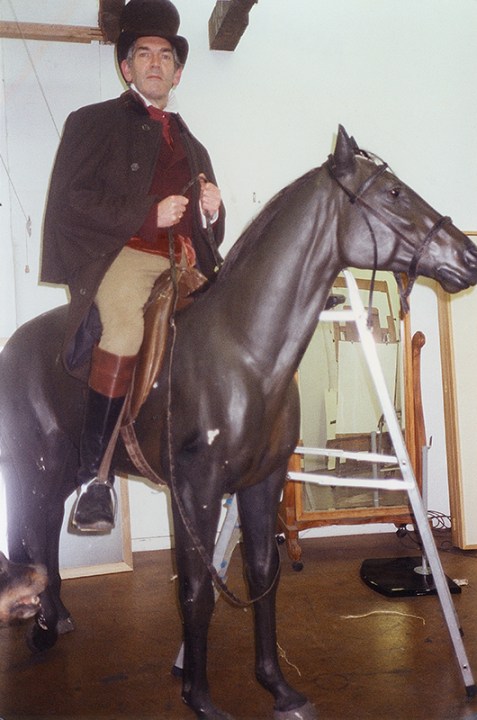
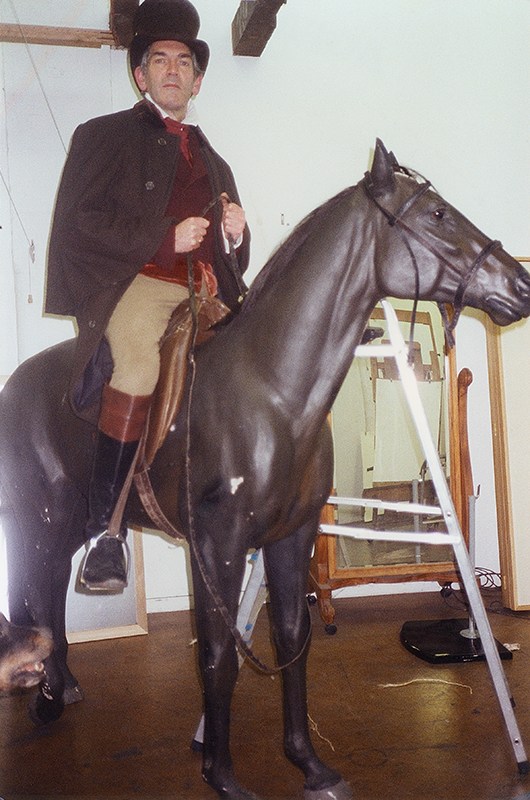
He certainly makes it sound like hard, and sometimes humiliating, work. In ‘The Last Feed’ (2012), he is dressed in a Pierrot outfit and represents ‘corruption incarnate in the old Portugal. Holding my crotch, and my mouth on the breast of the mannequin, my character is, in the words of Paula, sucking Portugal dry’. Another time, he was a perverted woman ‘sporting a little black dress… which I had to wear back to front in order to squeeze in’. Images inspired by Kafka’s Metamorphosis required him to ‘lie there naked – in one version decorous, in the other less so – keeping a straight back, with arms and legs supported by pulleys and stirrups’. He also quotes diary entries from the time – rueful comments such as ‘sore arse is a given’ and ‘I shall send Paula the osteopath’s bill’. He fell off a fibreglass horse while posing as Mr Rochester from Jane Eyre.
In some of the poses, Rudolf was able to take quick glances at Rego working as she turned away from him to look back at the canvas. Such snatched glimpses, over many years, have enabled him to give a vivid sense of how she struggled to manage ‘the constant tension between the pictorial and the narrational’. This sometimes led to ‘decisions about whether to move away from the imagined story’, often derived from a book or another source, ‘or change the design… The picture is finished when the story and design have become one’.
Since the book is rooted in personal experience, it isn’t in competition with the vast literature on Rego’s influences, art-historical references and the meanings of her powerful but often enigmatic narratives. Nonetheless, Rudolf makes clear that what she said about her art in public was often playful, perverse and contradictory, and agrees that critics sometimes attach too much significance to such off-the-cuff remarks.
There have been some fierce debates about the role of models in western art. One familiar argument is that male painters have been happy to project their own feelings onto often nude female models and portray them as alluring, mysterious or dangerous but without much individuality or inner life.
What does Rudolf feel about such claims?
‘Whatever was good for Paula was good for me,’ he replies. ‘It was as simple as that. Outside, when she wasn’t working, we were equals. When she was working, I was a willing slave. The model is like the mannequin I sometimes sat with; you are just there.’
Since he was generally playing characters, the issue of ‘doing justice’ to his appearance was largely irrelevant: ‘Finding the best likeness is the default position – Paula could do it in her sleep and draw me even if I wasn’t there – and she would then deviate from it to get the character from the story. In “The Cell” (1997), she got a fabulous likeness and then realised it was the wrong face for the story. So she said: “I’ve got to spoil your face, sorry.” She twisted it and made it more tormented. She tormented the paper with her pastels until she got the psychological torment of the wicked priest’, Father Amaro.
‘Outside, when she wasn’t working we were equals. When she was working I was a willing slave’
It is clear that much of Rego’s work expresses her feelings about patriarchal power, as represented by clerics, fathers, dictators and characters from fiction. This meant that Rudolf often had to pose either as what he calls ‘alpha, macho characters’ or as ‘defeated and feminised men. She projected on to me these different kinds of male figures that she was interested in’.
When he was required to take painful, abject or humiliating poses, did he ever feel she was also working through complex feelings about him? He has little time for this suggestion. ‘When we weren’t working, we were compatible. I don’t think she would have put up with a defeated or feminised man or his opposite, an ultra-macho man, whereas I am just a normal bloke. But I may be the wrong person to ask.’
Instead, he argues, Rego was able to address the tangled, ambivalent and violent aspects of relations between men and women ‘knowing that life is full of such complexities and contradictions. She embraces all that because she’s a grown-up, but she does the work almost like a child’. Key to this was the fact that ‘the studio is a place of total freedom and total routine. It’s quite vital that everything is routinised – the breaks, the music, the food – and, within that strict routine, she was completely free to confront her demons’.
Although the whole book is a tribute to a beloved compagne, perhaps the most poignant moment captures the fierce but magical complicity Rudolf sometimes experienced with Rego in the studio: ‘Best friends and lovers, we are like two criminals or conspirators, like children in the playground or actors in a theatre props store. These images convey the atmosphere of the crime scene which is the studio, a grownup version of her childhood playroom where, in vengeful and contrary mood, she snipped off the fingers of a doll, a precursor to her cutting up items for collage.’
Anthony Rudolf’s Office Hours in the Studio of Paula Rego is published by Art Publishing Inc. on 13 October.



Comments