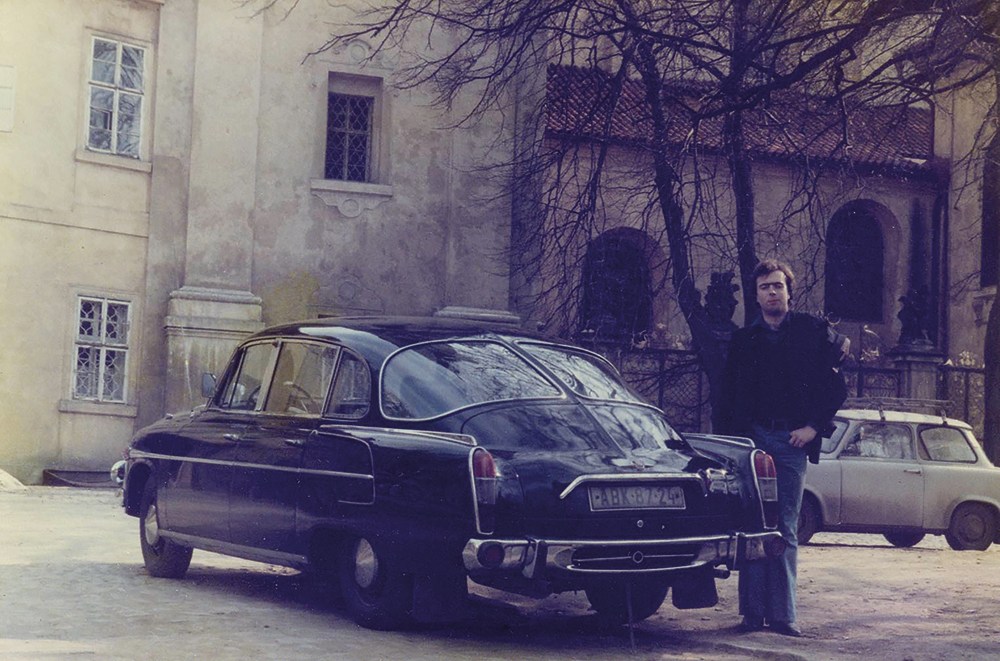
Proust can keep his soggy madeleine. For me the word ‘Prague’ is a trigger of memory like no other. It stirs me up like some plaintive half-heard tune, or the faint scent of lavender in sheets left folded for years.
Evil news from Prague, in another stuffy August long ago, turned my world over completely. This was 1968, a year of wonders, none of them very nice, which will not easily leave my recollection. It was the year I joined a Trotskyist sect. It was the year I punched a man (in self defence). It was the year I attended my first violent raucous demonstration, against the war in Vietnam, with the police horses thundering through the March mud in Grosvenor Square. A few weeks later Paris was full of tear gas and flying cobblestones, and how I wished I was there. It was an age when, if your head was not hot, you weren’t thinking or fully alive. I was on the wrong side – and I was on the right side. I will never be able to unscramble the messy omelette of opinions I then held, to separate the good from the bad.
It was the year I joined a Trotskyist sect. It was the year I punched a man (in self defence)
Then came Prague, and the Soviet tanks flattening a brief flowering of freedom, just about this time of year. I knew, or thought I knew, that revolutionary socialism did not need to lead to the cement-headed repression of the USSR. I despised that as a tyranny and a failure. Freedom under communism was like fire under water. But what was this mysterious city, Prague?
My geography lessons had been traditional, about the Empire or the Home Islands, so that I knew much of the Western Ghats or the Carse of Gowrie, and nothing of the Danube or the Carpathians. Now I was learning about a part of Europe I had never previously considered, and beginning to understand that it might be important in my life. And like a grey haze just behind the modern headlines, I could also see another Prague and another Czech crisis, in another stifling late summer then (amazingly) only 30 years before.
In 1968, the Munich crisis was about as distant in time as Princess Diana’s divorce from the present King is now. I imagined Prague’s baroque towers in a dark bend of the river Vltava, but what we saw on our TV screens was a jazzy city mainly of the 1930s, lots of glass and concrete, streamlined yet old-fashioned, and now full of stupid violence and righteous anger. Film of a tank smashing into a barricade of trams, as if it were made of biscuit tins, made me realise for the first time what a terrifying thing a tank must be. I had never before seen shameless power being exercised in plain sight.
In Vietnam you saw the bombs going off in the distance and heard the crackle of gunfire, but here people in civilian clothes, much like us, were being intimidated by iron-faced men in armoured vehicles, while their leaders were carted off in manacles to Moscow. We were all outraged. I remember fiddling late one evening with our elderly wireless, which had one of those illuminated dials promising transmissions from Kalundborg, Hilversum, Athlone, Droitwich, Königsberg… and Prague. I hoped absurdly to pick up a last whisper of protest on the night airwaves. Shocked and distressed as we were, we knew that our government would do nothing, because at Yalta we had promised to stay out. We hated what was happening, but our anger was empty and so rather shameful.
Partly for that reason, I never forgot it, and ten years later, when the chance came to go to Prague itself, I had to go. I really owe the journey to Evelyn Jones, wife of the once-mighty trade union leader Jack, and a friend of my wife’s parents. Evelyn had been a courier for the Comintern in the 1930s, carrying messages to Moscow from western communists and bringing gold back. She said: ‘You must go to Prague. Nowhere else still has the spirit of Europe between the wars. It is utterly beautiful and surprisingly easy to get to.’ As I was by then a Fleet Street journalist, my visa took some weeks to arrive, while the Czech secret police dismantled, photocopied and reassembled my passport. As we planned our railway journey (Paris, Heidelberg, Nuremberg) we noticed that the official map stopped at the Iron Curtain – from Nuremberg there was just an arrow pointing to ‘Praha’.
So, on an early spring day our train crossed from dozy Franconia into the evil empire, through a web of barbed wire, and if I had not thought this was an evil empire before, I certainly did then. The country was a sort of prison. Men in grey uniforms swarmed over, through and under the carriages, searching every corner of the train and every pocket and bag of the passengers. The seats were hard plastic. The compartments were decorated with a large Red Star. The cities we passed through were smoke-blackened and hung with red-and-white propaganda banners. Our fellow passengers had stainless-steel teeth.
It reeked of oppression. We learned for the first time what it was like to be afraid to say what you think
As we ran into the outskirts of Prague, we began to see Soviet railway carriages marked with the hammer and sickle, and to feel as if we were being pulled into the orbit of a darker sun. As we rode the tram from Wenceslas Square to our hotel, we were approached and befriended by the first secret police spy I have knowingly met. Later we would meet all kinds of other people, one of them almost in tears about the comfort the BBC World Service brought him, another an Anglophile black Cuban comrade on an exchange, anxious to share his splendid rum. (We did so. The rum broke several language barriers at once.)
Beyond all this lay the city, oddly reminiscent of Oxford with its crooked, narrow streets, bells and spires, best seen from the hill above, much of it black and held up only by ancient scaffolding. The communists did not treasure it. There were no tourists. The staple diet seemed to be dumplings. It reeked of oppression. We learned for the first time what it is like to be afraid to say what you think. And it did indeed whisper from its towers the last enchantments of the 1930s, as Evelyn Jones had promised. History, the real, dangerous sort that frightens and unsettles you, came rushing into my mind – and all this in the middle of one of the most movingly beautiful places I had ever seen. I am sorry, but you cannot go there now. The modern world has scrubbed it clean of the past. But we will always have Prague, the greatest history lesson I ever experienced.



Comments