I was in the most south-westerly pub in Britain, the Turk’s Head, on the Scilly island of St Agnes (population: 75) when I noticed a poster advertising a local exhibition of the work of ‘renowned artist and birdwatcher Hilda Quick, 1895-1978’.
I had never heard of her, but her work on the poster, ‘The Pursuit of Art’, was compelling. A stylish wood engraving from the 1920s, it showed female art students drawing a male life model. This was the new equality Hilda Quick would have discovered when she left her native Penzance to attend the Central School of Arts and Crafts in London in 1919. Even though the male model here was perhaps not particularly inspiring – Quick includes him only as a cadaverous pair of feet in the corner – the women at their easels are striking attitudes of fierce concentration, some more muscular than the model, or trying a little too hard, even though one can still believe in them as the artists of the future. So assured, so simultaneously witty and serious was this picture, that I asked the barmaid at the Turk’s Head if she thought I would make it across the island to the exhibition in time. ‘I guess so,’ she deadpanned. St Agnes is less than a mile long.

I had stumbled upon an artist with a wonderfully sharp line and an even sharper eye. At Central, she was taught by Noel Rooke, whose father was Byrne-Jones’s studio assistant. Rooke had fought to get wood engraving on the syllabus, believing in it not just as a method for printing but as a creative medium.
On graduating, she studied in Paris and toured Brittany, making observational wood engravings of local customs. By 1930 she had been lured into golden-age revivalism, creating 111 engravings for a beautiful but niche Complete Works of Edmund Spenser, published by Basil Blackwell’s Shakespeare Head in an edition of 375, some in vellum. Understandably perhaps, none of these is in the exhibition on St Agnes, which takes place in an unlocked, unattended hall.
But there is plenty to see – vitrines containing sketchbooks and printing blocks, even her sturdy walking stick. There are her costume designs for the earliest productions at the Minack Theatre, just after it was carved into the cliffside at Porthcurno. She also designed sets and programmes for Antony and Cleopatra in 1937 and The Trojan Women in 1949.
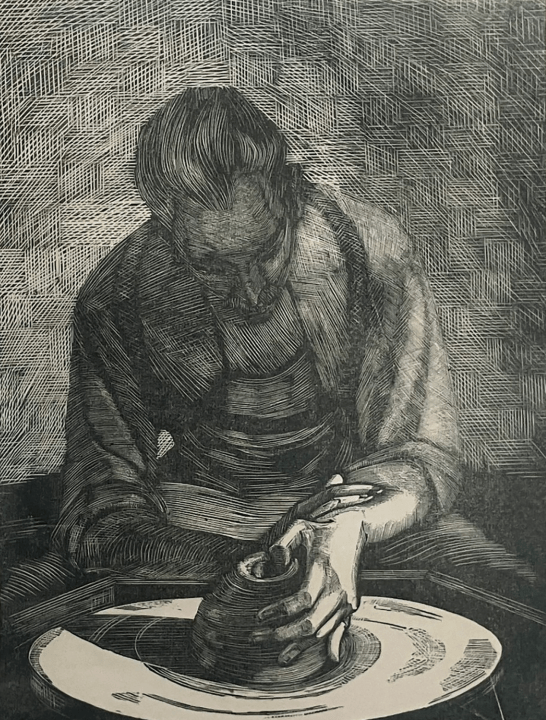
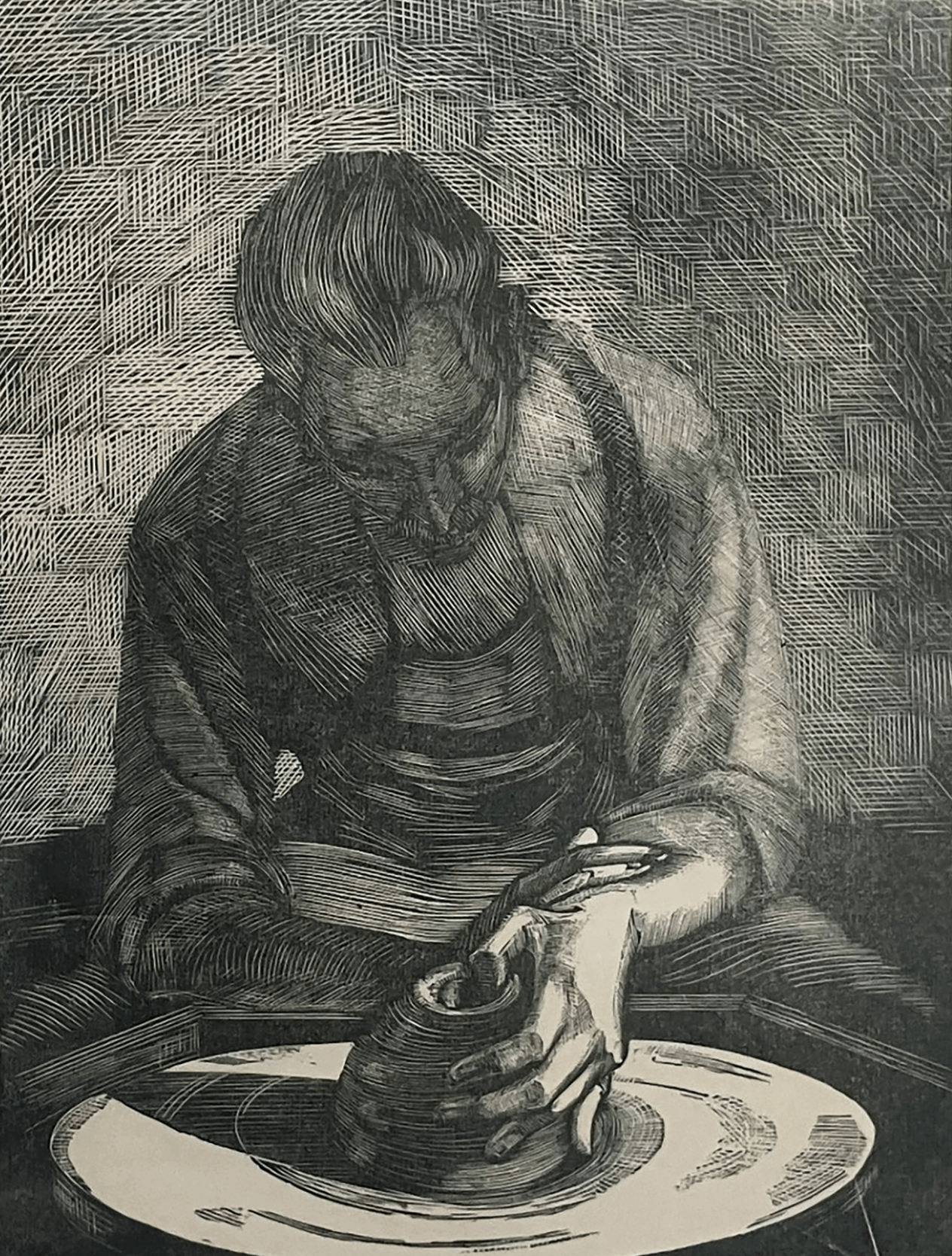
She was friends with the great St Ives potter Bernard Leach and made a wonderful engraved portrait of him at the wheel, ‘The Art of Creation’, sensitive, mysterious and rhythmically carved, her skill echoing his. A print is held by the Isles of Scilly Museum. Unlike so many beautiful pictures, which seem diminished when you snap them through an iPhone camera, her monochromes grow stronger.
In 1948 she had a hit: Jonathan Cape published her Marsh and Shore: Birdwatching on the Cornish Coast, which – with its jaunty, informative tone and beautiful illustrations – became a much-imitated formula. At this point, embedded in Cornish cultural life, in demand and well-set in Clarence Cottage, Penzance, she could have been a worldly success. But instead in 1951 she chose to move to St Agnes, this tiny, wild island, with its neolithic stone maze and its lowering cairns, where she lived out the rest of her life.
I had stumbled upon an artist with a wonderfully sharp line and an even sharper eye
I understood why a little better when I walked sandy, sheltered Blanket Bay and saw her former home, Periglis Cottage. It is quite large, with plenty of room for her studio and hand press, on which she made prints. She was almost self-sufficient, growing vegetables and brewing wine from plants, which locals fondly remember as undrinkable.
Periglis Cottage faces onto Annet, an uninhabited island preserved as a bird sanctuary. She could have looked from her window and seen the most fabulous activity. She was a devoted birder – ‘I do not feel properly dressed if I am not wearing my binoculars’ – and it was the perfect place to write her next book, Birds of the Scilly Isles (1964). Even so, it took her 13 years to write, illustrate and publish. Clearly, moving to a barely inhabited spot was no protection against social distractions. She ran the local WI, was a sacristan in church, checked the annual bird report. And when the BBC naturalist Ludwig Koch came to the Scillies, she hosted him and his team. She joined them as, over four nights in the open on Annet, they managed to record the call of the nocturnal Manx shearwater, a world first. Her cartoon of the visit is glorious.
And yet, despite her achievements, Hilda Quick is a rare bird, hard to track down, without even a Wikipedia page. In 1951 she became the first person to identify and report a blue-cheeked bee-eater in Britain. Let us hope that spotting her wood engravings in future is an easier feat than that. With this perfect little exhibition, the Isles of Scilly Museum & Cultural Centre has made a start


Comments