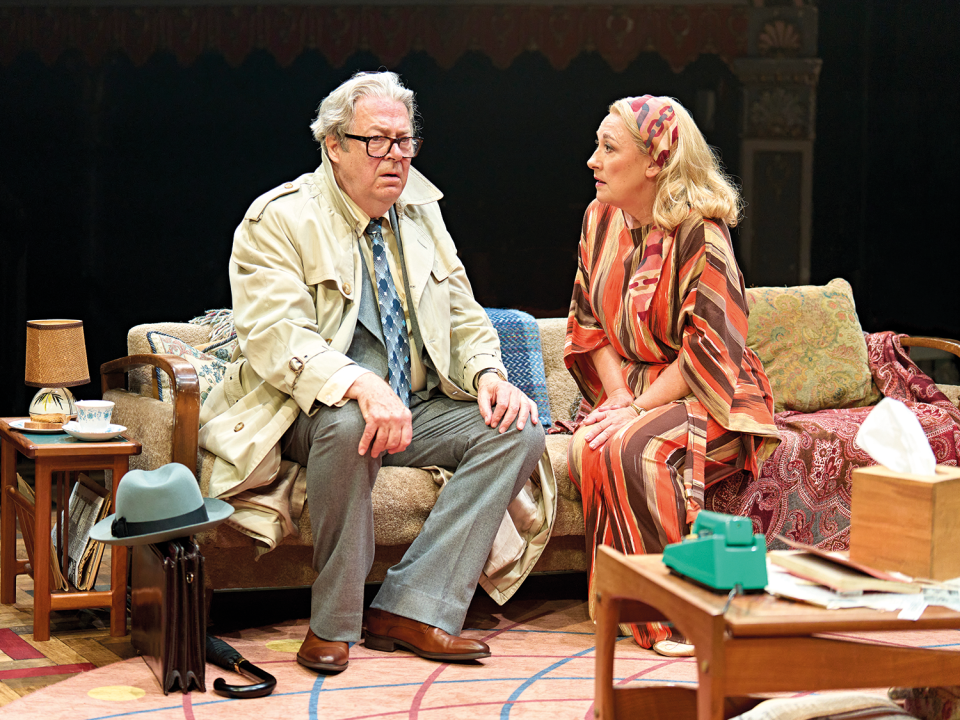


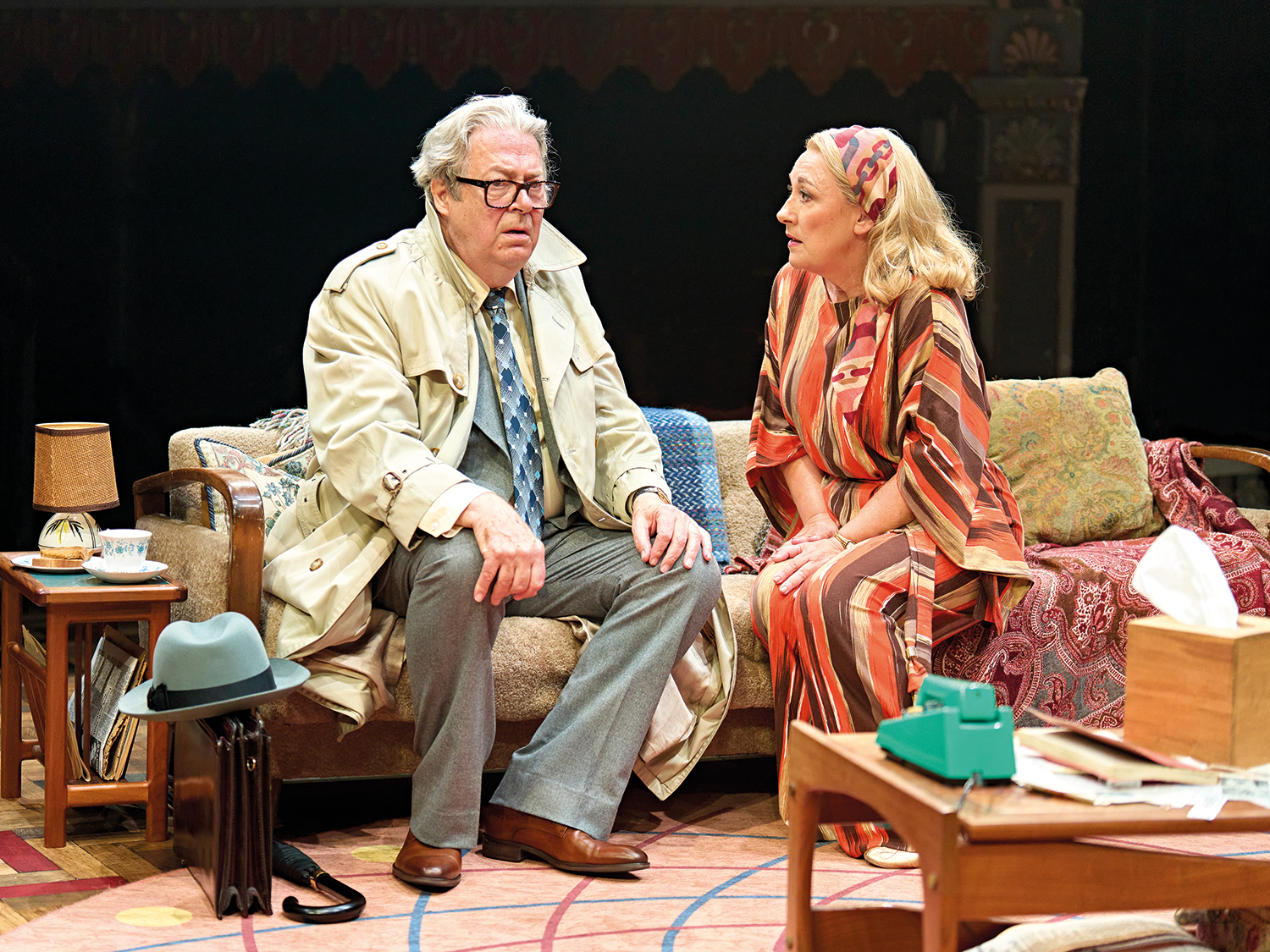
How the Other Half Loves is the play that established Alan Ayckbourn’s name as a writer of farce. Frank and Fiona, a posh, sophisticated couple, encounter problems in their marriage when Fiona has a fling with Bob, a handsome junior at Frank’s firm. Bob’s wife, Teresa, suspects Bob of infidelity and starts to investigate his social life. An innocent couple, William and Mary, are drawn into the muddle thanks to a series of misunderstandings. The centrepiece of the elaborate plot is a pair of dinner parties on successive nights performed simultaneously on a single set.
Roger Allam is as cuddly as Paddington and as caustic as Peter Cook
The complications are enjoyable to watch because you have to keep adjusting the pieces in your mind to make it all fit together. Class snobbery permeates the script, and Ayckbourn assumes that the viewers will assent to his tabulation of social desirability. He loves Frank and Fiona who are a rich and elegant in their mid-sixties. He admires the energy and ambition of the middle-class youngsters, Bob and Teresa. And he despises the crass, semi-literate dimwits, William and Mary, whose names happen to be those of a famous English king and queen. That’s an in-joke just for the audience’s benefit, and part of the enjoyment comes from the knowledge that the characters, William and Mary, would fail to get the gag because they know nothing about anything.
William is an angry control freak who hopes to transform his terrified wife into a suave hostess like Fiona, but Mary is incapable of acquiring any social graces. William treats her like a naughty puppy and slaps her hand when she misbehaves. Although she’s allergic to alcohol, Mary hasn’t the courage to refuse a glass of sherry, so she drinks it down and chokes it straight back up again. William, meanwhile, is too anxious to use the bathroom because Frank’s house has two lavatories and he’s unsure which to visit.

At times, the plot seems a little too clever for its own good, and the running time of 150 minutes is spun out from a single lie told by Fiona. The greatest asset is Roger Allam who slips effortlessly into the role of Frank. He’s as cuddly as Paddington and as caustic as Peter Cook. You’d be forgiven for thinking that the role had been written to suit Allam’s mannerisms, the modulations of his voice and his singular air of dilapidated amusement. But the play dates from 1969 when Allam was 16.
Abigail’s Party, which premiered in 1977, targets the same segment of the lower-middle-classes, but the script by Mike Leigh could hardly be more different. The setting is a Romford suburb where a bored but charismatic housewife, Beverly (Tamzin Outhwaite), throws an impromptu get-together for three neighbours. Nothing happens. The guests drink, eat crisps and talk rubbish. Beverly tries to provoke her husband Laurence by flirting with Tony, whose wife Angela is Beverly’s best friend. The play ends with a medical emergency.
Leigh’s social disdain for his characters is even more obvious and acute than Ayckbourn’s. Beverly and Laurence, consider themselves fractionally more sophisticated than their friends. When Beverly says ‘Beaujolais’ she pronounces the ‘s’ as if it were a plural and she chills it in the fridge. Laurence boasts about his embossed editions of Shakespeare and Dickens which he displays on a bookshelf, although he never reads them. He owns a recording of Beethoven’s Fifth and he decorates his sitting room with reproductions of paintings by Van Gogh and Lowry. He has one of each.
We, as viewers, are encouraged to feel amused that a man of such banal tastes should consider himself to be sophisticated – but the joke is on us. Our attitude to Laurence (Kevin Bishop) mirrors his attitude to his neighbours. We rush to laugh at him but perhaps we should question ourselves for wanting to mock him in the first place.
Tamzin Outhwaite seems like a mythical temptress appointed by the gods of comedy to make us laugh
The show fizzes with warmth and fun but it starts on a tired and self-conscious note. Before a line has been spoken, Beverly leaps onto a coffee table and performs a solo dance number while a glitter ball twirls above her head. And Act Two kicks off with a lengthy mime routine accompanied by thumping disco music and arty lighting. It all feels a bit Turner Prize. Luckily these excesses don’t last long enough to impair the joy and hilarity of the script.
Tamzin Outhwaite, in a floaty tangerine gown, seems like a mythical temptress appointed by the gods of comedy to make us laugh. She keeps using a particular term of welcome, ‘come through’, that feels like a personal catchphrase. In the bar during the interval, people were saying it to each other and giggling. Pandora Colin does a superb job as the nun-like Sue. Lauren Patel’s simpering, nervous Angela threatens at times to steal the top honours from Outhwaite. On this showing, Patel has the makings of a star.






Comments