
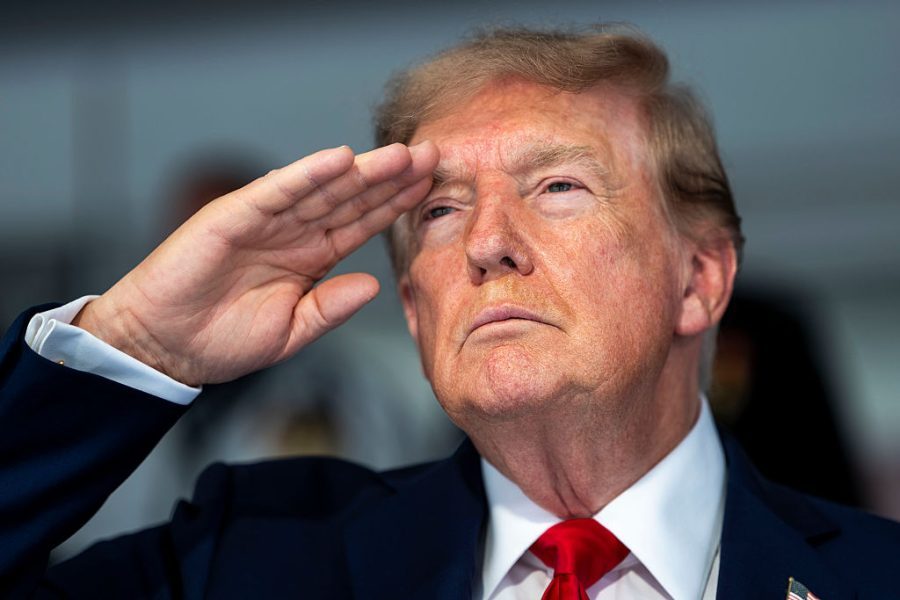
Donald Trump was revved up for his Freedom 250 Grand Prix auto race, which took place in downtown Washington yesterday. But even as the American President enjoyed the festivities, the mood elsewhere was distinctly less buoyant. With Democrats pounding away at voter concerns about affordability, Republican legislators are fretting that Trump might crash the party’s political fortunes with his costly tariff policies. If the President wanted to promote an economic programme that was designed to bolster the political prospects of the Democrats in the impending November midterm elections, he could hardly do better than his institution of new duties of 50 per cent against Canadian goods.
Already Republican candidates are reeling from Trump’s mishandling of the economy, not to mention the Iran war. Inflation is up. Employment is down. The standard Trump administration retort is to blame it all on Biden, but that dog won’t hunt. Democratic gubernatorial candidates in red states like Iowa and Texas are running even with their Republican coevals. A new Politico poll indicates that only 37 per cent of the Maga base continues to support the Iran war – down from 50 per cent in May.
The consequences of a prolonged trade war would be bad for Canada but even worse for America
Trump has sought to employ tariffs as a kind of Wunderwaffe, or miracle weapon. But foreign leaders are starting to sense that Trump is starting to lose his political grip. Canadian Prime Minister Mark Carney, who called Trump’s bluff during tariff negotiations, seems prepared to wait him out. O Canada! It’s now at the vanguard of the international resistance to Trump & Co. The Canadian prime minister Mark Carney said:
In recent days, the United States proposed new terms that were uneconomic, unfair, and undermined the net benefits for Canada, and called into question the reliability of any deal. In short, they asked too much, and they offered too little.’

In abandoning the negotiations, Carney pointed to the sweeping infringements on Canadian sovereignty that the Trump administration was demanding, including exerting direct control over its natural resources. The Trump administration has consistently proclaimed that individual nations must protect their sovereignty, but in practice it appears to reserve this principle for itself alone. When it comes to America’s closest allies, Trump seems to believe that he can create a kind of Warsaw pact arrangement, in which satellite nations pledge fealty to the imperial centre.
The consequences of a prolonged trade war would be bad for Canada but even worse for America. Three battleground states will be directly affected by the looming conflict: Maine, Michigan and Ohio. Writing in the Atlantic, David Frum noted that ‘more than 30 per cent of Ohio’s exports go to Canada and almost 40 per cent of Michigan’s.’ Then there is Maine, which imports about $2 billion (£1.5 billion) annually in non-petroleum products from Canada.
Small wonder that Republican Senator Susan Collins is imploring Trump to reconsider his latest tariff fusillade. ‘The on-again/off-again trade talks between the US and Canada lead to higher costs, risk, and uncertainty for Maine businesses,’ Collins stated in an X post on Saturday:
If the administration proceeds with these tariffs, they will increase costs for Maine families, as most businesses will have no choice but to pass on the tariffs to their customers through higher prices.’
Trump’s imposition of tariffs is a godsend for Collins’s opponent, Troy Jackson, who would otherwise struggle to defeat her. Will they also be enough to drag Michigan’s controversial Democratic candidate for the Senate, Abdul El-Sayed, across the finish line against Mike Rogers?
Trump, who has consistently averred that his tariffs won’t cost American consumers a farthing, torpedoed that message by hastily lowering tariffs on 300,000 metric tonnes of beef through November. His prime, as it were, constituency of cattle ranchers is livid. Republican Ashley Hinson, who is running for the Senate in Iowa, told Fox News that Trump had it wrong: ‘We need to focus on affordability, but I think this isn’t the way to do that.’ As Trump wilfully hikes and lowers tariffs, the GOP, you could say, may be discovering that it is between the devil and the deep blue sea.






Comments