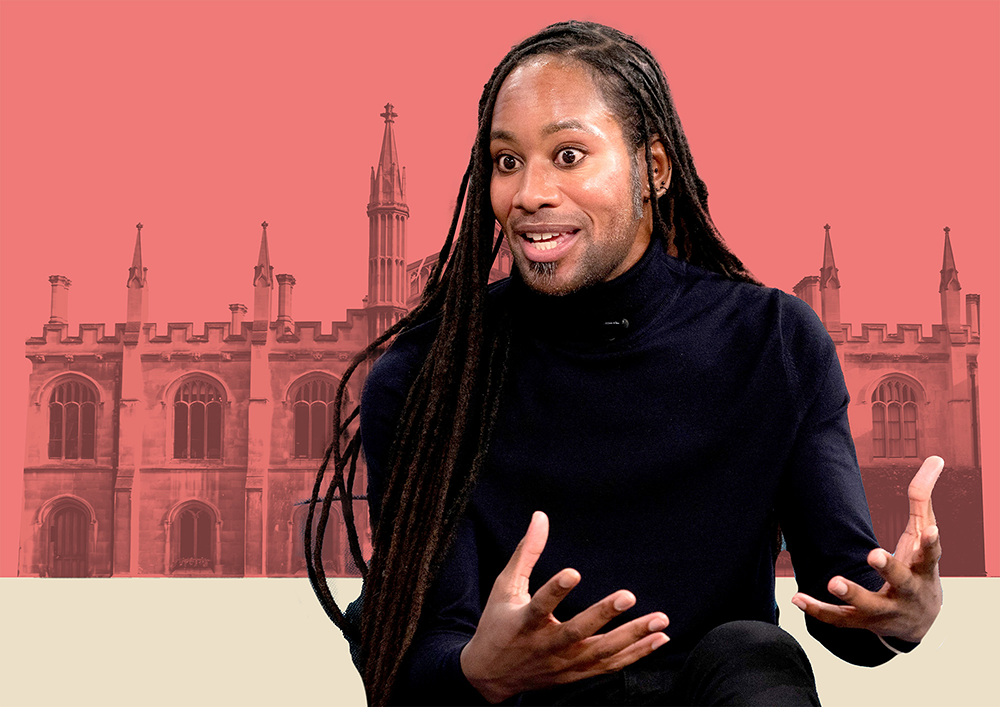
Physicians and the Samaritans warn against attributing suicide to a single cause. Doing so simplifies a complex tragedy. Those who take their own lives tend to do so because of an array of biological and social factors; pointing to a single spark, campaigners fear, can lead others experiencing similar pain to see suicide as the only way out. This advice does not seem to have registered with those politicising Jason Arday’s tragic death, which many are assuming was a suicide although that is yet to be confirmed.
The pinning of blame for Arday’s death began swiftly after the news broke last Friday. Arday’s supporters have suggested he died because of the press coverage of his case. Had journalists not uncovered Arday’s alleged plagiarism or exposed, among many other assertions, his dubious claims to have raised £5.5 million for charity running marathons while injured, or scrutinised his story that a pig’s head was left on his parents’ doorstep, his reputation would not have suffered. By digging into Arday’s absurdities, the narrative goes, the ‘right-wing press’ pushed the father of two over the edge.
The press is not to be courted and then denounced the moment it says something you dislike
Carole Cadwalladr, the former Observer journalist, described Arday’s death as ‘a digital lynching’, highlighting articles The Spectator had published about the Cambridge professor. In a 7,000-word polemic, titled ‘J’accuse’, the author Will Self has called on Andy Burnham to establish a public inquiry and suggested journalists persecuted a vulnerable man in pursuit of clicks. Self also indicated a congruence between ‘the British legacy media’ and ‘Himmler’s SS’ and proposed that ‘the police should be impounding computers’.
Labour MP Dawn Butler has written to Ipso, the press regulator, to suggest that Arday ‘would still be alive today’ if not for ‘coverage by the Times, Telegraph, Mail and Spectator’. Zack Polanski, the Green leader, has called this moment a prime opportunity to ‘tackle the press’. A petition is calling for Arday’s Law, a legal cap on the amount of coverage permitted about an individual in a set period.
The Prime Minister says this is not a ‘moment for any rushing to judgment’. But where the left leads, Burnham so often follows. He has previously voiced support for greater press regulation, backing Leveson 2, pushing for publications to sign up to a state-run regulator, and associating himself with campaigners from both Hacked Off and the Good Law Project, organisations that are using Arday’s death to demand greater press restrictions.
To use Arday’s death as an excuse to clamp down on journalists would be an appalling abuse of the man’s legacy, an intentional misremembering of recent history and an assault on the liberties that make such investigations possible. It would obscure the failings at the University of Cambridge, and across higher education, which Arday’s swift rise and rapid fall revealed, and prevent legitimate questions about diversity initiatives and progressive dogma.
Suggesting that Arday was criticised only by the ‘right-wing’ press disregards the fact that it was Times Higher Education – not exactly regarded as a bastion of reactionary thought – that first put questions to Arday about his work, a move that prompted him to contact the police and libel lawyers. While the original piece reporting on his alleged plagiarism may have come from Nathan Cofnas – a self-described ‘race-realist’ academic, formerly of Cambridge – one of the most damning exposures of Arday in fact came from the Guardian. Criticising a black academic whom the paper had lauded on his appointment may have been unpopular with readers – but an admirable commitment to reporting the truth won out.
For most of his career, Arday had benefited from fawning coverage: uncritical acceptance of his claims about his life and achievements. This was matched by a lack of inquisitiveness by the employers who continued to promote him. When Arday began to face questions about plagiarism in his work, Cambridge had the opportunity to deal with the matter quietly. Instead, the university doubled down, so it was left to journalists to try to uncover the truth. Public interest in Arday’s case was unsurprising given the prestige of the institution involved, the extent of the faith placed in him and the absurdity of what was discovered.
The reporting exposed the cult of ‘anti-racism’ which had established itself at one of the world’s top universities. Born of a desire to seem on trend following the Black Lives Matter furore, Cambridge over-promoted a black academic rather than ask questions about his competence.
Undoubtedly, having the details of one’s life and career picked apart in the national press would not be easy. But scrutiny comes with putting yourself in the public eye. The press is not to be courted and then denounced the moment it says something you dislike. It should be defended as a cornerstone of a liberal society, a bulwark against cant, lies and deceit.
A tragic death should not be reduced to a progressive parable of journalistic malice. However much Arday’s supporters disliked certain articles about him, that does not make the authors of those articles culpable for his death. Arday’s passing must not be used to silence those who ask difficult questions of powerful institutions and prominent figures.


Comments