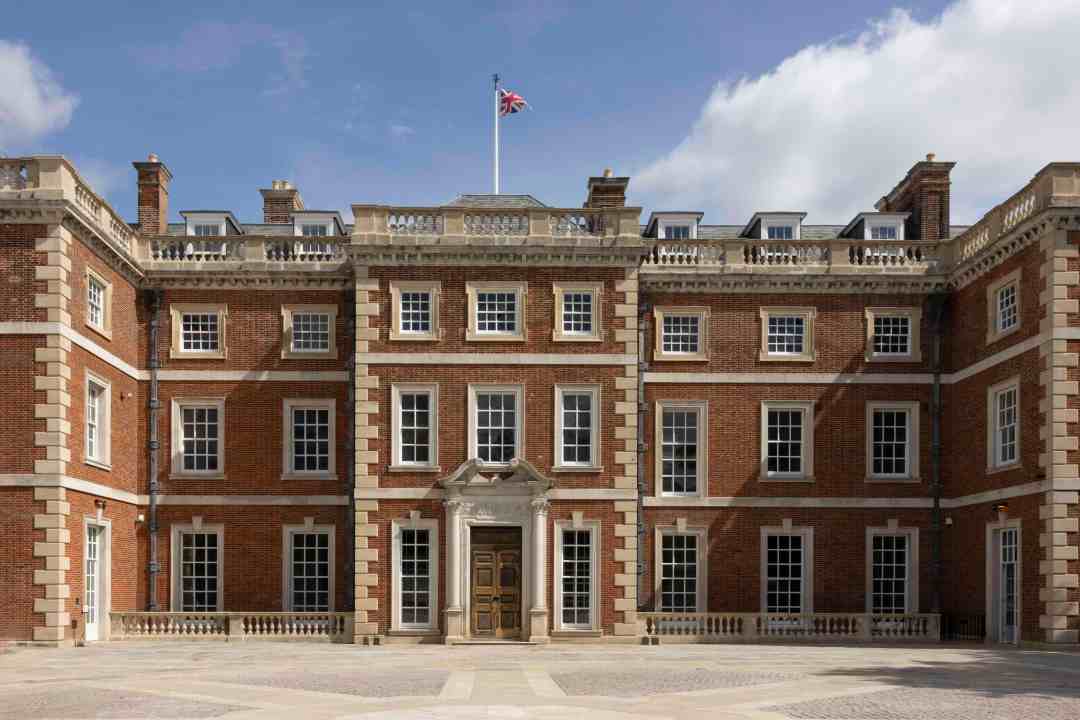
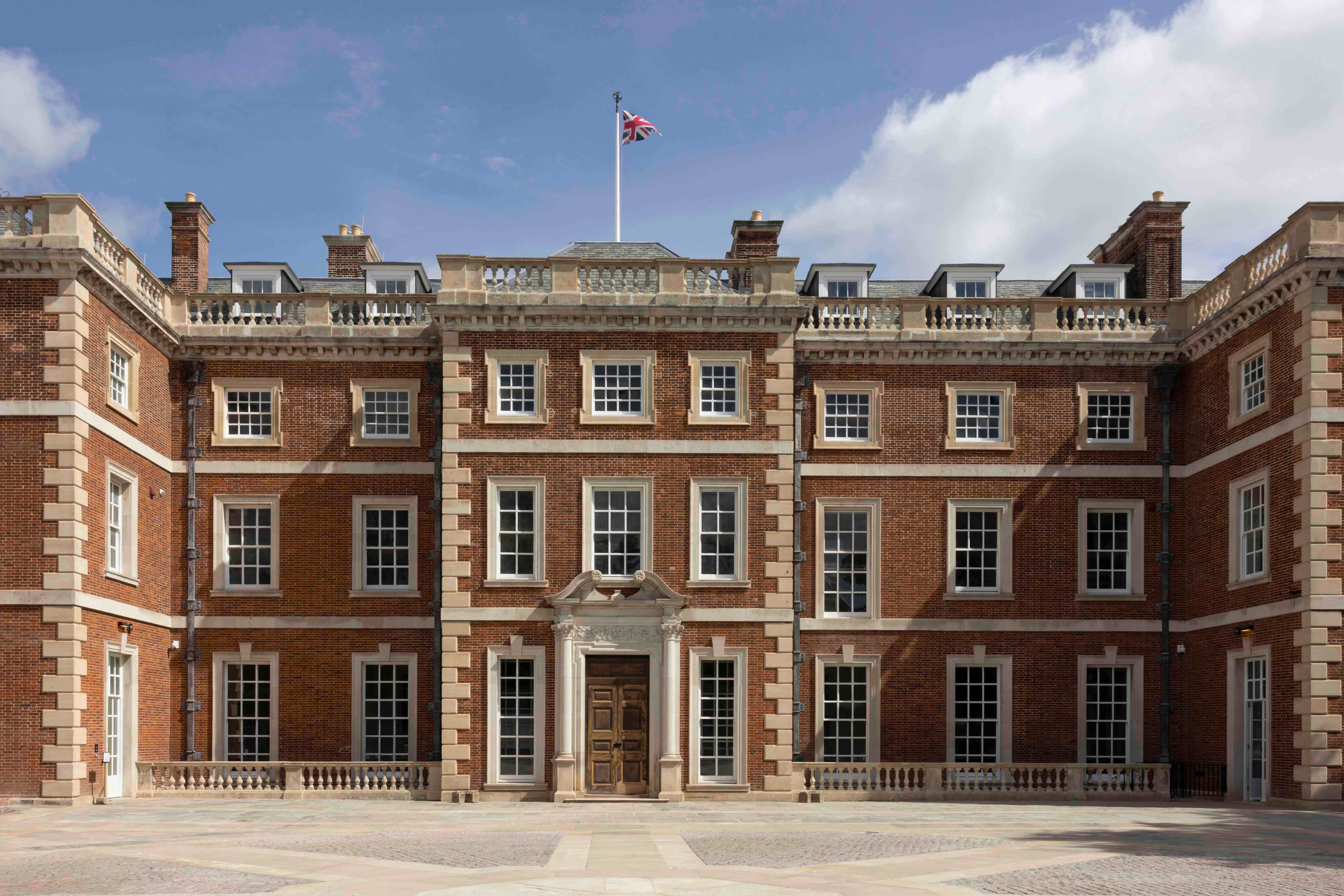
Trent Park, one of the most significant sites of social, political and wartime British history, had all but been forgotten in national memory. Described by Historic England as of ‘international interest which bears comparison to […] Bletchley Park’, the house, set in over 400 acres of medieval hunting grounds formerly owned by the Duchy of Lancaster, was one of London’s most neglected mansion houses – until now.
After the Crown deemed the park surplus to requirement in the 18th century, it was given to court physician, Richard Jebb, who contracted King George III’s architect, Sir William Chambers, and leading landscaper of the day, Humphry Repton, to create Trent Place. The estate was then sold to the earls of Cholmondeley and a succession of wealthy merchants, before being bought by the Bevans in 1833 whose bank, the second largest in London, was the forerunner to Barclays.
But in the interwar years, the house took on an entirely different life. Sir Philip Sassoon, heir to two banking fortunes, inherited it from his father in 1912, undertaking a reconfiguration to its Georgian proportions and almost outrageous ostentation: a menagerie of king penguins, black swans and flamingos in the lake, possibly England’s first heated swimming pool, murals by Rex Whistler and a patriotic Union Jack forecourt over which Sassoon would lead the RAF’s so-called ‘Millionaire’s Squadron’. The visitor book, also now on view, recounts the luminaries of early 20th-century Britain: Princesses Elizabeth and Margaret, Charlie Chaplin, T.E. Lawrence, Fred Astaire, Stanley Baldwin, Edward VIII and Wallis Simpson. One account recalls Churchill arguing with George Bernard Shaw over the teacups.
In June 1939, its owner died, ending ‘a phenomenon that would never recur’ as his friend Noel Coward put it which the outbreak of war but three months later would certify. Requisitioned by the War Office, watch towers and barbed wire were erected to become what was termed the ‘Cockfosters Cage’. Colonel Thomas Kendrick, a British intelligence officer who had trialled an interrogation centre in the Tower of London using expatriate Germans and Italians, wired the house and grounds with listening devices to record Nazi prisoners of war. Around 40 predominantly Jewish refugees, on constant rotation, were tasked with transcription. But of the three sister sites Kendrick pioneered, Trent Park was undoubtedly the most audacious.
On arrival, high-ranking German officers were welcomed by ‘Lord Aberfeldy’, a one-legged, Hitler-sympathising Scottish laird – an ingenious fiction that appealed to the inveterate snobberies of his Nazi guests who, complete with kilt and pictures of ‘his castle’, would take them up to London for shaving supplies and lunch at Simpson’s in the Strand. Antagonists, ‘stool pigeons’ and fake news reports were ingratiated into the party that between 1942-45 numbered 106 of Hitler’s commanders, eliciting over 3,000 conversations containing crucial intelligence for Bletchley, as well as revealing the V2 Rocket Programme at Peenemünde, resulting in its successful bombing in 1943. Boasts of ‘knock[ing] off about 1,500’ would have made for harrowing listening.
On arrival, high-ranking German officers were welcomed by ‘Lord Aberfeldy’, a one-legged, Hitler-sympathising Scottish laird
One General, regarded by his peers as ‘an outstanding person’ was noted by his captors as trying ‘to impress everyone with his own importance and knowledge, a troublemaker and a bore’; another derided as ‘a cinema-type German officer, fat, coarse, bemonocled and inflated with a tremendous sense of his own importance.’ Only much later were the files declassified – thereby omitted as evidence in the Nuremberg Trials – and the world realised the vital role that had been played in Allied intelligence.
After the war, the house became a teacher training college and was then bought by Middlesex Polytechnic around which portacabins and 1970s classrooms were constructed. It was then to Allianze University College of Medical Studies, a private institution from Penang, that soon collapsed leaving newly arrived lecturers unpaid and students without certification.
But in May 2014, then 28-year-old Jason Charalambous was elected Tory councillor for Cockfosters. For years, the park had been threatened by plans for development of the green belt. Charalambous began to attend to an avalanche of local complaint: ‘I had the crushing realisation of every young politician: what the hell had I got myself into?’ But it was on a walkabout with the Trent Park Conservation Committee, a local volunteer group, that he first saw the stately facade from which he had grown up but ten minutes away – and of which he had never heard.
Aided by a local historian, Charalambous formed a committee, quickly receiving 5,000 signatures to register the house as an ‘Asset of Community Value’. Locals feared property development; Christ Church Cockfosters, an evangelical Quaker Church on the edge of the parkland in which the Bevans are entombed, were terrified by a rumour that it would be replaced by a Sunni Mosque. The church hall was immediately offered to which the Labour-run council was invited.
‘Five hundred people showed up – the council was petrified’, he tells me. ‘I contacted any living relatives I could trace: Whistler’s niece, grandchildren of the listeners and Philip Sassoon’s great-nephew, the Marquess of Cholmondeley. As the meeting started, David [Cholmondeley] arrived with two holdalls filled with archive material, aerial shots of the house taken from Sassoon’s private twin-prop and so on. I wasn’t sure he’d turn up, but it saved the day.’
Support soon followed, including General Michael Hayden, former director of the CIA and NSA; Iain Standen, CEO of Bletchley Park; Sir David Jason (Dellboy); Fritz Lustig and Eric Mark, the last surviving listeners. A 2015 application was rejected by the council and the site subsequently bought by Berkeley Homes, then run by its charismatic late founder, Tony Pidgley. After months of fruitless petitioning Berkeley and their lawyers for a Memorandum of Understanding that would secure a proper museum, the trustees went to see the founder. ‘We weren’t confident, but a few minutes in, he just gave us this big grin: ‘You can ‘ave it!’ It was thanks to Mr Pidgley that we ultimately succeeded.’
The house has been meticulously restored over 12 years and now as of this summer, visitors can see what is a play of two acts: upstairs is Sassoon’s interwar world in an enfilade of restored rooms, almost solely informed by a 1931 Country Life profile of the house. Below the floorboards are the recreated listening and mess rooms from which the clandestine operation was conducted by the listeners. Bound by the Official Secrets Act in their lifetimes, now their story can be told. Above all, this testament to audacious wartime espionage illustrates well the extent to which British ingenuity, tenacity and amateurism can triumph – in times of war, but also in peace.




Comments