
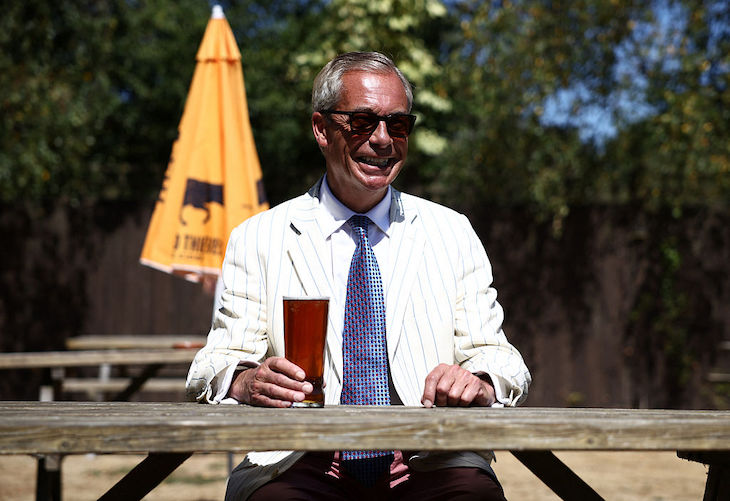
The Clacton by-election was finally over. Even by the standards of August news stories, it had grown pretty stale pretty quickly. The result was never in doubt, nor were the entrenched responses of the key players. Reform figures took to the airwaves to insist all questions about Nigel Farage’s finances had been answered by the ballot box. Those who opposed him took to the airwaves to insist the opposite was true.
Back at the count, the media were having to make do with increasingly contorted attempts to pretend Binface was amusing
In Clacton itself, Mr Farage was essentially playing a game of cat and mouse with the media circus. They wanted photos of him with the terminally unfunny ‘Count Binface’ and all the other randomers crowded on the stage so that they could mock him on the front pages. He was determined to deny them this and so instead spent the evening at ‘Farage Fest’ a sort of festival in rural Essex at which the faithful were invited to Farage world.
This ‘political festival’ included Farage-branded plastic pint holders, a ‘Farage wheel’ (which ground to a halt with GB News’s Political Correspondent Christopher Hope on board) and the mind-boggling opportunity to ‘have a sleepover with Farage’. It was compared to Glastonbury, but it seemed to be more like a theme park that had been taken over by a personality cult. Peppa Pig World meets Heaven’s Gate. The man himself gave a three-hour long speech in which he ticked all the standard Farage boxes; he railed against the establishment, he told jokes, he made oblique references to being proved right in the future.
Meanwhile, back at the count, the media were having to make do with increasingly contorted attempts to pretend Binface was amusing. Inevitably the BBC led their coverage with the rather bizarre angle that the investigation into Mr Farage’s finances was immediately reopening. Herein lies the problem for those who want to discredit Farage; as their own attempts to do so become more and more ham-fisted, they also end up discrediting themselves.
Yet for all the flummery and scent of silly season, the Clacton affair has crystallised a deeper reality. Mr Farage’s path to victory nationally necessarily has two prongs to it. Firstly, he requires the continued quiet radicalisation of the public by the deceit, incompetence and refusal to listen which is displayed daily by our political class. This he can rely upon, and indeed, if the Clacton fallout shows anything it is that this mix of contempt and condescension is only getting worse.
However, it also requires the second path; that those voters for whom the whiff of spivvery, the soap opera style fallouts and the air of a lack of seriousness about Reform either change their minds or refuse to vote tactically to stop Mr Farage from becoming Prime Minister.
Clacton and its circus seem to have made this second path less likely, even as the first path becomes ever more well-trodden. In short, after Clacton, the gulf between those who love Mr Farage and those who hate him has never seemed wider.




Comments