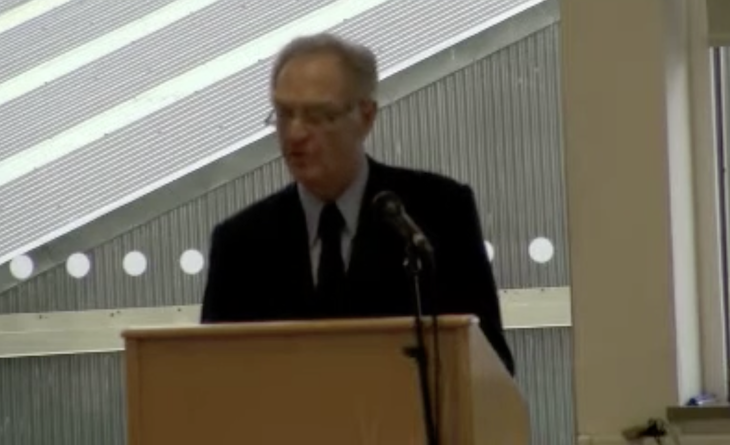
Michael Oatley, who has died aged 90, was one of the best-known MI6 field operators of the post-war era; his public reputation derives overwhelmingly from his role in the most high-profile of the intelligence services’ backchannels to the Provisional IRA, from the 1970s to the 1990s.
Oatley was by no means the first such backchannel – the activities of Sir Alfred (“Andy”) Cope, who talked clandestinely to Michael Collins in 1920-21 at David Lloyd George’s behest, were controversial at the time. But Oatley was the most durable practitioner of this kind of covert para-diplomacy.
This meant ending the violence – but to achieve this, Oatley was prepared to pay a very high price
Oatley also held a string of significant Cold War appointments at MI6’s old headquarters in Century House, including as Controller Middle East, Controller Counter Terrorism and finally Controller Europe, following significant postings in Africa during and after decolonisation, among them Harare in the early years of Robert Mugabe’s rule.
Oatley is now not remembered for achievements during his tours of duty in these geopolitically epicentral trouble spots. Instead, this hugely self-confident panjandrum, for all his global responsibilities, kept returning to handle the British State’s closest, yet most enduring national security challenge. Wherever he was in the world, he kept a line open to senior Provisionals.
And Oatley will be remembered primarily for his role in the Province because that is the part of his story he wanted to be told; and in Peter Taylor, the long-time BBC reporter who authored four books on the Troubles, he found a journalistic vicar on earth to tell it with Oatley as its hero.
Taylor’s writings rather remind one of E.P. Thompson’s description of the Cold War journalist Chapman Pincher: “A kind of official urinal in which, side by side, high officials of MI5 and MI6, sea lords, permanent undersecretaries….stand patiently leaking in the public interest. One can only admire their resolute attention to these distasteful duties.” Nonetheless, Taylor’s writings reveal something about what Oatley and others wanted us to know about his work.
If Oatley’s passion for Northern Ireland was unusual, his view of the Troubles was not. Like so many of his contemporaries in the national security state, he had no theory or practice of victory. The key, in the view of many of those officials, was to avoid the error of the French in Algeria: gravely damaging the country’s global reputation in an unwinnable war. This meant ending the violence – but to achieve this, Oatley (like others) was prepared to pay a very high price.
Over time, this aim was bolstered by a wider narrative. First, that the Troubles were caused and sustained solely by the effects of “the hopelessly bigoted and discriminatory regime” of the old Stormont state between 1921 and 1972; relatively little attention was paid to irredentist Irish nationalist ideology. Second, while the IRA could not prevail, it was deemed “militarily” undefeatable; third, the effort to end this pointless and costly “Mexican standoff” necessitated a search for credible Republican interlocutors who would be willing to “go political”; and, fourth, it was important to give those Republicans a “soft landing” – a sellable narrative for their own base once the campaign of violent insurgency had fallen short of its objectives.
From all this, several other themes emerge, which together form a powerful myth about Oatley’s record in Northern Ireland. The first is that identifying and reaching those Republicans was a difficult and dangerous task. In fact, as the former Republican prisoner Anthony McIntyre points out, it was remarkably easy to gain access to the Republican leadership for much of the Troubles – the very opposite of tracking down a Bin Laden in the Tora Bora caves. Republican leaders valued their dealings with British spooks partly because they were flattered to be courted by another secretive “elite,” and partly because they prized those pow-wows far above dialogue with their duller, now largely powerless, Unionist neighbours. After all, the British were the only party to the crisis who could “deliver” Unionists into a united Ireland.
Consequently, such clandestine outreach was hardly exotic for British intelligence backchannels like Oatley, and not particularly hazardous. It was vastly more dangerous to serve in the RUC, the regular Army or the UDR/RIR. As Sir Quentin Thomas, the long-time Political Director of the Northern Ireland Office in the 1990s, observed to me about one of these lines of communication, “it would have been better to contact the Provisionals in Derry via the simple expedient of posting them a second-class letter through the Royal Mail!”
Taylor acknowledges that there were many backchannels, but perhaps unsurprisingly accords Oatley and his other sources pride of place in his own account of the peace process. Anthony McIntyre and another ex-Republican prisoner and author, Richard O’Rawe both observe that the Derry route, run by Oatley via the local businessman Brendan Duddy, may not even have been the most important of them. Other conduits included Father Alec Reid, the Redemptorist at Clonard Monastery in north Belfast, and Labour backbenchers such as the late Roger Stott. But how does one now weight the relative significance of these multiple channels, Taylor’s assertions notwithstanding?
The second theme in the Oatleyan myth amounts to a cult of personality – a tribute act to the “great man” theory of history, à la Lawrence of Arabia, with an aesthetic dimension: Taylor makes much of Oatley’s James Bondian good looks and sartorial elegance. Republicans seem to have appreciated being courted by a metropolitan officer-class figure (with qualities, once again, they doubtless felt were in short supply among the more provincial Unionists). As told by Taylor, the Oatley story – and that of his successor as conduit, an ex-MI6 officer who transferred to MI5, known as “Robert” – is the triumph of a risk-taking, charismatic individual.
In this telling, the security forces were doing little better than achieving a stalemate through the quotidien business of running agents inside the IRA; and even here the RUC is given scant credit compared with the Army and the Agencies.
In fact, however, the huge collective effort of the entire security system, over many years, massively cut down the terrorists’ operating space. Alongside this, there was a concerted, multi-dimensional effort by successive governments to ensure that Northern Ireland never became anything like a ‘failed state’.
In those “Wild West” days – there were 480 Troubles-related killings in 1972 alone – anything was possible
Hence, for all the Provisionals’ economic campaign – the murder of the managing director of DuPont’s Derry plant in 1977 among much else, and the deflationary bite of early-1980s Thatcherism – the Province remained a functioning society for a large part of its population. Indeed, by the end of the decade its economy was recovering.
Much of this real work of stabilisation was done not by the backchannels but by the British State acting through the Northern Ireland Civil Service – by unglamorous stalwarts such as George Quigley, Arthur Green and Ken Bloomfield, whose achievements are at least implicitly dismissed and patronised in Oatley’s recollections.
Little of this prosaic, but ultimately game-changing endeavour registers in the Oatley-centric account. There, the story is one of the dashing hero riding to the quasi-diplomatic rescue, undertaking his (sometimes unauthorised) outreach and gradually “educating” Republicans in the advantages of going political. In this worldview, the duller spirits in the Northern Ireland Office and MI5 were also forever missing a trick, playing Roundheads to this one-man Cavalier show. Indeed, at times, the claims made by Oatley, “Robert” and others about being central to the evolution of the peace process are reminiscent of nothing so much as the recollections of the individual band members in Jersey Boys – where every one of them thinks that they were central to the success of Frankie Valli and The Four Seasons.
Small wonder that Dame Stella Rimington disliked Oatley enough, as head of Counter Terrorism, to refuse him access to her offices; or that his own Service had to clip his wings when he sought to maintain his Northern Ireland connections after his supposed retirement in 1991. Yet such was his lack of collegiality that Oatley did not even hand over the contact details for his backchannel to “Robert” when he took over; “Robert” had to make his own way round Derry.
The third key theme of Oatley’s years in Northern Ireland was his lack of interest in Constitutional politics, born perhaps of the not-so-healthy respect which he accorded to the roughest of Republican rough trade. According to one of his MI6 protégés, Oatley would have hated to go to Northern Ireland merely to seek out the plodding Constitutional nationalists of the SDLP, who could not “deliver” a sustainable settlement; he craved the excitement of those who could, considering Republicans worthy opponents.
Of Martin McGuinness, he memorably observed that “it was rather like talking to the ranking officer of one of the tougher regiments like the Paras or the SAS. I thought him very serious about the situation he occupied. I didn’t see him as someone who enjoyed getting people killed.” A quote that reveals far more about Oatley’s moral compass than it does that of McGuinness. Oatley even accorded a grudging respect to Billy McKee, one of the most primitive sectarians in the Provisionals’ ranks.
The Dutch political scientist Arend Lijphart – influential on elements of British and Irish officialdom during the Troubles – was one of those to conceptualise a potential consociational settlement for Northern Ireland, resting on the mutual accommodation of sectarian elites. Oatley, by contrast, envisaged the mutual accommodation of secretive elites, elevating the dialogue of covert British proconsuls with leading Republicans into the key building block of the peace process.
The prolonged diplomatic minuet thus resembled nothing so much as Gillray’s Napoleonic-era cartoon of Pitt and Bonaparte carving up the globe between them, captioned The Plumb-Pudding in Danger. No wonder the late Martin Mansergh, éminence grise on Northern Ireland for successive Fianna Fáil Taoisigh, was nervous about these covert British-Provisional channels: as he saw it, the interests of the Republic counted for too little in the Oatleyan worldview.
It was not only the provincial dullards of the impeccably democratic Free State, the SDLP, the UUP and the NICS who were disadvantaged by Oatley’s approach. So, at times, was the central British Government he was notionally working for. He was impatient not merely with sceptical colleagues in the Agencies but also with the democratic constraints imposed by those “ere today, gone tomorrow” politicians. He thought he knew better than they did where the final balance of a settlement ought to lie.
In this he was not unique: Seán O’Callaghan, one of the most senior security-force informers in the IRA, recalled being told during his MI5 debriefing in Holland in 1984, “If Gerry and Martin can sort out some of their problems with the boys, and we can sort out some of our problems with Maggie, we’ll have a deal.” Such self-belief was characteristic of a certain kind of MI6 officer of the era – but such men normally operated overseas, not in a part of the United Kingdom. Tellingly, Oatley admitted that he and his colleagues regarded the Northern Ireland Civil Service as “natives” who had to be kept away from documents marked “UK Eyes Only.”
It is true that Oatley enjoyed some form of “top cover” during the first two of the four main phases of his Northern Ireland career: in 1973, when his SIS predecessor in the Province, Frank Steele, introduced him to his contacts; and then in the period around the 1975 IRA ceasefire. That top cover seems also to have obtained under two very different Governments – the Heath and then the Wilson Ministries.
In the second hunger strike, the channel was reopened without Thatcher’s prior, final approval – a sign of things to come
But in those “Wild West” days – there were 480 Troubles-related killings in 1972 alone – anything was possible. As William Whitelaw, the first Secretary of State after Direct Rule, told Steele: “You funnies do what you have to – but don’t expect me to be there for you if it all goes wrong!”
Merlyn Rees, the first Labour Northern Ireland Secretary, seems to have understood what Oatley was up to, and served a Prime Minister, Harold Wilson, preoccupied above all with how to extricate Britain from the Province. Oatley also claimed the backing of Sir Frank Cooper, the influential Permanent Under-Secretary at the NIO.
All this changed from the late 1970s when the Labour Government, under Roy Mason as Secretary of State, showed far greater fixity of purpose; significantly, Mason enjoyed strong bipartisan support from his Conservative Shadow, Airey Neave (later murdered by the INLA). Mason sought stability rather than grand initiatives and, backed by Sir Brian Cubbon, the astute Permanent Under-Secretary at the Northern Ireland Office, he shut down all contacts with the Provisionals. Despite this, Oatley decided, off his own bat, to keep sending messages down the “bamboo pipe,” his favoured term of art.
The third phase of Oatley’s Northern Irish career came during the 1980-81 hunger strikes. Then the backchannel was initially authorised by Margaret Thatcher – though, in the normal way, she did not know Oatley’s identity. In the second hunger strike, the channel was reopened without her prior, final approval – a sign of things to come. The code name of the backchannel was Mountain Climber, and it is widely thought to have been Oatley.
Following his formal retirement in 1991, Oatley maintained these links in a manner some former colleagues and Ministers deemed highly unorthodox. Patrick Mayhew, as Secretary of State, was enraged by the ex-SIS officer’s continuing interference – “he fucked up,” as Mayhew told me with considerable asperity – and much of MI5’s senior management felt the same, disliking his penchant for “running interference” with what was, by now, “their” backchannel. This reflected the changing footfall of the Agencies in the Province: originally an SIS preserve, it became a joint SIS-Security Service station, before finally becoming a Thames House bailiwick.
Yet Oatley and “Robert” were at one on a key issue: they sympathised with the Republican movement rather than the Major Government over whether the IRA should hand in its guns before entering the political process. Oatley thought no sustainable end to the campaign was possible if Republicans were “humiliated” in this way; far better to let their weapons “rust” gradually – in what he called the time-honoured Irish fashion – once politics had been seen to work.
Oatley derided the Government’s “preconditions” for Sinn Féin/IRA entry to talks as “picador politics,” – after the fashion of the matador in the bull ring who reckons he can goad a bull into a charge before administering the coup de grace. He and “Robert” were impatient with Major’s need to weigh the balance of forces in his Cabinet and Parliamentary Party – which, after a quarter-century of terrorist murder of their constituents and colleagues such as Sir Anthony Berry and Ian Gow, sought some evidence of Republican bona fides. Although by then long in retirement, Oatley claimed to be unsurprised when the IRA ended its first ceasefire with the 1996 Docklands bomb, which murdered two newsagents.
His long-term priority was to tilt the internal balance on bodies such as the IRA Army Council and Executive in favour of the “politicals,” Gerry Adams and Martin McGuinness, against the supposedly more apolitical “militarists.” For all the feathers he ruffled, his broad approach eventually became a lodestar of policy under Governments of every stripe. He was not the only believer in it, and perhaps not even the first within the wider security system; but he was its most flamboyant and consistent advocate.
All this raises a large question: for whom do such covert servants of the State understand themselves to be working, and to what end? By his own admission, Oatley could push the envelope where their government strategy was uncertain – and the operational details of how backchannels were run were treated largely as a matter for the Agencies, as the then-Northern Ireland Secretary Peter Brooke acknowledged around the end of Oatley’s formal career.
There was no uncertainty in the Roy Mason era, yet Oatley got away with it. His less deft successor, “Robert”, managed all this less successfully. In 1993, during the tense run-up to the first IRA ceasefire, he had to fall on his sword and resign after it emerged that he had maintained the backchannel (by then codenamed Operation Chiffon) – despite being ordered to desist by the Government following the IRA bomb atrocity at Warrington.
But even then, how absolute was the prohibition? Sir John Chilcot, Permanent Secretary at the NIO in this period, later told Niall Ó Dochartaigh, for his book Deniable Contact: Back-Channel Negotiation in Northern Ireland (2021), that while the most senior Agency officers in the Province would have been expected to abide by Government policy, such a fatwa would not necessarily have bound more junior operatives.
“Robert”’s departure from Government policy guidelines highlights another common feature of his and Oatley’s approach: never to place the Provisionals beyond the pale in perpetuity, no matter what they did. Both would doubtless have endorsed Gerry Adams’ formulation, deployed to explain away IRA atrocities, that it was important not to engage in the “politics of condemnation”; in such circles, during “conflict resolution,” condemnation is only for the unsophisticated. The message conveyed to Republicans was that if they simply stopped the violence, a whole world of possibilities would open up. The IRA’s campaign of violence thus cost the IRA heavily in a “military” sense, in terms of dead, maimed and imprisoned comrades; but less so politically, at least when it came to the post-ceasefire “goodies” on offer to senior cadres of the movement.
Oatley justified such ambiguities in the manner of an old colonial officer
What was the long-term impact of all this backchannelling? In the mid-1970s, Oatley seems to have told his interlocutors not merely that “structures of disengagement” were potentially up for grabs, but perhaps even British “withdrawal”; Billy McKee said as much to Taylor. Oatley held these to be necessary ambiguities: “structures of disengagement” might have meant no more than reduced security-force pressure, or a return of the Army to barracks. At the time, the critique from the rising Adams and McGuinness was precisely that the old southern-based leadership had been “suckered” by warm British words into a dialogue that took the edge off the “national liberation struggle”. The charge underpinned Adams and McGuinness’s subsequent takeover of the IRA.
Oatley justified such ambiguities in the manner of an old colonial officer: “They wanted some encouragement, I think, that republican aspirations could be accommodated. You have to bear in mind that we’re dealing with Irishmen who have a wonderful facility for language and subtlety. Marvellous poets and lawyers, so everything was open for discussion.” No stereotyping there – only the Blarney Stone and the leprechauns are missing.
His later caveat was that the State would not, in the end, violate the “consent principle” on the Province’s final Constitutional status. Maybe so. But that is not necessarily what his Republican interlocutors heard, or wished to hear; and short of that end point, elements of the British State were prepared anyhow to entertain massive, rolling changes in the way the Province was governed in return for a sustained ceasefire – as duly followed the Belfast Agreement of 1998. This rolling programme of change is also manifest today in official responses to the contemporary “memory wars” over the legitimacy of armed struggle, which have brought the continuing prosecution of former members of the security forces and the demoralisation of a Unionist population (no longer, it appears, a self-proclaimed majority in Northern Ireland).
Oatley’s messaging continues to echo down the years in other ways
Did all this Oatleyan messaging help persuade the Provisionals, at their lowest ebbs, that the condemnation of Ministers and media counted for little? Like the Spice Girls, many senior Provisionals came to believe that their spook contacts knew what the permanent British State really, really wants. Conversely, news of these covert channels impacted negatively upon the Unionists – always suspicious of British State intentions and especially so after the Anglo-Irish Agreement of 1985. Were the assurances given by successive Prime Ministers about the consent principle merely “superstructural” concealing a secret game plan to undermine their political position further? And did such covert backchannels make the UUP leader David Trimble’s task of selling the Belfast Agreement to a sceptical Unionist population that much harder?
Oatley’s messaging continues to echo down the years in other ways. After the Warrington bomb of 1993, “Robert” told the Republican movement – at least as recorded in Sinn Féin’s account of the secret dialogue, Setting the Record Straight – that “the final solution is union. It is going to happen anyway. The historical train – Europe – determines that. Unionists will have to change. The island will be as one.” Perhaps this was another masterpiece of ambiguity, building on constructs forged earlier by Oatley. But on whose authority was that portion of the message – about Britain’s European destiny transcending divisions on the island – transmitted?
The point matters because a persistent theme of Irish nationalist discourse since the 2016 Brexit Referendum is that, by voting to leave the EU, the British violated the terms of the Belfast Agreement and undermined the peace process. That theme has deep roots. The notion that functional cooperation between the two parts of Ireland – and, later, shared membership of the European club – would erode the border and ultimately reconcile Unionists to their neighbours long predates the “European train”: it runs at least from the time of Seán Lemass’s succession to de Valera in 1959; his pursuit, through the Anglo-Irish Free Trade Agreement of 1965 and parallel applications to join the EEC; of practical collaboration in transport, drainage and animal health as a solvent of the cold war between Dublin and Stormont.
Naïve, perhaps, but an ingrained seam in Irish attitudes, deepened by common EU membership – which is why Brexit was experienced as such an existential shock. There is a serious argument, on the basis of the 1994 Republican account, that Oatley and “Robert” had once again pushed the envelope here, on the long-term meaning of European integration. As Peter Bell, a senior NIO official of the era, observed of the very different negotiations over The Way Forward document in 1999, “it was never quite clear what was being said, by whom, and on whose behalf.”
There were, in Oatley’s phrase, many “bamboo pipes”, and many stories blown down them. Sir John Chilcot, the long-time Permanent Secretary at the Northern Ireland Office, who knew Oatley well and was fascinated by his intelligence “product”, once told me how the British had bamboozled the Provisionals into giving up armed struggle with talk of an impending Catholic demographic triumph. “We gulled them,” he exulted. But in the light of the subsequent slide in the Province’s Unionist demography, was Chilcot deluded – or was I the one being “blagged”?
And what of the Oatley legacy beyond Northern Ireland? No one now in SIS served with him, and his style is deemed redolent of a “big beast” of an earlier epoch, his kind neutered by the imperatives of modern HR and, more importantly, by a judicial accountability that did not exist before SIS was placed on a statutory basis in 1994. As one very senior retired officer puts it: “Freebooters bring big pluses. But there is always a big tax to pay on freebooters — and there are now processes in place to ensure that the hounds don’t slip the leash any more.”
What are the political chains of command for Oatley-style covert outreach to the current generation of home-grown Islamists?
Nonetheless, Oatley’s record remains a part of the folklore of the Service – and is taught to younger Whitehall officials as part of their lessons in conflict resolution. Indeed, another prominent insider asserts that this kind of para-diplomacy has played a part in diluting the Service’s focus on its core mission, namely the recruitment and running of agents. But for better or for worse, such an approach has now become part of the UK’s wider post-imperial “offer”: off the back of his role as Tony Blair’s Chief of Staff, and before becoming the current National Security Adviser, Jonathan Powell built a second career out of backchannelling, carrying his Northern Ireland learning to the Basque Country, Colombia and Syria; indeed, he is by no means the only official to have done so after leaving public service.
The question of accountability also remains unsettled. What are the political chains of command for Oatley-style covert outreach to the current generation of home-grown Islamists – apparently being undertaken as part of what one senior official describes as the attempt to conjure into being an “Islamic Sinn Féin” (modelled on the building-up of Republicanism’s political wing against the “hard men”)?
Foreign Office Ministers and Permanent Secretaries now sit fairly heavily on SIS; by comparison, the avowedly self-tasking Security Service (dubbed by one Whitehall wag “the independent Republic of Thames House”) is comparatively left to its own devices by the Home Office; the police even more so, often invoking a very broadly defined form of “operational independence”. There are good reasons for this autonomy, but it comes at a price; indeed, elected Governments do not always think the security system wise in its choice of Muslim partners, as David Cameron’s difficulties with the permanent bureaucracy over the 2011 Prevent Review and the 2015 Muslim Brotherhood Review attest.
Significantly, there are many forms of legal accountability in place for intelligence operations at home and abroad – and they are relatively transparent. Consider, for example, the requirements imposed upon a Director General of MI5 to apply to a Home Secretary for a range of surveillance and eavesdropping warrants. Legal risk is thus well understood. By contrast, are the political risks inherent in the para-political channels undertaken by MI5 and the police equally well understood? Significantly, as several generations of Special Advisers have pointed out to me, it might not be worth the candle for a Home Secretary of the day to get into the weeds of all this, were he or she to be minded to do so.
As noted above, one key aspect of the British State’s modus operandi in Northern Ireland was that it had few objections to the IRA’s political aims, only to its nasty methods; and if the IRA abandoned those, it stood a chance of a decent offer. This was the opposite of the British State’s approach during the war against Fascism and in the Cold War against Communism, when the State did take a clear view of the Far Right’s and the Far Left’s political subversion. Since the demise of the Soviet Union, MI5 has ceased to do so, instead assuming a counter-terrorism posture derived more from the Northern Ireland model, with no particular political end point in mind.
Partly, this approach was born of the late Imperial era of decolonisation – during which Oatley first served. There, the direction of travel was always towards a lowering of the British flag, literally and metaphorically. But what happens when that modus operandi is adopted not to address a “quarrel in a far away country, between people of whom we know nothing” but within the United Kingdom itself – and with too little input from the political echelon?
Dean Godson is Director of Policy Exchange and a member of the House of Lords. He is the author of Himself Alone: David Trimble and the Ordeal of Unionism (HarperCollins, 2004)




Comments