
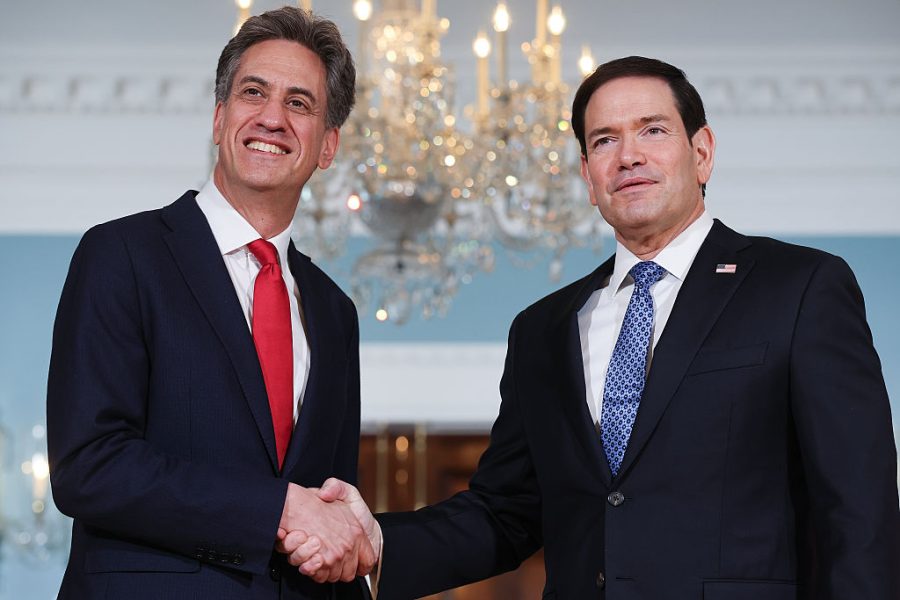
This week Ed Miliband made his first trip to Washington DC since becoming Andy Burnham’s Foreign Secretary. He is 56 now, an MP of more than 20 years’ standing in his fourth cabinet role, yet there is something both boyish and gauche about him: the eternal younger brother. How would he fare as Britain’s envoy to President Trump and the cult of MAGA?
Miliband had been invited to Washington by Secretary of State Marco Rubio after the pair met at an Association of South East Asian Nations foreign ministers’ conference in the Philippines last month. It had been rumored that the Trump administration was disappointed at Burnham’s selection of Miliband as Foreign Secretary, insofar as it is possible to imagine President Trump displaying much interest in the matter at all.
Miliband’s enthusiasm for net zero targets and his opposition to new oil and gas extraction in the North Sea were anathema in Washington. The US Secretary of Energy, former oil industry CEO Chris Wright – who has said “there is no climate crisis and we’re not in the midst of an energy transition either” – supposedly nicknamed his then-counterpart “Miliwatt.” The new Foreign Secretary had also previously accused Trump of being “a racist and a misogynist” who “lowered the bar for idiocy.”
Burnham cannot dodge reality with Northern bonhomie
Warren Stephens, the US ambassador in London, told the media, “I would suspect his views have changed on President Trump, but I haven’t talked to him about that.” And surely Miliband could find some solidarity with Marco Rubio, who called the President a “con artist” and suggested he was incontinent when the two were contenders for the Republican presidential nomination in 2016.
Miliband and Rubio met for 90 minutes this week, and both sides were keen to focus on policy issues. A State Department spokesman set out the party line:
The two discussed the importance of Europe taking on a greater role in its own security. They reiterated their shared commitment to safe transit in the Strait of Hormuz and ensuring Iran never develops or obtains a nuclear weapon.
The Foreign Secretary managed to sound even more formulaic. He thanked Rubio for a “warm, productive meeting” and declared himself “hopeful” that the Strait of Hormuz would be reopened. Then it was as if he had remembered a script Burnham had given him:
The number one priority for this government is to tackle the cost of living crisis that people are facing and my job as Foreign Secretary most immediately is to work with our closest ally the United States on getting a lasting ceasefire in relation to the Iran war… People should be in no doubt, I know as Foreign Secretary that the British people are worried about what’s happened to petrol prices, diesel prices, energy bills… [we] spoke about the intolerable situation in Gaza and the urgent need to address the humanitarian situation there, as we work towards a lasting peace for Palestinians and Israelis.
This was foreign policy for domestic consumption; the UK’s influence over the war with Iran and in Gaza is minimal. What was important was Rubio’s reference to “the importance of Europe taking on a greater role in its own security.” It has been made clear that Washington wants the UK to increase its level of defense spending, and this presses on a vulnerability of Burnham’s premiership.
Temporizing on defense spending was one of the flaws that brought down Sir Keir Starmer. John Healey, now Chancellor of the Exchequer, resigned as defense secretary in June because Starmer would not commit to raising expenditure to 3 percent of GDP by 2030. Healey regarded this as “a headmark date… [which] Britain must set.” He also said the Defense Investment Plan fell “well short of what is required for defense and the country.”
Burnham has provided no greater reassurance. He has said he will “honor” the UK’s commitment to NATO to reach a level of defense spending of 3.5 percent by 2035, but that date will come in the next Parliament but one, two general elections away; the Prime Minister underplayed the timeframe when he said “those commitments relate to the Parliament after this.” The new Defense Secretary, Wes Streeting, has also been evasive on the issue, saying “it’s not for me to write the Chancellor’s budget or the next spending review.”
There is no easy way out of this, and Burnham cannot dodge reality with Northern bonhomie or his preposterous, dim-witted “Makerfield test.” Marco Rubio is saying what military experts and analysts across the spectrum have said: the UK is not spending enough on defense and is not increasing its spending quickly enough. Starmer said publicly that the assessment of British and NATO intelligence was “there could be an attack by Russia on NATO as soon as 2030.” That was why John Healey felt the date was a resigning matter.
Healey now holds the purse strings, but the buck stops in Downing Street. Current defense spending cannot sustain the UK’s existing plans and commitments. Washington is not making an unreasonable demand but reminding us of what we already know. Andy Burnham now has to make a decision: fund our defense according to threats and commitments, or don’t.





Comments