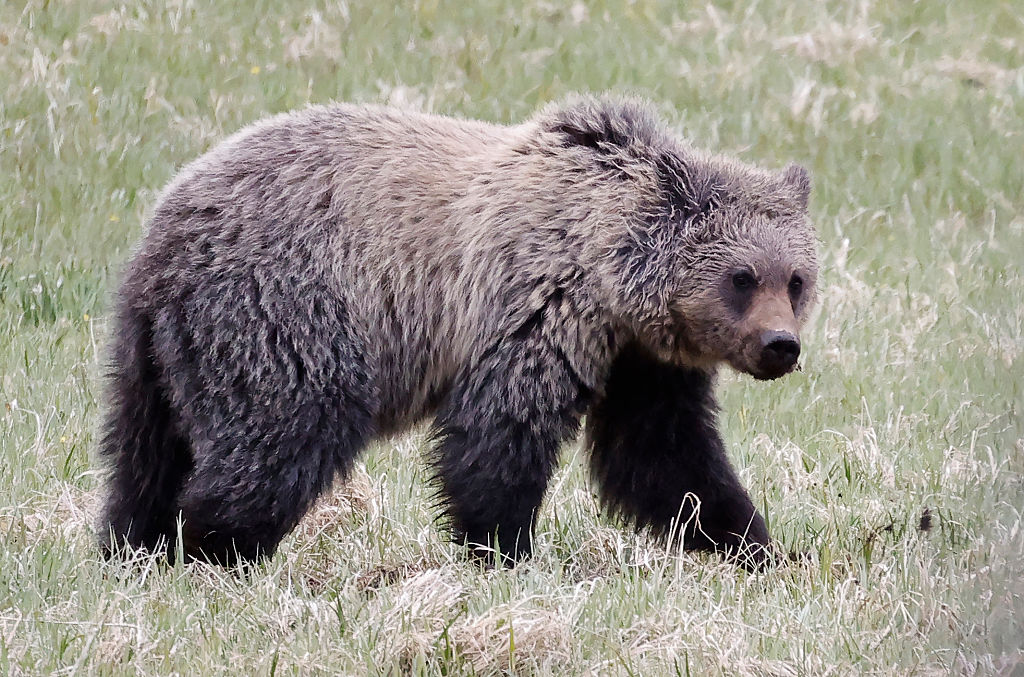
Grizzly hunting – banned in the lower states since 1975 when the bear was added to the federal endangered species list – may soon make a return. US Interior Secretary Doug Burgum has announced a proposal to allow states to manage their own stocks if numbers have recovered.
Judging by recent headlines, it certainly seems as if the numbers are back up. A grizzly recently attacked two brothers in Yellowstone National Park, a hiker was likely killed by a grizzly on Mount Brown Trail in Glacier National Park and a grizzly charged a man and fractured his arm in Glacier National Park.

Black bears are getting in on the action too. Warnings were issued on the Appalachian Trail over aggressive black bears chasing and biting hikers in May. A black bear attacked two women in their tent in the Big Horn Mountains of Wyoming. And human remains found in a Colorado picnic area had been partially consumed by a bear and likely other wildlife, it was determined.
But what are the bear facts about human encounters with bears? It might appear that with rising numbers of the apex predator, that the danger to humans, weak and tasty as we are, increases. However, there is no centralized source for bear-human conflict data. Some hikers only learn about aggressive bears at the site of attacks by reading witness accounts written in shaky hand in trail shelter registers.
US and Canadian wildlife agencies get about 40,000 complaints about black bears each year, but we aren’t told when or where exactly the incidents occurred.
Research from the International Association for Bear Research and Management found that 35 states had stable or increasing encounters. But these numbers are inaccurate because Alaska (with 100,000 black bears), Montana (with 13,000 black bears), and Wyoming failed to report.
Moreover, why isn’t this data released every year? Why don’t all states share the information? And are there any aggressive bears near the campsite I’m considering for the night?
The opacity tracks. Two years ago, when I asked a well-known nonprofit for bear-human conflict data from their trail, they declined. And a bear conflict Freedom of Information Act request I submitted to the National Park Service in May 2024 is still unfulfilled.
Instead of a knowledge sharing system, we have a collection of people afraid of vilifying bears.
“My bear spray probably saved me from a fight I couldn’t win.”
My first grizzly encounter came in British Columbia where the Tatsatua River lapped at the carcasses of spawned-out salmon. I was walking too fast and too quiet when I startled a grizzly feasting on a salmon. The roar was a wall of sound that seemed to steal time. Fortunately the bear broke in the opposite direction, while I stood in the river, sobered by a dose of adrenaline and the realization that I am no match for such a powerful creature.
Years later, along Virginia’s Blue Ridge Parkway, a big male black bear circled me, silently. A bear biologist later told me that the bear was likely predatory and deciding if he could take me. My bear spray probably saved me from a fight I couldn’t win.
If either of these bears had attacked me, it would have been my fault. I had walked into their cafeterias unannounced.
To be clear, I hunt and I eat bear. Hunting is central to conservation and bear management in America. But we should be careful of launching a predator killing campaign after it has taken us so long to get over the last one. There are other ways to reduce the risk posed by bears to humans.
The first is to awake from the bear myth. For more than 100 years, since Teddy was born, Americans have offered bears to babies in cribs and children have clung to them for comfort. Purveyors of American pop culture – from the McGuffey Readers to Instagram – have taught us the bear is our friend. The bear is not our friend.
Step two is to be prepared when we step into the woods. We are responsible for ourselves and we need to carry bear spray in bear country. It works. Note: check the regulations at California’s national parks, some of them absurdly do not allow you to protect yourself with bear spray.
Step three should be, I believe, a Waze for bears with up-to-date access to information about sightings, encounters and attacks. We have this for shark attacks, so why not bears? Every day, crowdsourced data warns drivers using Waze of police patrol cars around the bend. We consider the consequences and, usually, we make some change in behavior.
Before a hiker heads into an area, they could check Waze for bears. If they encounter a bear, they report it, as can officials. Everyone is better informed and safer. The Outdoor Industry Association, with its 450 members committed to getting Americans outdoors and fueling the $1.3 trillion outdoor economic engine, would certainly seem uniquely positioned to build such an app.
We’ve brought bears back and now we have to learn to live with our success. Technology can help with that cohabitation and make sure when we go down to the woods we aren’t in for a big surprise.






Comments