
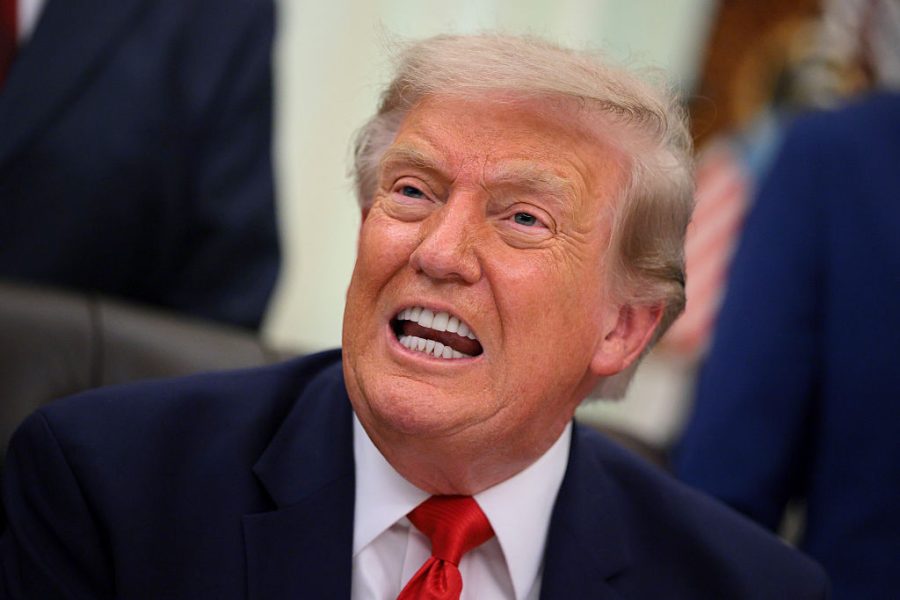
The US Senate narrowly defeated a measure yesterday intended to crimp, if not terminate, President Trump’s ability to conduct hostilities against Iran. The 50-49 vote on a war powers resolution testified to the mounting hostility toward the military campaign among American voters, two-thirds of whom regard the conflict as a futile endeavor. The result is that Trump’s own popularity rating has plummeted to 32 percent, edging out Joe Biden’s 33 percent shortly before he declared that he was exiting the presidential race in July 2024. Presumably, this is one personal record that Trump will not be inclined to tout at his Maga rallies.
What is to be done? Two diametrically opposed camps have emerged on the right to advise Trump on Iran. The first camp consists of national security hawks, such as the Hudson Institute’s Rebecca Heinrichs, who are urging Trump to double down. A two-week bombing campaign, they argue, will force an already weakened Iranian regime to cry uncle. Failing to crush Tehran would be akin to ending an antibiotics regimen prematurely, thereby helping to strengthen the original infection. Exhibit A is a new op-ed by Marc Thiessen in the Washington Post, which lambasts Vice President J.D. Vance as a feckless appeaser when it comes to confronting the threat posed by Iran. According to Thiessen, Trump has already scored big victories against Tehran:
Trying to decode Trump’s views on Iran and Israel and Ukraine is akin to practicing haruspicy
Perhaps it’s time for the President to take the advice of those who have delivered him success in Iran – not those like Vance who have failed him.
The second camp of self-styled “restrainers” will have none of this. They believe that Vance is right. Trump should return to the America First credo that ensured his ascension to the presidency in the first place. Instead of engaging in foreign adventurism, he should focus on the economy, whose growth rate was a measly 1.5 percent in the second quarter of this year. They even suggest that the neocons have no compunctions about sabotaging Trump’s presidency by bogging him down in a fresh forever war, one that might eclipse the 2003 Iraq war in its disastrous geopolitical consequences. As Curt Mills, the executive director of the American Conservative, told me:
On Iran, Trump has kept very bad company. The Murdochs, the Foundation for the Defense of Democracies, the Lindsey Grahams of the scene care not a whit for his presidency and legacy – as long as they get what they want out of it. And he may enjoy playing emperor on television to the Netanyahus and Zelenskys of the world, but it’s a facade – it’s the United States that is paying tribute to them. The President still has it in his power to reverse this embarrassing state of affairs.
Maybe so, but the truth is that trying to decode Trump’s views on Iran and Israel and Ukraine is akin to practicing haruspicy. As ever, he remains predictable only in his unpredictability. Speaking with Edward Luce of the Financial Times yesterday, Trump suddenly mused that he was “not sure” about his previous asseveration that he would permit Ukraine to build Patriot missile systems.
As Nebraska Republican congressman Don Bacon, a former brigadier general, noted yesterday, Trump’s White House has a proclivity for “moral ambiguity” when it comes to Russia’s war against Ukraine. “It’s Putin who started this war and is doing the invading,” Bacon wrote on X. “Blame Putin. This is embarrassing.” So it remains an open question whether Trump is truly warming to Ukrainian president Volodymyr Zelensky, or continues to view him as a nuisance.
It should hardly come as a surprise, then, that Trump is a study in indecision on Iran. He never anticipated a lengthy war, reckoning that it would be Venezuela 2.0. Now his drive for a fresh imperial conquest is looking as disastrous as Napoleon’s ill-fated 1798 invasion of Egypt. If Trump launched the 14-day campaign against Iran that the hawks are demanding, he might well call it off after a day or two in a fit of whimsy. His tempestuous approach to international relations brings to mind the maxim sic volo, sic jubeo: thus I will, thus I command.
Indeed, a fresh example arrived yesterday evening when Trump proclaimed that he has persuaded Hamas to disarm and Israel to withdraw from Gaza. In a post on Truth Social, Trump said:
This is a major milestone in the implementation of the Trump 20-Point Plan. The agreement will be carried out in carefully structured phases. As disarmament is completed, Israeli forces will withdraw, and the International Stabilization Force will work with a new Palestinian police force to take responsibility for Gaza being safe for its residents and its neighbors.
Oh, dear. The more likely prospect is that the conflict in Gaza will grind on inconclusively, much like the war against Iran. Meanwhile, the midterm elections are less than 100 days away.

Comments