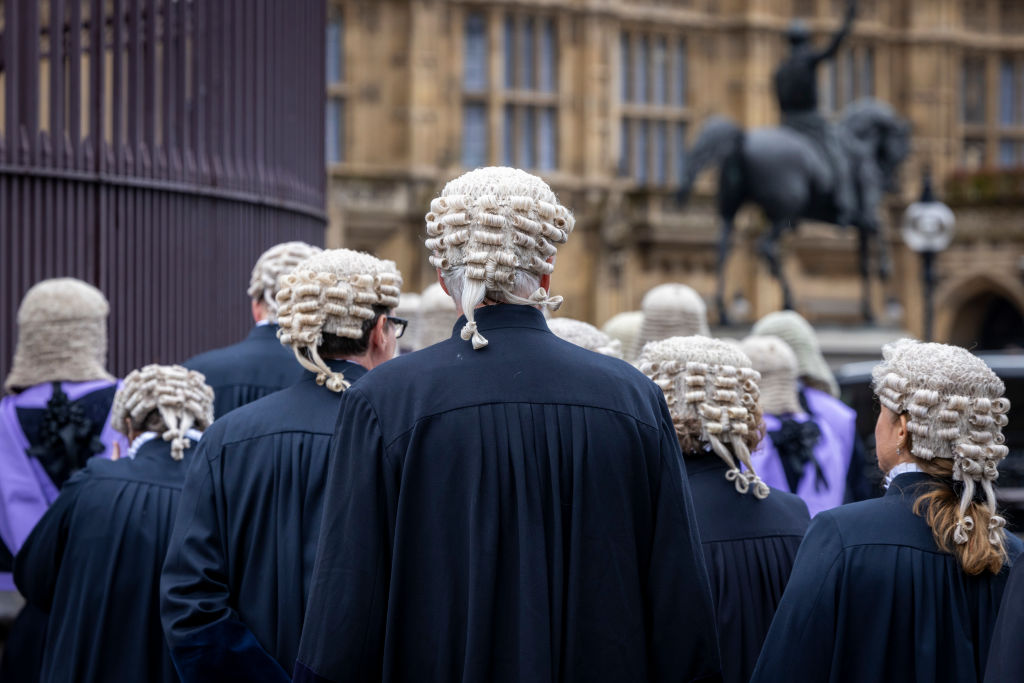
In a cutting judicial pronouncement this month, the Lady Chief Justice, Baroness Carr, criticised the former attorney general, Lord Hermer, for not sticking up for a Crown Court judge whose sentencing in a case had been the focus of personal attacks which had led to threats.
In the eyes of some, when it’s Palestine it appears the laws of England are not supposed to apply
This reprimand by the head of the judiciary came shortly after Prince Harry was criticised for describing the widely respected judge in his case, Mr Justice Nicklin, as having presided over ‘a complete and obvious whitewash’ after the Prince resoundingly lost his lengthy civil action against the Daily Mail (Associated Newspapers). It seems to have been lost on the Prince that the very fact that the judgment extended to around 436 pages rather points to the very opposite of a ‘whitewash’. Any written judgment that reaches that length is clearly intellectually forensic, whatever its conclusion.
Now even the left are piling on the bandwagon against judges. This seems strange from those who have protested furiously when right-wing politicians have criticised unfavourable judicial rulings or milksop sentences. What could possibly have induced the left to take this stance? Surprise, surprise: it’s Palestine!
At Woolwich Crown Court in January a trial judge gave a direction to the barristers acting for defendants accused of criminal damage against an Israeli defence company, Elbit Systems. The barristers were told that in their closing speeches to the jury they were not to raise issues he had judged were not relevant for the jury to consider when it came to guilt or innocence.
One of the barristers, Rajiv Menon KC, in his speech to the jury, allegedly defied this ruling. He is said to have referred to the defendants being prevented from giving evidence about Elbit Systems and later referred to the company being ‘protected’ and ‘wined and dined in the corridors of power’. (The barrister representing him at the Court of Appeal earlier this year, Adrian Waterman KC, said he ‘did not think he was knowingly breaching the order’ and was ‘utterly shocked at what was being suggested’.)

Menon is now fighting proceedings for contempt of court and some on the left have criticised the judges for even bringing the case.
It seems to me that any judge giving a ruling about not influencing the jury this way is only applying common sense. After all, if you or I deliberately throw a stone through our neighbour’s window we would be charged with criminal damage. The question of whether the neighbour was an arms dealer or an archbishop should be irrelevant if the glass was smashed and the damage was done. The morality of the person who owned the glass should not be relevant.
But in the eyes of some, when it’s Palestine it appears the laws of England are not supposed to apply.
I suppose you can’t blame barristers if they try this approach because it has tragically worked on several occasions in English courts. Jurors have indeed failed to convict defendants despite mountains of evidence, because they have presumably been convinced they can go home afterwards and think of themselves as moral titans by standing up for ‘the little guy’ and against, for example, the world’s only Jewish state.
However, in this case the judge whose orders were allegedly disobeyed asked an independent judge to decide whether to refer the barrister for contempt of court proceedings. There are legal arguments now pending about the process and the jurisdiction of the courts to take the action they are contemplating and those issues have yet to be decided. But it appears at the moment that a court will in due course decide on the merits of what is thought to be the first time a barrister has ever been accused of contempt of court for his closing speech to an English jury, although it must be said many barristers over the years have been accused of contempt for other things.
The fact is that barristers are not above the law. Indeed, they are expected to conduct themselves as ‘officers of the court’ and uphold high standards. Of course, whether this individual barrister has done anything wrong still remains to be seen.
More generally, the derangement that a worryingly large number of people feel about Israel cannot be allowed to contaminate our society any more than it already has. We have seen police officers fail to arrest suspects abusing Jews, crown prosecutors who don’t prosecute offences against Jews, and even some magistrates fall short in their sentences or judgments when it comes to offences against Jews. We cannot allow this stain to contaminate our senior courts as well.
English judges are amongst the UK’s most prized assets. They are so highly respected that individual litigants, companies and corporations from around the world choose to litigate their civil disputes here because they have confidence in the integrity, intellect and honest incorruptibility of our judges. We should keep it that way.
That is not to say judges should be above criticism. Disapproving of the general concept of judicial activism, for example, is in my view perfectly legitimate and indeed understandable. But individual judge’s orders in court must be obeyed and those who disobey such orders cannot be surprised if consequences follow.





Comments