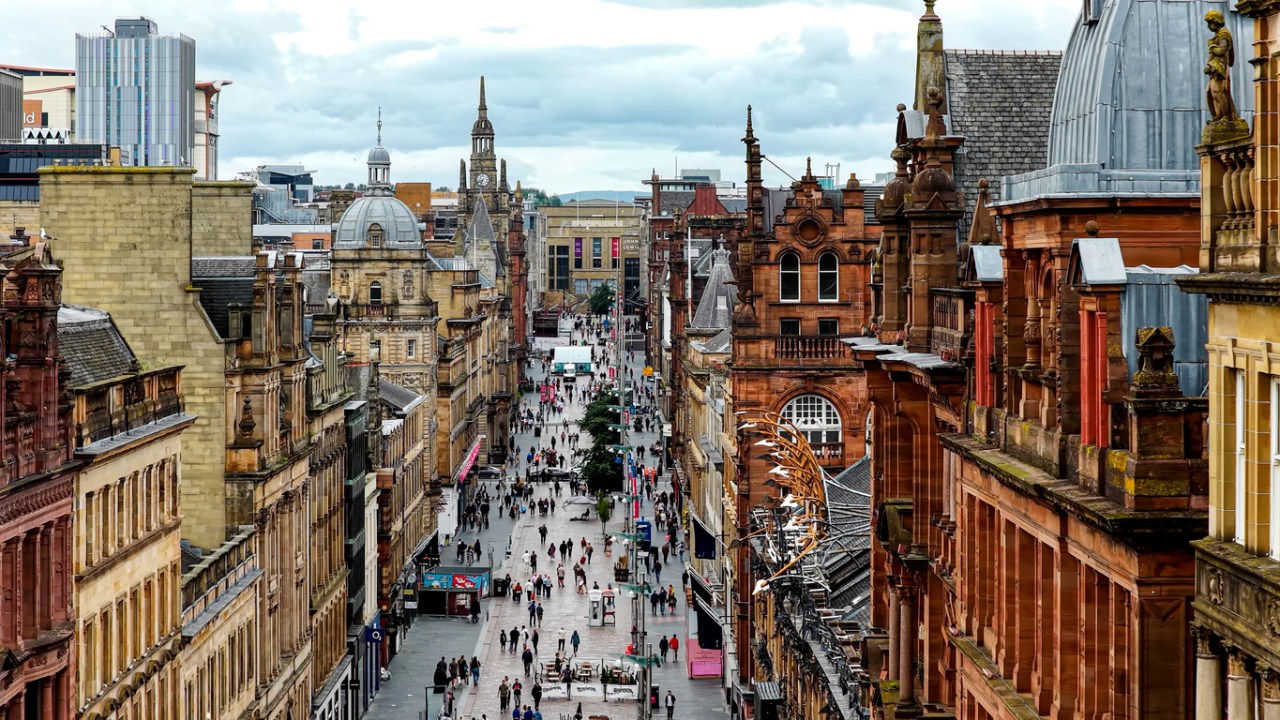
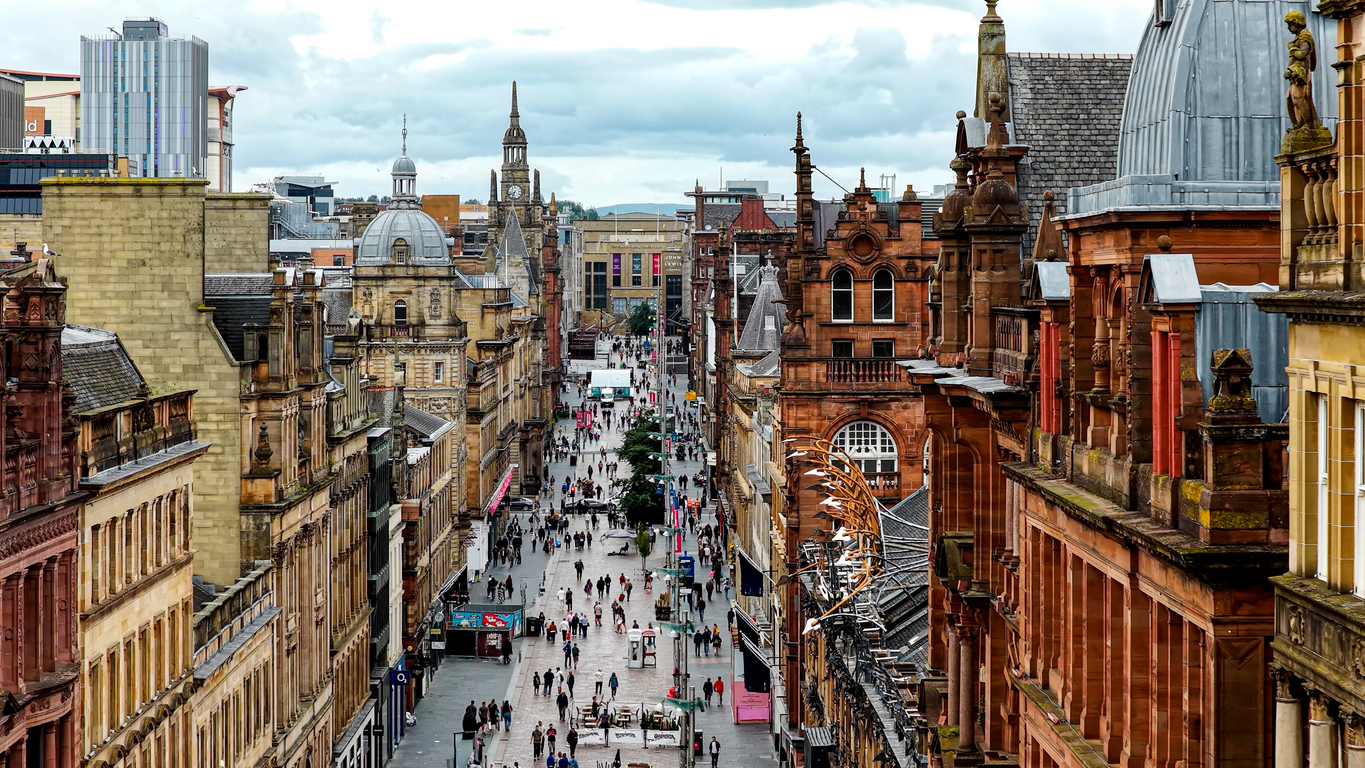
It’s a big summer for Glasgow. Fresh from twinning with Boston after the Tartan Army’s World Cup antics entranced the Americans, Scotland’s metropolis is now welcoming visitors for the Commonwealth Games. Those in town for the week and a half will find a city of underrated beauty – but one which seems strangely determined to let its impressive Victorian and Edwardian heritage crumble.
The latest example of Glasgow’s apparent death wish came this week when it was announced that a lack of cash means that Charles Rennie Mackintosh’s masterwork at the Glasgow School of Art, destroyed in 2018 by a second fire in four years, won’t be faithfully rebuilt after all. The school says it can’t afford the £265 million bill to restore the building alone and has come up with a vague plan for the site to act as a ‘heritage “anchor” for a wider innovation cluster that supports local regeneration objectives’. Call me unconvinced.
That punch in the gut came after the vape shop conflagration in March which shuttered Glasgow Central Station and took down the historic Union Corner. Just down the road, the majesty of Alexander ‘Greek’ Thomson’s derelict A-listed Egyptian Halls (completed 1872) has only just been partially revealed again, after one of the finest buildings in the city spent decades covered in scaffolding.
The list of heritage disasters, sadly, could go on. More and more historic buildings are being put on heritage risk registers while the city centre struggles with vacant shops and mounting litter. I’m sceptical, but it can only be hoped that the council’s £123 million ‘Avenues Programme’ regeneration plan isn’t just a dubious sticking plaster over the city’s decaying fabric.

Still, for those tempted to dismiss Glasgow as a post-industrial hellscape benighted by sectarianism, I’d argue that the city is more beautiful than is commonly appreciated. While Glasgow has been shooting itself in the foot, after taking major strides to move on from post-industrial decline when I was growing up there in the 1990s and 2000s, it still has plenty to boast about.
Visitors should take in, to rattle off a few sites of interest, the 12th-century Gothic cathedral, the Necropolis (the city’s version of Paris’Père Lachaise cemetery), the villas and terraces of the West End, Gilbert Scott’s gothic revival work at the ancient university (where one Adam Smith once taught – how Glasgow and Scotland could do with him these days), Kelvingrove Art Gallery, the Burrell Collection, the Mitchell Library and the City Chambers. The Greek Revivalism of Thomson’s churches can still be admired, even if they are crumbling, as can the Mackintosh attractions still standing.
In Alasdair Gray’s novel Lanark, the autobiographical character of Duncan Thaw provides insight about why Glasgow’s aesthetic attractions are often overshadowed:
‘Think of Florence, Paris, London, New York. Nobody visiting them for the first time is a stranger because he’s already visited them in paintings, novels, history books and films. But if a city hasn’t been used by an artist, not even the inhabitants live there imaginatively.’
That’s one reason, perhaps, why Glasgow is always so resolutely left in the shade of Edinburgh. Glasgow is often seen in film, though usually when it’s presented as New York. Sometimes it is simply ignored: when it came to the 2023 adaptation of Gray’s wonderful novel Poor Things, starring Emma Stone, the action was simply transported to London in defiance of the author’s Glasgow setting.
However, the fundamental problem hanging over contemporary Glasgow is that it doesn’t seem to know what it stands for or where it’s going. Rory Olcayto, former editor of the Architects’ Journal, hit the nail on the head in a 2023 lecture when he argued that ‘psychologically Glasgow is paralysed’ between the Victorian ‘living story carved in stone’ and the Modernism which is ushering in ‘Caledonia’s Logan’s Run.’
Glasgow’s retreat from its Victorian heyday, when shipbuilding and engineering made it the Second City of the Empire, has cast a very long shadow over its fortunes and identity. Part of the story of Glasgow’s architectural paralysis is embarrassment and shame over the old city’s sources of wealth.
Yet if historical self-flagellation over Empire and the iniquities of the Atlantic slave trade doesn’t excuse contemporary neglect, rose-tinted glasses about Glaswegian Victoriana isn’t useful either. The bulk of Glasgow’s population, crammed into tenements, did not flourish on the wages which underpinned the world of heavy industry. Far too many also blame past events, including policy decisions made in Westminster half a century ago, for Glasgow’s current woes. While Glasgow is mercifully no longer the murder capital of Europe, as it was in the early 2000s, it remains the continent’s drug death capital.
The city’s difficult moment is also seen in rising social tensions as it becomes the biggest asylum dispersal area in Britain after London. Tommy Robinson last week apologised after falsely accusing a man in Glasgow of being ‘another invader hanging around a park filming children,’ while militaristic groups dressed in black have staged strange silent protests outside both Glasgow Cathedral and the Scottish Parliament.
Hopefully those in town to watch some gymnastics or boxing can appreciate Glasgow’s brighter points rather than be dragged into depression by the city’s fading glory. That glory needs to be appreciated and protected, even in diminished form. Edinburgh is still nicer though.






Comments