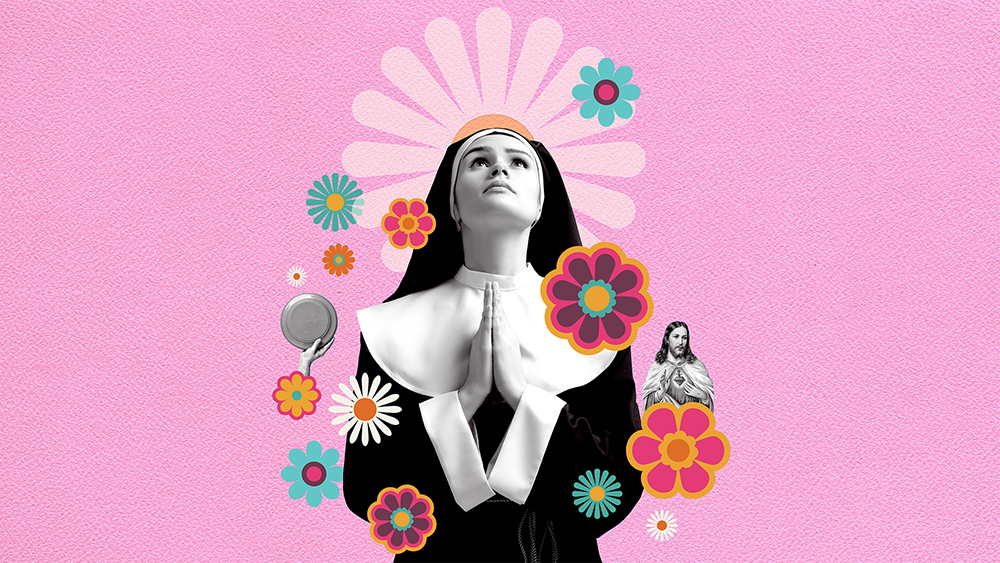


The nuns were wrapping up their night prayer when I entered the chapel at Tyburn Convent. I couldn’t see them but heard their soft voices singing the last phrases of the ‘Salve Regina’: ‘O clement, O loving, O sweet Virgin Mary.’ Across the road in Hyde Park, an outdoor concert heaved. What was I doing, spending my Friday night here instead?
I had come to see if the rumours of a ‘nun girl summer’, as it’s being called on TikTok, were true. Earlier this year, a video of two nuns discussing their ultimate frisbee skills went viral: ‘Sister, you are so good at that!’ ‘Sister Miriam, you also are!’ As the pair record an episode of the podcast Dominican Sisters Open Mic, they’re filled with the kind of blissed-out giggly joy you really only see in nuns and people on edibles. I then heard stories about young women moving into convents, and of silent monastic retreats getting booked up months in advance. Bibles are said to be flying off the shelves, with record sales in both the US and UK last year.
When I hear my friends talk about having a ‘celibacy era’, they sound more relieved than repressed
As I might have expected, the Tyburn chapel was half-filled with little old stockinged ladies and their inexplicable number of shopping bags (‘We’re small in numbers so we’ll all have to sing a bit louder this time,’ the usher said). But even if the ‘nun girl summer’ trend has not resulted in overflowing pews or more women taking the veil, it points to a spiritual ache among young women that is real. Nuns, we hope, can offer some guidance.
When I hear my friends talk about having a ‘celibacy era’, they sound more relieved than repressed. Dating apps, for one thing, have made love feel like a humiliation ritual. A vow of chastity might not be that bad after all. Housing is also a demoralising necessity, whether you’re trying to buy or facing the expensive and brutal rental market. Boarding in a convent is a clean, quiet and, importantly, cheap alternative, as long as you can put up with chores and a curfew.
The distinctly female life of a nun also appeals. As ‘female-only spaces’ – or any solid notion of femininity – have become politically fraught, I think young women have lost the confidence to acknowledge that uniquely feminine virtues exist and should be celebrated. Nuns are not all clement, loving and sweet, but their small society allows them to flourish as women. While the rest of us are encouraged to develop as citizens or employees, that crucial part of our nature is often neglected. No wonder we might crave a bit of sisterhood.
However, your late teens and twenties are supposedly a time to see the world, live hedonistically and have ‘hot girl summers’. Is the convent really such an ideal place to spend our formative years? I think of Pansy Osmond in The Portrait of a Lady, who is raised in a convent and becomes, to her manipulative father’s delight, ‘a passive spectator of the operation of her fate’; or the tragic heroine of Maupassant’s Une vie, whose ignorance of the world, thanks to her education in a convent, is the source of her miseries. How many convent schoolgirls leave complaining of ‘Catholic guilt’ and other nun-induced neuroses? Weren’t nuns meant to be knuckle-rapping, mean old biddies?

‘Nun girl summer’ is partly an outcome of the nunnery’s revamp over the past decade or so. Under Pope Francis, religious sisters saw an expansion of their role in the Catholic Church. He appointed sisters to leadership roles in the Roman Curia and allowed women to vote in the Synod of Bishops, which convenes to advise the Pope. In the popular imagination, nuns are quietly crusading feminists changing the Church from within – as depicted by Isabella Rossellini’s character in Conclave, Sister Agnes, who steers the election of the new pope despite not having a formal vote. The reality is perhaps less exciting, but more beautiful. I recently spotted a pile of prayer cards at church with a beaming photograph of Sister Clare Crockett, who died at 33 in an earthquake in 2016. She looks as if she might host a podcast, and is also on her way to being recognised as a saint.
When I was a teenager in the Francis years, just about every one of my female friends went through a nun-curious phase. We went to girls-only prayer retreats with religious sisters, spending silent hours in Ignatian contemplation. A week of our summer holidays was spent at a co-ed Catholic overnight camp, where young women in habits ran through fields like Maria von Trapp in the Alps, chasing frisbees.
When the campers gathered for evening prayer, a priest would ask that anyone who felt ‘called to a religious vocation’ – Catholic lingo for wanting to become a priest or a nun – come forward for a blessing. I often did – though it was partially an attempt to impress the handsome young seminarians there. It was also a kind of teenage radicalism. I told one theology teacher that I would gladly renounce society for the uncomplicated life of a nun. He said that if I was running to the convent to escape the world, I would still find myself unhappy there. I knew he was right.
Others were more serious about it than I was. A few years ago, my childhood best friend told her then-boyfriend that she wanted to explore other options before getting married. For her, this meant spending time with some nuns, mulling over whether to devote her life to Christ (I imagine it’s terrifying to contend with a literally flawless man for your lady’s heart). But ‘nun girl summers’ must come to an end, and they decided to marry after all.
The question of my vocation was, thankfully, more straightforward. I got engaged (in Vatican City, funnily enough). The following day, I watched as a group of nuns slowly climbed Rome’s Scala Sancta on their knees, praying. I found that I envied their grey anonymity and self-effacing devotion, even though I had been called to a different vocation, that of marriage. My flirtation with the religious life was only ever half-hearted, but I suppose even a summer fling can stay with you a long time.



Comments