

Dave and Lynne are remembering the good old days when kids had their baths in galvanised tubs in front of the fire. ‘No inhibition,’ says Dave. ‘Straight with your clothes off. Straight in there. Mum’ll throw a bucket of water over you. Wash yourself. Another bucket of water.’
Dave manages the E. Langston hardware shop, but it isn’t a real business. Not anymore. Some years ago, its premises were transposed from Piper’s Row in Wolverhampton to the Black Country Living Museum. Its life is happier here. There’s not much left on Piper’s Row today: an off licence, a bus stop, a cheap hotel.

The Black Country Living Museum was founded in 1978 to teach people about life during the Industrial Revolution. When homes or businesses of that period face obsolescence, the museum resurrects them on its fake high streets. The place looks like a working town – just one that’s locked in time and free from concerns about crime, profit and rent. E. Langston’s interior and façade are set in 1930, the museum’s chapel is set in 1837, its functioning bakery is set in 1900 and its working man’s inn – which sells alcohol to visitors (sawdust on the floor, no lager) – is set in 1915. There’s also a tailor, a library, a school and a chippie which fries in dripping.
The museum is set on a big plot on the outskirts of Dudley, a short train ride from Birmingham. No region in Britain has seen its morphology change as dramatically since the industrial age as the Black Country. In 1869, the US consul to Birmingham, Elihu Burritt, wrote about climbing Dudley Castle, a couple of hundred yards from the site of the museum today, and seeing a warzone of furnaces: ‘It was the sublimest battle scene ever enacted on Earth; that ten thousand Titans were essaying to breach heaven with a thousand mortars, each charged with a small red-hot hill.’ The Black Country’s last working blast furnace – named Elisabeth, at the Bilston Steelworks – closed in 1979. It was blown up with gelignite a year later, its remains sold for scrap.
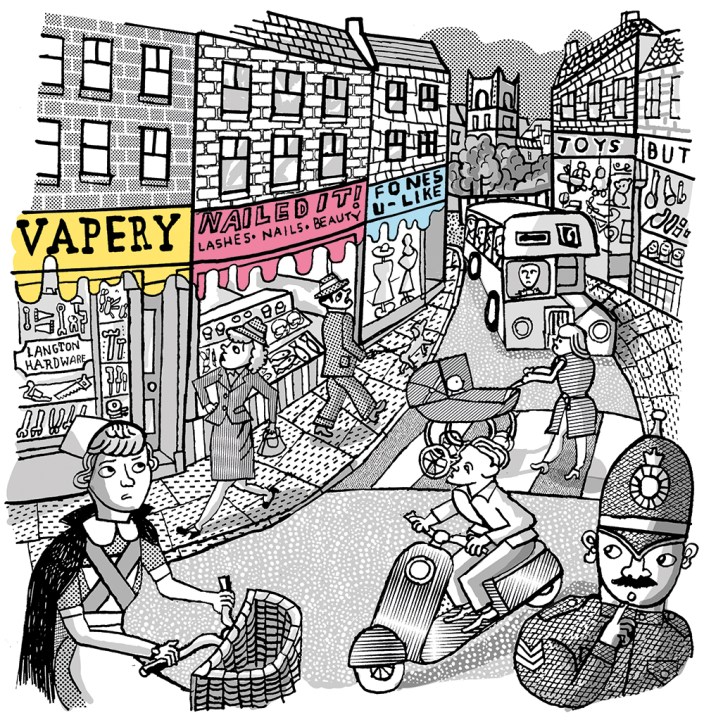
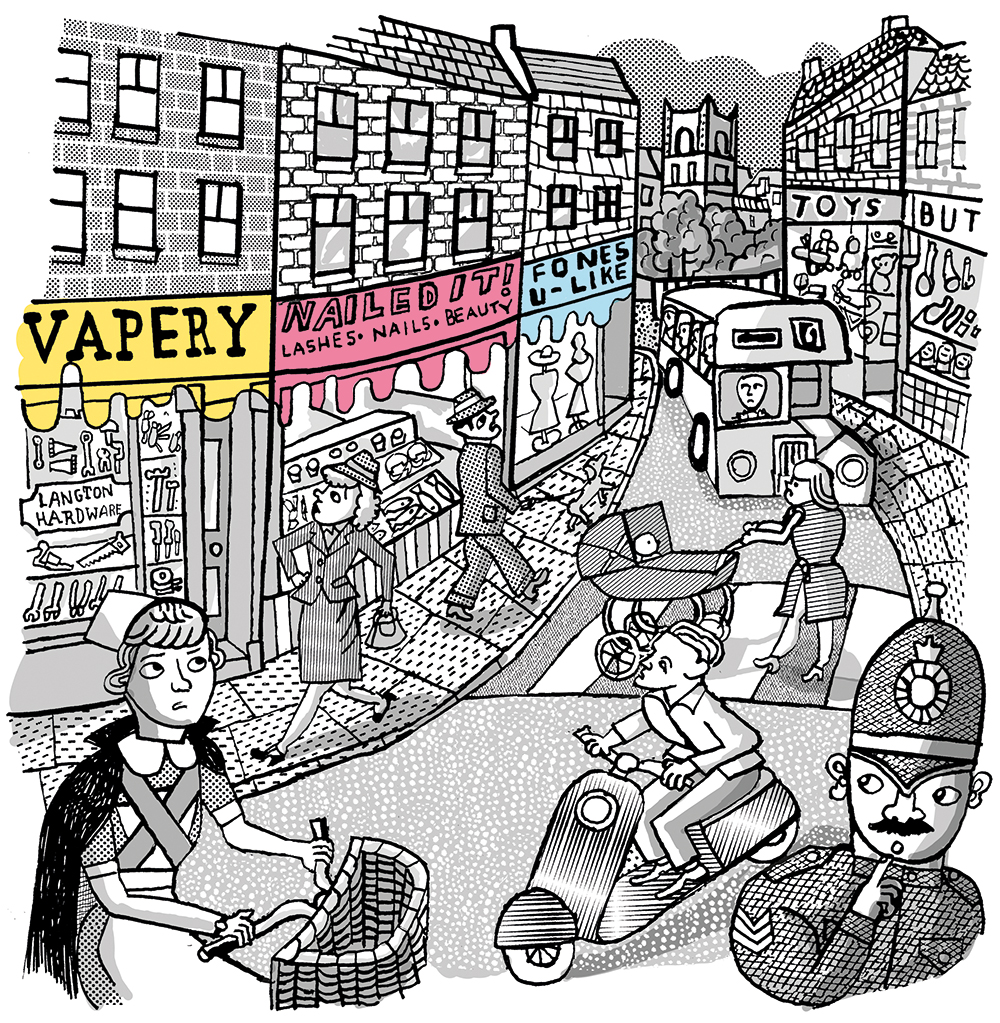
Today, people come to the Black Country Museum less to educate themselves about history and more to see what a proper town used to look like. ‘Where I’m from in Oldbury there was the most beautiful bank,’ says Dave from behind his counter at the hardware shop. ‘I think it was a Lloyds Bank years ago. It’s a vape shop now.’ Lynne, a museum visitor, agrees: ‘We used to have a hardware shop like this that were on our estate for donkey’s years and now it’s gone. Guess what it is now? Vape shop.’ It is surreal that the most idyllic high street in the area is a reconstruction.
The place looks like a working town – just one that’s free from concerns about crime, profit and rent
The museum has clearly noticed the strong market for British nostalgia and has changed focus accordingly. It no longer only chronicles the peak years of collieries and steelworks, but more recent history too. Homes and shops from the 1960s have been moved onto the site. Next to a cast-iron house set in 1960, taken from the nearby Brewery Fields estate – for a while, in a desperate search to save money, Dudley Council tried using cheap iron panels instead of bricks to build homes – are Kathleen and her grandson Reuben. Kathleen brings Reuben to the museum once a year so he can see how she grew up in Cradley Heath, about four miles away. Kathleen’s father, David, was a miner at the Sandwell Park and Jubilee collieries.
Nostalgia is normally confined to the old. Today, however, many young people don’t want to live in our modern era. Last year, an Ipsos poll showed that only by a margin of 4 per cent would Gen Z rather be born today than in 1975, a year they never saw. A study from 2022 showed that the shape of Britain’s nostalgia is changing. Once, it was about a desire to revert to a more traditional time. These days, it’s rooted in a fear of the future: of economic deprivation, of technology.
Lynne says that to some extent we are all responsible for the state of our towns and villages. Blame councils and the government all you like, but our high streets have suffered because we’re addicted to convenience. Lynne says she buys her clothes from the Chinese online marketplace Temu. ‘Most of what I’ve got on is Temu,’ she says. ‘Every-thing from Temu.’ She tells me she’s from Sheffield, from a family of cutlery makers. ‘I always went to work with my mum or my dad when I was little. I used to love it. My dad did big trays for Saudi Arabians. They were huge. They used to buy big trays and serve cooked baby camels on them. I used to polish the trays up.’
By the fake post office, set in 1965, a giggling man is telling his children to pose for a photo. They have their arms around a painted fibreglass girl, who has around her neck a collection box for the Spastics Society from the 1950s. ‘HELP THE SPASTIC, THANK YOU!!’ the box reads. There is an information card informing visitors that ‘in the years following the charity’s creation, the word “spastic” was used as a cruel insult’. In the museum’s library, too, there are notices in books informing readers they ‘may include negative depictions of other people’ which were ‘wrong then and are wrong now’. Even here, the past can’t rest in peace.





Comments