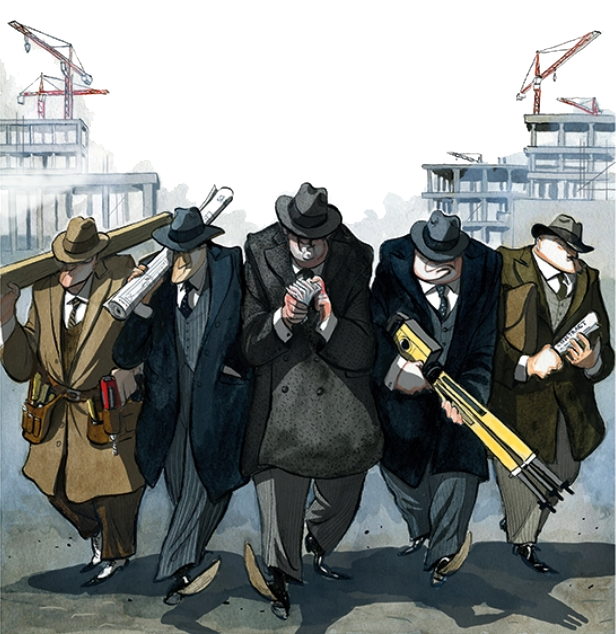

‘It’s basically a dictatorship,’ one insider tells me. If you want to build anything in Britain’s second city, you have to get permission from the so-called ‘Manchester mafia’. These are the officials who have overseen the city’s extraordinary redevelopment. The number of towers in Manchester has increased sevenfold since Andy Burnham became mayor in 2017.
You might assume that Burnham is the boss of this mafia family. But you’d be wrong. ‘He just appears at the meetings and says, “Yes, yes, that’s fine”,’ explains a source. ‘His political involvement is minimal,’ confirms Andrew Teacher, a real estate adviser who’s worked in the city. ‘The ship was motoring along well before he arrived.’ The vast redevelopment had almost nothing to do with Burnham.
In fact, much of the foundation was laid by George Osborne. The coalition government worked with the true mob boss of Manchesterism, the late Sir Howard Bernstein, chief executive of the city council from 1998 to 2017.
Bernstein apparently used to insist that developers use Deloitte as their planning advisers. ‘I run a property company, not a council,’ he was once heard saying. Just days after leaving his job there, he took up a non-exec role in Deloitte’s planning department.
Bernstein died in 2024 but his legacy, and his consiglieres, still exert control. His son was involved in the purchase of what will become ‘No. 10 North’, currently a derelict retail park on the edge of the city centre. The council paid £100,000 for his advice.
‘In the Bernstein era, Bernstein himself, Richard Leese and Dave Roscoe were essentially the people who pulled the strings,’ says a source close to the council. Roscoe is still calling the shots from the planning department, which he has run alongside his wife Julie since the 1970s.
During the pandemic, Roscoe did a charity workout for the NHS from his living room. Among the £20 and £30 donations from friends was another payment: £50,000 from Salboy Limited, a Manchester developer owned by Betfred founder Fred Done. Those who know Roscoe say he has quite a reputation. ‘He’s a hardass,’ says one. A city developer told me Roscoe has a habit of putting his feet on his desk during meetings.
A few years ago, the planning officer appeared on a panel about development in the city. A man in the audience put his hand up and said: ‘There’s this perception that you’re only allowed to use certain architects or certain planning consultants when you work in Manchester. What do you think of that?’ Roscoe replied: ‘Who asked that question? What was your name?’ My insider thought: ‘You’re never going to get work in Manchester again.’
Look at the list of developers in the city and you’ll see the same five names again and again: Renaker, Property Alliance Group, Salboy, Relentless, Select Property Group. Renaker was the main beneficiary of the £300 million loan pot provided by the coalition government, a relationship that has come under scrutiny.
Earlier this summer, a rival developer, Weis Group, took the council to court, arguing that Renaker had been given preferential interest rates. The case was thrown out, but the sense of chumminess remains. The Greater Manchester pension fund, which contains civil servants’ pensions, has invested tens of millions of pounds in Renaker.
‘It’s referred to as the Manchester mafia for a reason, but I don’t think that in itself is dodgy,’ explains Teacher. ‘It’s just the nature of how the business world works. People want to do business with people they know and trust.’
So what can we learn about Manchesterism from the way the city is built? Burnham seems perfectly happy letting the civil servants run the show, as long as he gets to take the credit at the end. I ask a developer what happens to those who don’t want to live under the diktat of civil servants. ‘If you’re not in the little special gang, they will hound you out of town.’






Comments