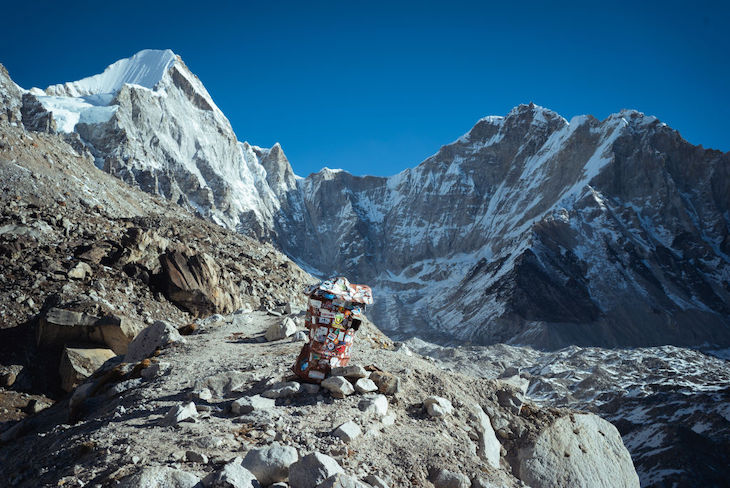
In May this year, two Indian climbers died on Mount Everest’s southern slopes in Nepal. Arun Kumar Tiwari reached the summit but developed acute mountain sickness (AMS) on the descent and died at about 8,790 metres. His teammate, Sandeep Are, also collapsed but was dragged down to Camp II by five Sherpas only to succumb to altitude sickness there.
Both deaths were tragic. Both were, in my view, avoidable.
Around 200 bodies are still believed to remain on Everest. Some are hidden beneath snow and ice while others lie where hundreds of climbers walk past them
After 22 years working for the Himalayan Database, the archive of expeditions in the Nepal Himalaya, I have seen the same pattern again and again. Summit fever has an extraordinary ability to override signals from the body. Climbers ignore headaches, confusion and exhaustion because the summit is tantalisingly close. Nobody should die of AMS on Everest, yet many still do.
Are’s body could be flown down by helicopter from Camp II and returned to his family. Tiwari’s could not. Recovering a body from nearly 8,800 metres is one of the most dangerous undertakings, and one of the most expensive. Faced with the staggering cost, his family decided to leave him where he lay, saying they were happy for him to remain in “Lord Shiva’s abode”.
It struck me as a wise decision, even if hundreds of climbers later that season had to squeeze past his body. Not every family reaches the same conclusion. While some accept Everest as a final resting place for their loved ones, others seek to bring them home – even decades later.
Later this year, Dorje Morup – better known as Green Boots – is reportedly due to be recovered from Everest’s Tibetan side. Morup, a member of the Indo-Tibetan Border Police expedition, died high on the northeast ridge during the disastrous storm of 10 May 1996 that claimed eight lives and became immortalised in Jon Krakauer’s Into Thin Air. His lime-green Koflach boots protruding from a small alcove near 8,500 metres turned him into one of Everest’s best-known, and maybe most macabre, landmarks.

For years, expedition leaders would tell clients: “If you haven’t reached Green Boots by a certain time, turn around.”
I often wondered how Morup’s family felt knowing that their beloved son, husband or brother had ceased to be a person and turned into a waypoint. Had he returned safely from the summit, I doubt that anyone outside his family would ever have heard of him.
Green Boots was moved out of sight in 2014, but for decades, nobody could say with certainty who he was. Only last year did DNA testing confirm that the body belonged to Dorje Morup rather than his fellow climber Tsewang Paljor which finally gave the family the certainty they needed. It is entirely understandable that now they want to bring him home. What is not so understandable is whether that certainty justifies the risk involved in retrieving him.
Around 200 bodies are still believed to remain on Everest. Some are hidden beneath snow and ice while others lie where hundreds of climbers walk past them. Recovering a frozen body, which can weigh up to 200kg including climbing gear, from the death zone is among the most arduous jobs on the mountain. Every recovery puts Sherpas and other high-altitude workers at risk. Estimates suggest recovering Morup could cost between $100,000 (£75,000) and $150,000 (£110,000), assuming the Chinese authorities even grant permission. Helicopters are out of the question. They are not permitted in Tibet, and even if they were, no helicopter could simply pluck a body from 8,500 metres.
Everest is littered with stories, but a few have become mythology. None more so than those of the legendary British climbers George Mallory and Andrew Irvine, who disappeared into the clouds in 1924. More than a century later, the mountain still guards its biggest secret: whether the pair ever reached the summit. When Mallory’s well-preserved body was discovered 75 years later, the search team did not bring him home. At his family’s request, they performed a Buddhist ceremony and left him where he had rested for three-quarters of a century.
Everest, however, has not always been so accommodating to its dead. The first German woman to reach the summit, Hannelore Schmatz, also became the first woman to die there. She succumbed to exhaustion during her descent in 1979 after attempting to help a fellow climber. An effort to retrieve her body five years later ended in tragedy when two Nepali high-altitude workers fell to their deaths. For more than two decades, climbers passed her frozen body, slumped against her backpack with her eyes open and her hair blowing in the wind until she was eventually swept down the Kangshung Face.
Then there was Francys Arsentiev, who became the first American woman to summit Everest without bottled oxygen in 1998 only to succumb to AMS during the descent. Resting peacefully as though asleep, she became known as Sleeping Beauty until mountaineers moved her body out of sight nine years later.
Yet even such poignant endings do not settle the question of what Everest owes its dead and what it demands of the living. In 2006, South Tyrolian alpinist Hans Kammerlander was outraged when Nepal’s Ministry of Tourism refused to refund his $2,000 (£1,500) rubbish deposit after the body of his climbing mate remained on the mountain, effectively classifying him as litter.
Today, perhaps, we have become less willing to leave death alone. Modern technology encourages us to believe that every body can be recovered, every tragedy tidied away, every ending given closure. But Everest does not always cooperate.
Morup’s family has good reason to want him back. Thirty years is a long time to wait. But I wonder whether the greatest respect would be to let him remain where he took his final breath. His body no longer confronts passing climbers. His family now knows his fate. Must others now risk their own lives to move him from one resting place to another?
Sometimes peace lies not in bringing someone home, but in allowing them to stay where they fell: in what some regard as Shiva’s abode.




Comments