
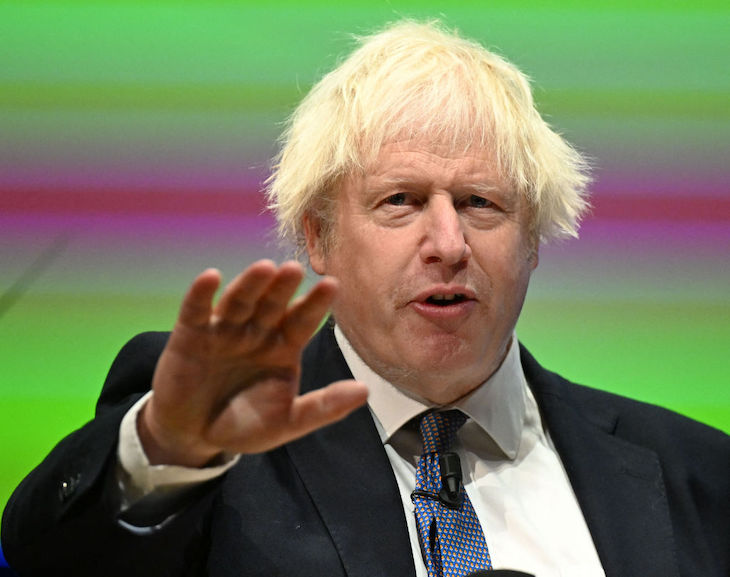
Boris Johnson is one, under the merry Tory veneer. Bill and Hillary Clinton were pioneers. Barack Obama is one – he seemed not to be at first – then he seemed happier cutting Netflix deals than trying to inspire a tricky nation. Peter Mandelson is very much one – his comment about being intensely relaxed about people getting filthy rich is gliberal holy writ. But Tony Blair is not one – the earnestness wins out. Almost everyone who appears on or runs television or radio is one.
The Gliberal can tell you the best vinyl shops in Tokyo and the best restaurants in Bologna. But not the name of their next-door neighbour
Gliberals are glib liberals. They are liberals who fail to see that liberalism is a deep and earnest matter, in which the human soul is involved. They think it’s pretty obvious that people should be free to make money and live as they choose, and that any seeming harms in this worldview will come out in the wash.
Are gliberals the same as neo-liberals: socially progressive believers in global free markets? This is their political identity; I am drawing attention to their cultural identity. For gliberals are not just defined by their politics. Gliberalism is a way of life.
They are atheists on the whole, though they mostly have the sense to avoid the topic, which can easily ruin a good dinner-party. They affirm all religions equally, which is not very much.
They have no inkling of evil. They suppose that the social problems of the planet would be solved if everyone had attended Harvard Business School. They are reluctant to admit that life contains serious questions of morality, for surely economic growth is the only gold-standard moral cause, and it seems to absorb all sorts of amoral behaviour, like a magic sponge, and make them irrelevant.

They are citizens of anywhere, but get offended if you point it out to them. For they want their wide experience of foreign places to be a mark of authenticity. They can tell you the best vinyl shops in Tokyo, the best restaurants in Bologna. But possibly not the name of their next-door neighbour, even though she once helped with the Airbnb people.
On the family front, they tend to raise children with behavioural problems, which normally clear up in the teenage years, just in time for Oxbridge. They are half proud of having children diagnosed with this or that – it’s normal in their circles, thank goodness the old stigma has gone. It’s almost a sign of having better things to do than raise children with old-fashioned, time-consuming, career-stifling care. If people have to be employed to limit the damage of their offspring, well that is a way of spreading the wealth, and also helping the kids see the benefits of immigration.
They are relaxed about culture. There’s always been a lot of smutty trash on telly, it’s a harmless by-product of freedom. I remember Boris Johnson once writing about being on holiday with some other families and finding it ridiculous that a fellow parent wondered if the children should be watching Sex and the City. Now I think I know who you are, I felt: someone who is defiantly relaxed about culture, who sees such indifference as a sign of strength. In fact, the credo of gliberalism could be summed up thus: intensely relaxed about people getting filthy rich and also intensely relaxed about people offending against what used to be called ‘public decency’.
Talking of Sex and the City, their spiritual home is New York. They like its sassy humour and its radical open-mindedness, and complete unstuffiness. (Why on earth are the English still half in thrall to the attitudes of their grandmothers?) They know a lot about Dylan and post-punk bands, and films. Books are fine, but haven’t they sort of been replaced by box-sets and podcasts?
A certain type of gliberal claims to see through the neoliberal order, which he complains about a lot. But his complaints are still basically gliberal. He laps up satirical panel shows in which earnest traditional values are mocked and contemporary orthodoxies are slightly mocked but basically upheld. In fact, this is a root cause of gliberalism: the satire boom of the sixties.
Another type of gliberal claims to see through progressive orthodoxies, and to favour Tory values, but when real life intrudes he goes with the flow. For example, he makes politically incorrect jokes about ‘the whole trans thing’, but if little Flora wants to become Florian he defends their choice with the zeal of the convert.
Some will be thinking: you just mean liberals. No. Liberals used to have a hinterland of depth and angst and care. Look at Gladstone. I know that’s going back a bit, but he still defines the non-glib liberal. He championed liberty, but tensely, knowing that it was a risk, for his religion warned against the expansion of mere license. If liberty is not rooted in a moral vision, it devours itself. Thatcher was in this tradition, but she faced both ways. She sensed that gliberalism was good for the economy, so she held her nose and promoted it.
By the way, some of our institutions remain liberal but not gliberal. The Church of England is worthy and anxious in its liberalism, quite rightly. The monarchy too, on the whole. And in a way Number Ten has repented of its housing of a certain aforementioned gliberal, and has made up for it with a few earnest types, for better or worse.
Liberalism is in crisis, according to a steady stream of predictable books. But it will not revive and rout the populists by means of experts explaining its virtues as a political ideology. We know all about that, and chat about it changes nothing. It will revive when it turns on its inner weakness, which is its cultural complacency. The non-glib liberal – the unashamedly earnest liberal – sees that liberalism must be rooted in something more substantial than itself. That probably means religion. For liberalism, as we know it, is a sort of semi-religion. It says that there is enough meaning here, in this mix of individual liberty, a vague humanism, and a cheery sense of humour. There isn’t.





Comments