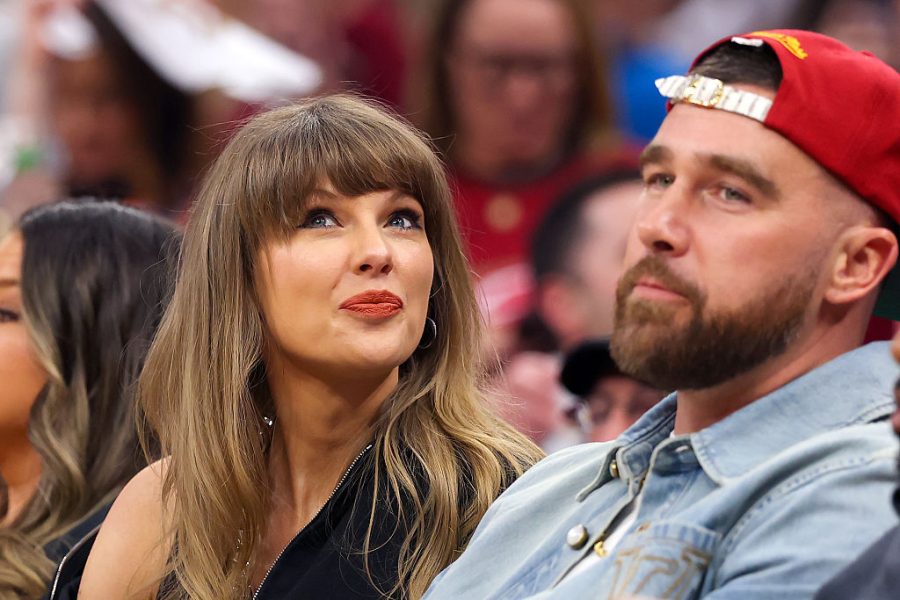
Taylor Swift’s wedding – a multi-day extravaganza kicking off in earnest at New York’s Madison Square Garden arena later today – is the most American event anyone could have ever dreamed of. Many might be curious as to why Swift, a billionaire with unlimited access to any wedding venue in the world, would choose such a Gatsby-esque approach rather than opting for a private affair with close friends and family. But Swift is known for her marketing genius, and her wedding is no exception.
Swift couldn’t have timed her wedding to the American football player Travis Kelce better than to take place on the 250th anniversary weekend of the declaration of American independence. While the official ‘Freedom 250’ celebrations have struggled to capture the nation, all eyes are on the happy couple and the love story which signifies so much about US culture. The multi-Super Bowl-winning quarterback marries the biggest pop star of the 21st century. No matter our politics, one thing unites Americans – they all love love.
Britain, of course, invented the royal wedding. We have the genuine article: medieval abbeys, actual castles, hereditary monarchs. When Prince William married Kate Middleton in 2011, Westminster Abbey had already witnessed nearly a thousand years of British history. Generations of kings and queens had been crowned and buried there. The building itself was older than the US.
We need Taylor Swift to go where prime ministers and presidents will not
America simply hasn’t been around long enough to rival that history. So Swift has done what she does best and created an imitation. She has reportedly built her own ‘castle’ inside the arena – but with better parking, mod cons, and corporate hospitality suites than any original British one could offer.
That somehow feels entirely appropriate. On the one hand, the entire spectacle is gloriously, unapologetically tacky. Yet on the other, there’s something timelessly hopeful about the proceedings. Miss Americana has found her Heartbreak Prince. The national girl next door, marrying the boy on the football team. Amidst all the chaos of a divided United States, something good and beautiful and permanent remains at its social core: marriage.
At 250 years old, this was never a given. For the better part of two decades, popular culture across the US, UK and the rest of the West has treated marriage as faintly embarrassing. A generation of women were taught by Cosmo magazine and Sex in the City that being a good modern woman meant putting career, travel, and self-discovery first – chasing corner offices and trips to Bali, not commitment and ‘settling down’.
The numbers tell their own story. Marriage on both sides of the Atlantic has fallen dramatically over the past half-century. Here in the UK, pensioners are more likely to marry than young men, with marriage falling by almost 100 per cent for young people over the past 50 years. More than half of babies in England and Wales are born outside marriage – a remarkable reversal from the 1970s, when it was fewer than one in ten.
When women do get married, they’re choosing to do so later – and marriage is increasingly concentrated among wealthier, better-educated citizens while declining sharply elsewhere. That class-bound inequality should concern us all, no matter our politics. Married men and women consistently report higher levels of life satisfaction than their unmarried peers. They are generally less likely to experience chronic loneliness, more likely to enjoy long-term financial stability and better health, and more likely to raise children who flourish educationally and economically. Kids from broken homes are far more likely to face poverty, poor mental health and even incarceration.
Of course, no statistic guarantees an individual’s future, and no marriage is immune from hardship, but the pattern is remarkably strong. The decline of marriage is impossible to separate from the modern West’s most prominent hardships – endemic mental health crises and rising crime statistics included.
Headlines frequently warn us about collapsing birth rates, an epidemic of loneliness, declining trust between the sexes, and widening inequality. No politician is bold enough to consider tackling marriage decline for fear of looking too old-fashioned. In fact, Keir Starmer’s Labour government has recently dismantled the institution further, granting unmarried co-habiting couples of three years or more the rights and privileges usually reserved for those in a legal marriage union, including when it comes to property and inheritance. The government has signalled that marriage is just a frivolous, expensive add-on party – undermining the institution that has underpinned society for centuries.
Perhaps, then, we need Taylor Swift to go where prime ministers and presidents will not. Love her or hate her, nobody can deny the tremendous influence the megastar has on young people around the world. Swift once embraced the worldly view of feminist hedonism – claiming on her track ‘New Romantics’, ‘we are too busy dancing to get swept off our feet!’. But when the shine of materialism wore off, her later albums raged against the men who had failed to commit to her, writing in ‘So Long London’: ‘You swore that you loved me, but where was the proof? I died on the altar waiting for clues.’
Now that Swift has found the happy ending to her ‘Love Story’, perhaps her life can be a lesson to the millions who follow her every move. It might just take an unlikely democrat-leaning American superstar to inspire the West and make marriage great again.






Comments