

James Delingpole has narrated this article for you to listen to.
I tried to think, Pointless-style, of two of the countries least likely to be participating in the world kicky-ball nonsense. Then I burst into the sitting room to annoy Boy. ‘Quick! Quick! We’re missing Haiti vs Burkina Faso.’ He looked up contemptuously from the sofa. ‘Actually, Haiti are playing right now. Against Morocco. So that’s another of your comedy fails.’
Sixty years in I don’t think I’m ever going to get a handle on this football malarkey. I first realised I was different in my first week at boarding school. All the other eight-year-olds owned a football and knew how to play with it and had even been taken by their dads to matches. I was the one who knew the Latin name for the common wall lizard.

For years, I used to think of it as a handicap, not knowing about ‘the thing that you have to be interested in if you hope to fit in’. Now I recognise it as a superpower, a kind of Cassandra-like gift to discern truths that most mortals deny: that football is not just boring and pointless but a sinister elite-control mechanism.
This might sound like a conspiracy theory but suppose you ran the world: how would you go about keeping all those billions of mere latrine-fillers under the cosh? Well, one way would be promote a ‘sport’ at once mesmerising and divisive. So, while you were busy doing all your evil stuff – importing rubber dinghies full of unassimilable immigrants, wasting trillions on net zero, getting everyone teed up for having their sons fed into the meat grinder of another unnecessary war, etc. – the cannon fodder would be too busy painting themselves in the colours of their national ‘team’ to notice that they were being had.
I’ve noticed various TV commentators referring to it as the ‘beautiful game’ as if this were some kind of unassailable truth. Beware of such phrases. It’s like when the NHS calls itself ‘the envy of the world’, or when the BBC assumes the lovable mantle of ‘Auntie’, or when the works of Banksy are described as ‘art’ or ‘trenchant social commentary’. If it were true they wouldn’t need to keep insisting on it.
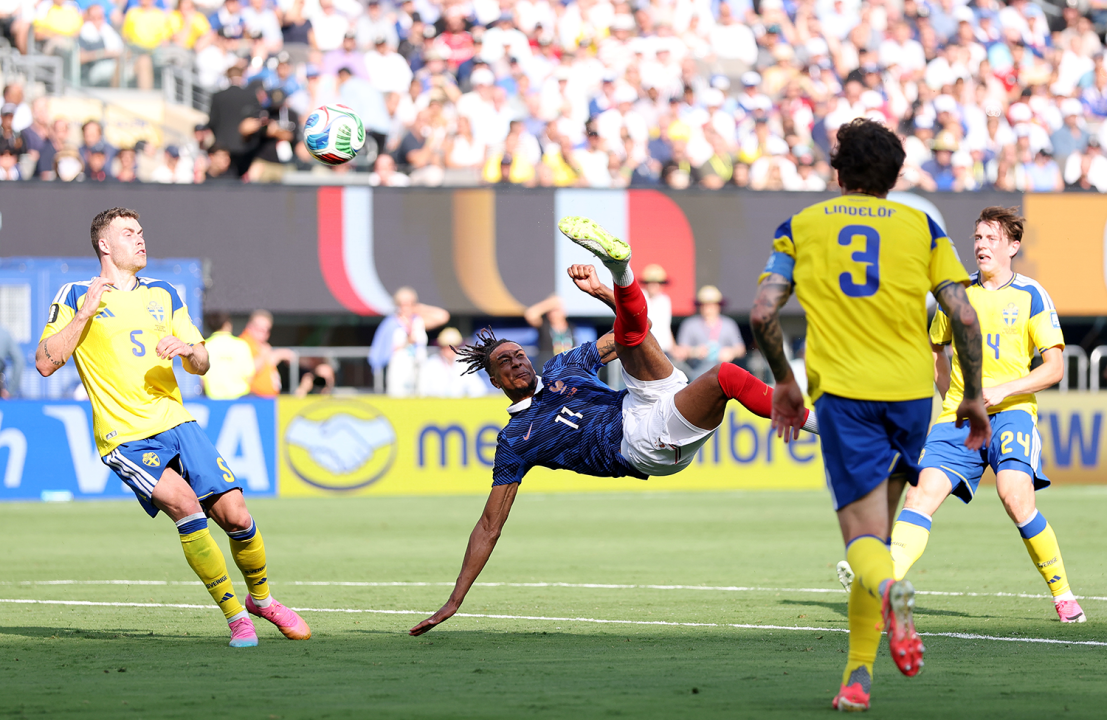
Try watching football with the sound turned down, as I did with the England vs Panama match – edited highlights, obviously: I’m not stupid. The excitement, you realise, is largely a product of the crowd’s collective hysteria (which is why they had to pay those busloads of girls to shriek at the Beatles’ Shea Stadium gig), and of the expert, intonational manipulation of the commentators’ yelping, which magically transforms the dross of a lacklustre tap towards the goal mouth into almost-gold. Just two goals from the side drawn from a population of nearly 70 million against a nation of 4.5 million. They might be your team but they are definitely not mine.
Personally, I’ve been rooting for Iran to win. At least I was till they fell victim to some quite possibly dubious VAR and refereeing decisions. Maybe I’m wrong – I’m no expert, you may have gathered – but it seems to me that built into the modern game (just like in the other major bread and circus events from F1 to the Super Bowl) are so many opportunities for micromanagement and chicanery both on and off the pitch that they could rig the result in almost any way they wanted.
To stop you noticing this stuff, footie Big Brother bombards you with relentless messaging about how very much you love the game and how inextricably it is bound with your happiness. This is where celebrities get to whore themselves for dosh. One of the reasons David Beckham has become football’s first billionaire is because of all the World Cup adverts he has been doing: McDonald’s, Stella Artois, Adidas, Home Depot.
Football is not just boring and pointless but a sinister elite-control mechanism
Gordon Ramsay, meanwhile, is happy to negate everything he has ever taught us about the importance of good eating by fronting an ad for Uber Eats. ‘Who could cook at a time like this?’ asks the irascible, crevice-faced carrot top, materialising in people’s kitchens as they’re about to prepare proper evening meals, rather than ones laced with rapeseed oil, refined sugar and MSG brought to them in sweating boxes by an illegal on a scooter. I hope the money was worth it, Gords.
As well as corrupting all it touches, footie tends to drag into the limelight the kind of people who, for all our sakes, would have been much better left living under a rock. In a parallel universe, where the beautiful game is unknown, Gary Lineker is a popular Leicester costermonger, a job to which his charm, conversational skills and intellectual hinterland are well suited. But in this one, for some bizarre reason, he has a media empire, including a Netflix show called The Rest is Football in which he and a trio of males resembling East End criminals who’ve been scrubbed up and groomed so as to impress the judge at a remand hearing pontificate stiltedly about passing little.
There hasn’t been space, unfortunately, for me to address the recent, decreasingly escapable, increasingly fanatical and terrifying promotion of the role of women in football. But perhaps this is just as well.




Comments