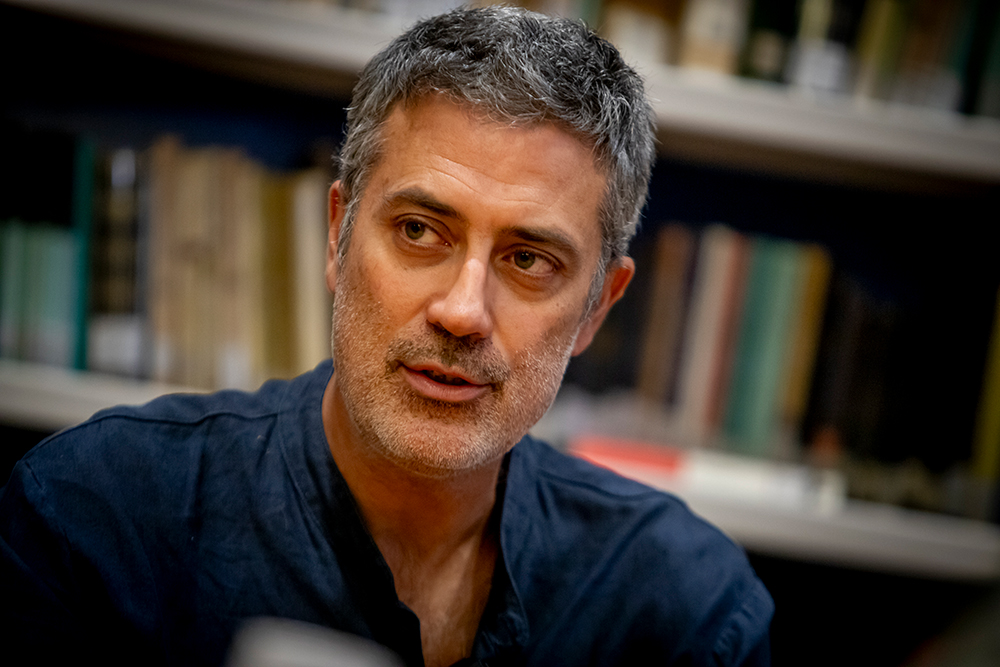
Andrea Bajani’s short novel The Anniversary won Italy’s Premio Strega prize last year and has since become an international bestseller. It is narrated by a 51-year-old man who, ten years earlier, cut all ties with his family, and who, on the anniversary of that audacious and purifying move, looks back and tries to make sense of the events that led to it.
It is a deliberately simple story, of considerable and radiating power. In tight, short chapters, a portrait builds up of a family dominated by an abusive father. References accumulate less to incidents than to the overwhelming atmosphere of dread between those incidents, ‘the looming threat that tightens our throats’; ‘a constant sense of impending danger… the possibility that everything would suddenly, for reasons we couldn’t understand, burst into flames’. What is registered more than the moments of actual violence, which later receive a devastating summary almost in passing, is the effect on the other family members, cowed into silence or complicity, and bearing, it is implied, permanent damage.

The dominant metaphors are infernal. Fires, explosions – points of light which become the only visible thing, casting everything around them into darkness. The narrator, his mother and his sister live in the shadows, deploying varying survival techniques. In contrast to the motif of fire and flame, the coolness of the narrator’s prose represents both a mastery of childhood trauma and the evidence of its lasting effects. Much of the book is focused on the mother, trying to retrieve her overshadowed and obliterated figure, an act often requiring imagination, the novelist’s art. But also barely visible are the narrator himself and his sister, about whom astonishingly little is said – just enough, in fact, to make the silence itself suggestive.
Despite the narrator’s traumatised self-doubt – ‘It’s still not clear to me whether my father actually hit my mother,’ he writes, when it is quite obvious that he did – he scrupulously makes evident what a monster his father was: a fascistic tyrant who turned the family home into ‘an internment camp’. Related political metaphors recur throughout. The narrator’s domestic situation arguably parallels the political turmoil in Italy between the 1970s and the 1990s. Interestingly, Aldo Moro’s assassination, the Years of Lead, and the ‘strategy of tension’ are all fleetingly mentioned, and although Bajani doesn’t spell it out, that ‘strategy of tension’ – fear as an instrument of authoritarian control – is surely a metaphor for the abusive home.
Might the novel be partly a covert political allegory? The narrator does at one point suggest that members of the Italian diaspora are motivated by a desire to be ‘far away from their families’, and that the primacy of the family in Italy is, among other things, a reason for governmental instability.
But the triumph of this short, sometimes heartbreaking book is its patient attention to human psychology; and its narrator’s attempt at fair accounting is a constant riposte to the totalitarian monomania of his father. Late in the book, the narrator learns that ‘one way to express violence was through destruction, but that another way… was through precision’. Lethally judicious, The Anniversary lingers in the mind long after you close it.






Comments