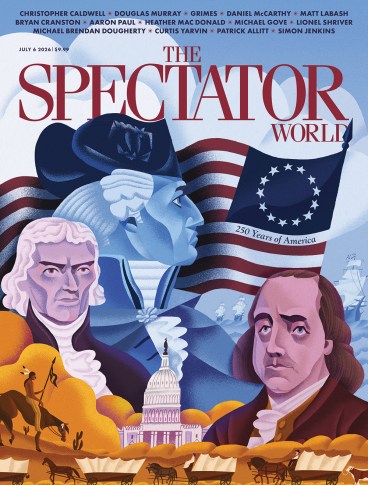
Whatever shape the 250th anniversary celebrations take, two things are certain. First, they will very prominently feature our 47th President and, second, there will be fervent renditions of “The Star-Spangled Banner” at every opportunity.
Whereas Donald Trump will not face any time limits on his oration during his headline slot at the promised rally on the National Mall – he has two and a half centuries to cover, after all – the anthem-singing will be cut short, as usual, after one verse, and will certainly not extend to the third, which expresses the fervent hope that, “no refuge could save the hireling and slave; From the terror of flight, or the gloom of the grave.”
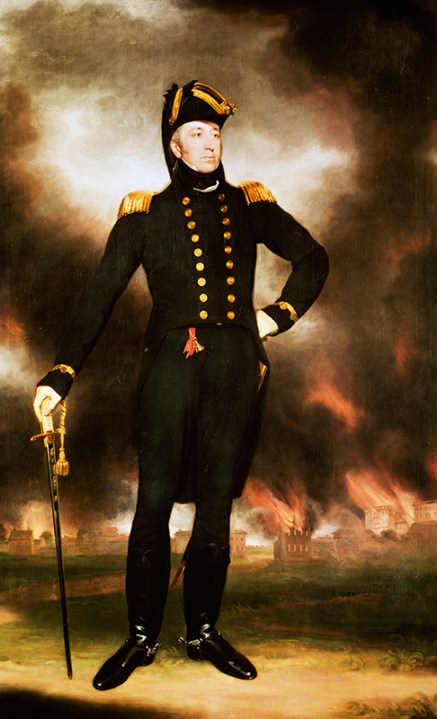
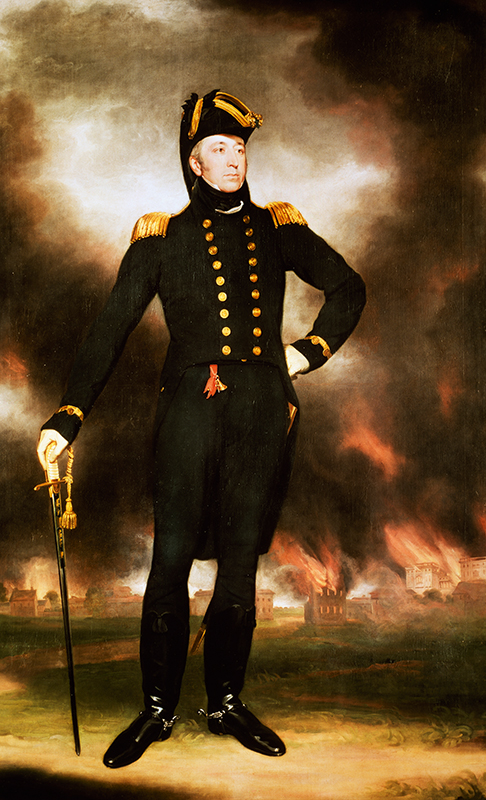
For me, the words always evoke a glow of family pride. Francis Scott Key’s malign desire that fleeing slaves should find no refuge was directly inspired by the actions of my distinguished relative Admiral Sir George Cockburn of Britain’s Royal Navy. In August 1814, he fought his way to the White House at the head of an army partly composed of slaves he had freed, armed and trained – and torched the place, along with the Capitol and much of Washington.
Horatio Nelson, Britain’s greatest naval hero, would soon praise the young officer’s ‘zeal and courage’
Over the course of a two-year campaign, he rescued as many as 6,000 slaves and, despite Key’s hopeful verse, not to mention angry demands from the US government, sailed them away to freedom. Obviously, the admiral qualifies as one of the great emancipators, and I am proud to claim a family connection (Cockburn was my great-great grandfather’s first cousin).
There were some familiar aspects to the War of 1812, given that it was what we today call a war of choice. It was launched by then-president James Madison in the hope of conquering Britain’s Canadian colony, thought to be easy prey while the British were distracted by their life-and-death struggle with Napoleon. Not for the last time, expert opinion predicted a walkover.
“The acquisition of Canada this year, as far as the neighborhood of Québec, will be a mere matter of marching,” wrote Thomas Jefferson soon after war was declared. A fellow ringleader of the war party, Henry Clay, assured Congress that “the militia of Kentucky are alone [able] to place Montréal and Upper Canada at your feet.”
Things did not go to plan – especially since the military was woefully unprepared and led by incompetent commanders. The Canadian expedition ended in disaster and large portions of Maine and Michigan fell under enemy occupation. By the time Britain agreed to call it a day, the bitterly divided United States was war-weary and on the verge of bankruptcy.
By then, George Cockburn was the most hated man in (white) America, vilified in the press as the “great bandit.” Cockburn, the scion of a Scottish landed family ruined by his speculator father, had entered the navy at the age of 14. From then on, he was almost continually at sea – and, once France’s war with Britain broke out in 1793, frequently in combat. This conflict, initially waged against revolutionary France and then against Napoleon, was essentially the first “world war,” fought across much of the globe and offering plenty of opportunities for a tough, ambitious professional such as Cockburn.
At 23, he was already a captain in command of a 215-man frigate. Horatio Nelson, Britain’s greatest naval hero, would soon praise the young officer’s “zeal, ability, and courage, which shine conspicuous on every occasion which offers.” (Cockburn also rates praise in Patrick O’Brian’s Aubrey-Maturin novels, being described as “the best sort of naval gentleman” by Maturin.)
By 1813, when he first arrived in Chesapeake Bay, Cockburn was 41 years old and a rear admiral. His mission was straightforward: to inflict as much damage as possible on this economic heartland, thereby dissuading pro-war Democratic-Republicans (as opposed to antiwar Federalists) from their rash attack on the British Empire. “I have no hesitation,” he wrote to a superior officer, “in pronouncing that the whole of the shores and towns within this vast bay, not excepting the capital itself, will be wholly at your mercy, and subject if not to be permanently occupied, certainly to be successively insulted [raided] or destroyed at your pleasure.”
This ruthless scheme, which Cockburn was to follow to the letter, would have been impossible without first-class intelligence operatives to alert his raiding parties to enemy forces and guide them around the tortuous shoreline. Fortunately, volunteers for such a mission soon appeared: slaves.
At first they were single men, eagerly welcomed by the British as the pilots and guides they needed. But the numbers quickly grew as entire families made their way to the ships. At this point the invaders made a crucial decision: they would accept any slave – man, woman or child – and guarantee they would never be handed back to their owner.
When Cockburn and his fleet returned to Chesapeake in the spring of 1814 after wintering in Bermuda, he was determined to take full advantage. His orders read: “Let the landings you make be more for the protection of the desertion of the black population than with a view to any other advantage… The great point to be attained is the cordial support of the black population. With them properly armed and backed with 20,000 British troops, Mr. Madison will be hurled from his throne.”
On May 29, 1814, horrified planters had their first look at the next stage of the British scheme. A raid on Pungoteague, on Virginia’s Eastern Shore, featured the Colonial Marines, a regiment of former slaves armed and trained on Tangier Island, Cockburn’s base in Chesapeake Bay. Their ragged clothes had been replaced with bright red uniforms and they were eager for battle, rapidly putting the defending militia to flight. “I was highly pleased with the conduct of the Colonial Marines,” reported the raid’s commander. “Every individual of which evinced the greatest eagerness to come to action with their former masters.”
Cockburn, delighted with his recruits, noted happily that they excited “the most general and undisguised alarm” among the populace. He was certainly correct. “Our negroes are flocking to the enemy from all quarters, which they convert into troops, vindictive and rapacious – with a most minute knowledge of every bye path,” wrote an American commander in early August. “They leave us as spies upon our posts and our strength, and they return upon us as guides and soldiers and incendiaries.”
Raids along the coast in the spring and summer of 1814 left dozens of towns, plantations and stores burned, with livestock and freshly harvested tobacco carried away. Yet these were merely precursors to Cockburn’s ultimate plan to strike at the heart of the enemy by raiding Washington itself. This, he calculated, would be a devastating psychological blow, discrediting the Madison administration and drawing enemy troops away from Canada. Furthermore, the Americans had burned York – as Toronto was called in those days – so this could be billed as justified retaliation.
The advance on Washington, with the Colonial Marines very much to the fore, was launched in the third week of August. As Cockburn had predicted, the American defenses were in a sorry state; a hurriedly assembled militia was swiftly routed on August 24 at Bladensburg, on the outskirts of the capital.
Key, who as a militia officer had been busy offering unsolicited advice to the American commanding general, was among those stampeding back to the city and beyond. Only an improvised US naval artillery unit, partly manned by free black people, made a stand. With Washington now at his mercy, Cockburn contented himself with destroying public buildings, such as the Capitol, military installations and the offices of the National Intelligencer.
To his disappointment, he could not burn the newspaper’s offices, off-limits as private property, but instead commanded his sailors to “smash all the C’s, boys, so the rascals cannot any longer abuse my name!” His ultimate goal was the White House, from which Madison had fled a few hours before, followed by his wife, Dolley. (Late in life she revealed that the admiral had, in the months prior to his attack, been sending her lubricious mash-notes, deposited by his agents in the White House postbox.)
His work as liberator has gone unrecognized in the United States
Cockburn and his party helped themselves to a lavish dinner ordered by Dolley in expectation of an American victory, and collected souvenirs (though they were barred from taking valuables, on the grounds that would constitute looting). Cockburn himself took the First Lady’s chair cushion, remarking lewdly that it would be a reminder of her “seat.” Then they piled up the furniture and torched the place.
Following the subsequent failed attack on Baltimore that inspired Key’s verses, Cockburn moved south to harry the Georgia planters from a new base on Cumberland Island, and rescued more slaves. The motive for his rescue work clearly went beyond military expediency – he continued to encourage fugitives up to the last days of the war, and indeed into the peace.
Despite angry American insistence that the peace treaty mandated the return of all property (i.e., former slaves), Cockburn bluntly refused to hand them over and shipped everyone off to Bermuda. Most eventually settled in Canada, but the Colonial Marines accepted an offer of land in Trinidad. Settled in villages, each under the command of their company sergeants from the old regiment, they were known as the Merikins. Their descendants live there to this day.
Cockburn, who was knighted following his successful exertions in the American war, was given the important assignment of bringing the defeated Napoleon to his exile in St. Helena. Promoted again, ultimately to overall command of the Royal Navy, he entered politics, becoming a member of parliament and serving as a naval minister in a number of reactionary Tory governments.
His work as liberator has gone unrecognized in the United States; my suggestion to the director of the National Museum of African-American History that Cockburn, or at least the Colonial Marines, deserved some honorable mention, was rejected out of hand.





Comments