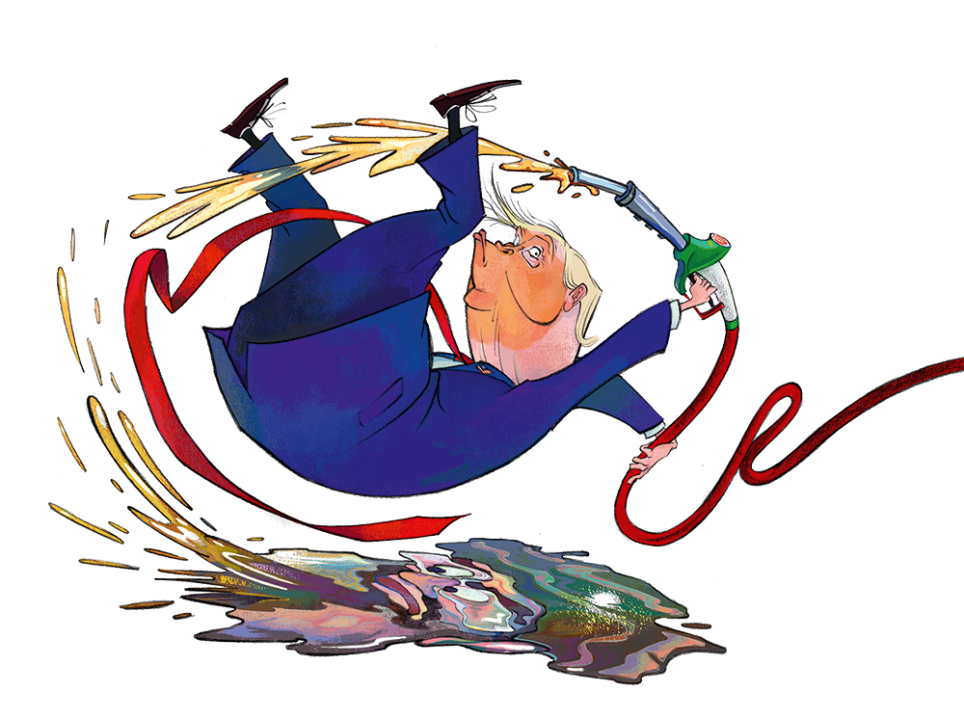
Clarissa Eden famously declared that ‘in the past few weeks I have really felt as if the Suez Canal was flowing through my drawing-room’. Does Melania Trump feel the same about the Strait of Hormuz? Or perhaps Donald will be reminded of the strait every time he hits one over the water at Bedminster. He ought to be. The Iran war will define his presidency. It is his legacy – just not in the way he imagined.
In 1956, a British prime minister discovered that we were no longer a great power. It was an end to illusions. We liked to think we had the best navy in the world, but that was irrelevant to whether we could keep a canal in Egypt. Today, the United States has the most powerful and expensive military in history, but it cannot impose its will on a country with the world’s 34th-largest economy.
There is a crucial difference between Suez and Iran. Anthony Eden folded because the US threatened to cause a run on the pound (something to remember if you are sentimental about the ‘Special Relationship’). No outside power forced President Trump’s climbdown. His voters wouldn’t put up with gas at $4.50 a gallon; he expected ‘bedlam’ when America’s strategic petroleum reserve ran out. He ‘choked’, as he would say.
The problem for the President is that there are diminishing returns for his crazy talk
That Iran would close the strait and that this would damage the global economy was both predictable and widely predicted. Trump still seemed surprised by these developments. Now – in a familiar pattern – he has retreated into a fantasy version of events. At the weekend, he posted on his Truth Social: ‘BEST ECONOMY EVER! Greatest Military in the World, by far. We are WINNING on all fronts, WINNING LIKE NEVER BEFORE.’ Aneurin Bevan’s verdict on Eden comes to mind. If Trump is ‘sincere’, he is ‘too stupid’ to be President.
The Memorandum of Understanding (MOU) – agreed with Iran as a basis for talks – represents almost total capitulation by the US. Trump, who knows little and cares less about history, actually signed this humiliating document at Versailles. (Was Emmanuel Macron trolling him?) Oil sanctions will be lifted; Tehran will get $24 billion in frozen assets; there will eventually be a $300 billion reconstruction fund. Trump used to attack Barack Obama for sending ‘pallets of cash’ to the mullahs. The nuclear deal Obama negotiated gave them enough money to cause mischief around the region. Now they will be swimming in cash to give to Hamas and Hezbollah.
Trump went to war over Iran’s nuclear programme, but the MOU puts off that question. Iran’s ballistic missiles – another reason for the war – are not in the agreement. The text does not restrict Iran’s support for its armed proxies. And of course regime change has been abandoned. Trump now praises Iran’s ‘new group of leaders’ as ‘smarter’ and ‘far less radicalised’ than before. ‘They love their country,’ he says.
Trump did succeed in killing hundreds of Iran’s senior leadership. Their deputies or assistants stepped into their shoes. Contrary to what Trump says, younger replacements are often more radical, and certainly more energetic. That was the lesson from killing Taliban commanders in Afghanistan. Assassinating your enemies can be counterproductive.
Trump has spent at least $40 billion waging a war to replace one Ayatollah Khamenei with another. Ali Khamenei, the ‘cautious chess player’, is dead. His fatwa against weapons of mass destruction, whatever it was ever worth, died with him. The man now in the Supreme Leader’s chair, Mojtaba, is seen as more hardline, more willing to take risks. He also watched his father, sister and a niece all die in a missile blast.
Khamenei has not been seen since that explosion. He is apparently badly injured. Statements are issued in his name – there’s no face, no voice. But he may still be in charge, and so we should try to work out his thinking. His mentor in the seminary was the cleric most identified with apocalyptic Mahdism, the belief that eradicating Israel will return the hidden Twelfth Imam, leading to a final battle between good and evil, Judgment Day, and a kingdom of peace and justice on Earth.
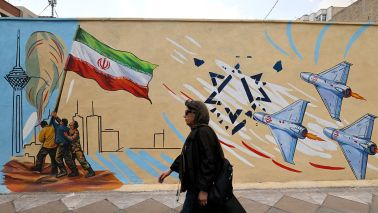
This is one ideological current in the mullahs’ regime, and we don’t know how much Khamenei junior buys into it. One of the statements issued in his name predicts that Israel will not exist within the next 15 years, calling it a ‘cancerous tumour’. This repeats Khamenei senior’s statement in 2015 that Israel had only 25 years left – so until 2040. There is even an hourglass in Palestine Square in Tehran showing just over 5,000 days remaining for the Jewish state. But this is not a promise that Israel will disappear under an Iranian mushroom cloud; it’s a prediction that it will collapse on its own.
If the Iranian leadership is not purely a death cult working to cause the apocalypse, then it is susceptible to deterrence. Israel has hundreds of nuclear weapons, against the handful which Tehran could produce if it achieved nuclear ‘breakout’. The regime may now try to sprint to obtain the bomb, having drawn a lesson from the recent conflict that possessing one might be the best way to guarantee its survival. The Americans never attacked North Korea, did they?
The war that was meant to stop an Iranian nuclear bomb has strengthened its rationale for building one, or several. The trouble is that having just a few bombs makes it more likely they will be used in the event of hostilities. Stable mutual deterrence, the balance of terror, means having a large enough arsenal to survive a pre-emptive strike. Otherwise, it’s use them or lose them.
And having that nuclear umbrella could free Iran to use its militias around the region. The bet would be that Israel wouldn’t dare to escalate against a nuclear armed state. A nuclear Iran could be destabilising without ever using the bomb.
This is the world bequeathed by Trump’s abandoned war against Iran. It’s an argument for pushing ahead for regime change; on the other hand, it’s also an argument that ditching the Obama nuclear deal was a mistake. Trump would find it psychologically impossible to admit that. The moment he resolved to run for president may have been at a White House Correspondents’ Dinner where he was mercilessly mocked by Obama.
Still, he is conflicted about the peace talks he so obviously and desperately needs to succeed. He has called the MOU he signed only last week ‘just an option’, saying: ‘I can do whatever I want after that option.’ The US might seize control of the Strait of Hormuz permanently, he said, collecting some of the oil passing through it.
Is this the usual Trump bluster? A leading Republican hawk, Senator Lindsey Graham, said he’d spent four-and-a-half hours with Trump and believed he was serious about taking control of the strait if the peace talks failed. Then the US would, indeed, charge a fee to tankers. And: ‘If Iran contests control of the Strait of Hormuz by the United States, we will obliterate them.’ Trump said the same on the phone to Fox News, warning Iran he would ‘blow the shit out of them’ if they closed the strait again. He went on, addressing the Iranian delegation at the talks: ‘You won’t have a country… You won’t even make it back to your fucking country.’

The Iranian officials took this both personally and seriously. For a moment, it looked as if the talks might collapse. The problem for Trump is that there are diminishing returns for his crazy talk. And the Iranians know they just have to lay a few mines and lob a few missiles to close the strait. To prevent that, the US would have to seize parts of the Iranian coast. That is the kind of creeping ground war for which Trump has shown he has no stomach.
Trump loves bombing things and has said: ‘It’s amazing what bombs can do.’ It’s also important what they cannot do. They cannot force a determined and fanatical enemy to obey. The mullahs have been quite prepared to watch their country burn as the price of staying in charge. The US has had a lesson in the limits of military power, and Trump has left Iran more dangerous than before.
The journalist and historian Keith Kyle wrote of Suez: ‘On 26 July 1956, the British Empire received a blow from which it would never recover.’ History’s verdict on Trump’s Iran war will be just as harsh.



Comments