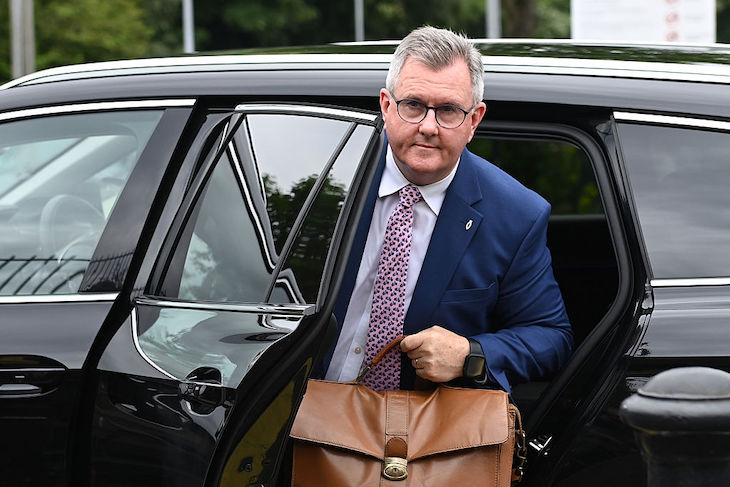
Former DUP leader, Sir Jeffrey Donaldson, was found guilty of eighteen counts of child sex abuse, including rape, at Newry Crown Court. The jury also found that his wife, Lady Eleanor Donaldson, aided and abetted his offences against the two victims. Due to problems with her mental health, though, she faced only a ‘trial of facts’, which tested the evidence but did not result in a criminal conviction.
Whether voters punish the DUP for allowing a paedophile to influence its policies for two-and-a-half decades will become apparent next May
It would be impossible to exaggerate how shocking this verdict is to the Ulster public. Donaldson has been a household name in Northern Ireland for the past three decades.
In the wake of the Belfast (Good Friday) Agreement, he played a critical role in the rise of the DUP and the decline of David Trimble’s Ulster Unionist party. The Lagan Valley MP resigned from the UUP in 2003, alongside Fermanagh MLA Arlene Foster, having spent five years fighting the party’s leadership from within.
The pair’s decision to join the DUP entrenched its new-found position as the dominant unionist party in Northern Ireland; it edged ahead of the UUP for the first time in the Assembly election of November 2003, just a month before Donaldson and Foster defected. The addition of anti-agreement politicians, who were regarded as moderate and articulate, allowed the DUP to move on from its image as a party of unbending, Paisleyite hardliners.
The thoughts of most people will properly be on the ordeal suffered by Donaldson’s victims, as well as the dignity and courage they showed during the trial. Donaldson insisted to the end that he was innocent and effectively accused them of concocting a story against him.

Inevitably, though, there will soon be speculation about what this means for the DUP, for unionism in Northern Ireland and for the stability of the devolved executive, which has collapsed repeatedly since it was first formed in 1998.
Before his arrest in March 2024, Donaldson spent his final months as party leader brokering a deal with Rishi Sunak’s government that restored power-sharing at Stormont. The DUP ended a two year boycott of the devolved institutions in Belfast on the basis that its Safeguarding the Union agreement had effectively removed the post-Brexit Irish Sea border and resolved issues with the Windsor Framework.
Donaldson viciously attacked unionist critics who claimed that the deal would bring about only cosmetic changes to trade barriers between Great Britain and Northern Ireland, while leaving the province under swathes of EU law. The then DUP leader even gave an impassioned speech in the House of Commons, implying that his opponents had stirred up a dangerous mood that resulted in him being threatened with violence.
This apparent bid for sympathy inspired the Social Democratic and Labour Party (SDLP) leader at the time, Colum Eastwood, to claim that those who menaced Donaldson, “couldn’t lace his boots.” The former MP’s plausible and sincere manner did not just take in his unionist colleagues, but nationalist rivals as well.
It was left to Donaldson’s successor as DUP leader, Gavin Robinson, to retract the party’s claims that it had removed the Irish Sea border and stopped a ‘pipeline’ of EU law to Northern Ireland. The deal with the Conservatives, he eventually admitted, had been ‘oversold’. However, he insisted it represented ‘progress’ towards resolving problems with the Windsor Framework.
The DUP will be relieved that Donaldson’s conviction is not likely to be followed by a quick election
The DUP will be relieved that Donaldson’s conviction is not likely to be followed by a quick election, even though many of its staff and representatives are clearly shaken by the revelations about its former leader. The next Stormont poll is due to take place next May. Gavin Robinson will hope that the new Labour leader decides against calling a snap general election in the interim.
The DUP’s most vociferous critic from within unionism, Jim Allister of the Traditional Unionist Voice (TUV), wasted no time in speculating that Donaldson may have been compromised during the negotiations to restore Stormont.
“It is inconceivable that the government was unaware of his proclivities and the idea of such being used as leverage is far from fanciful,” the North Antrim MP wrote in a social media post, asking “How far did his ‘troubles’ give rise to his sell-out on the (Northern Ireland) Protocol?”
This is an insinuation that, were it to gain traction with the public, could undermine the fractious power-sharing executive at Stormont. The devolved government in Belfast is currently led, nominally, by Sinn Fein, which is the largest party. With the support of other Irish nationalist MLAs and so-called ‘progressives’ in the Alliance party, it can muster a majority in the Assembly on many controversial issues. Arguably, the DUP’s most important role is currently to moderate the instincts of this coalition of convenience, using power-sharing safeguards to veto its wilder proposals.
Whether the DUP can maintain its position as the largest unionist party after the next Stormont election, or whether voters punish it for allowing a paedophile to influence its policies for two-and-a-half decades, will become apparent next May.
Donaldson, meanwhile, left Newry Crown Court in an armoured van. From being one of the most important power-brokers in Northern Ireland politics, and a significant figure at Westminster, he is destined to spend his next years in Maghaberry prison.




Comments