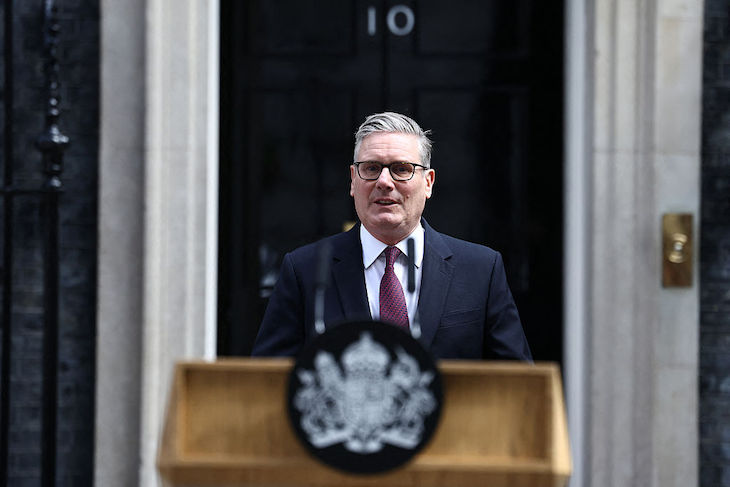
Keir Starmer has set out his timetable for leaving office less than two years after winning a landslide 174-seat majority. He was voted in on a promise of change but failed to deliver it. He said his election would ‘stop the endless Conservative chaos’ but delivered Labour chaos instead.
Election
Starmer was elected in a loveless landslide, with the biggest gap between the share of votes won and share of seats won in post-war history. Labour got 9.2 million votes. In 2017, Jeremy Corbyn got 12.9 million.
Popularity plunge
His popularity soon fell – lower than any recent prime minister’s, and faster than any except Liz Truss. What made him so unpopular?
Winter fuel
Rachel Reeves announced cuts to winter fuel payments in the same month Labour was elected. That announcement from the Chancellor, and Starmer's response to riots after the Southport murders the same day, ended the PM’s brief honeymoon period. A U-turn and restoration of the £300 bung to pensioner households with incomes of up to £35,000 couldn’t reverse the decline.
Manifesto vs budget
Starmer’s popularity dropped further with his Chancellor’s first Budget. Before the general election, he had declined to set out how he would deliver the change he promised and deal with the problems he saw in the country – and he and Reeves certainly didn’t seek a mandate for tax-and-spend: Labour’s modest manifesto had just £8.5 billion of tax rises and £10 billion of extra spending.
Reeves’s Halloween budget had tax rises that were almost five times as big, in large part a rise of employers’ National Insurance. That raised questions about whether Reeves had broken the manifesto commitment to ‘not increase taxes on working people, which is why we will not increase national insurance, the basic, higher, or additional rates of income tax, or VAT’.
Reeves came back for more in her second budget, extending the income tax freeze (something she had said would ‘hurt working people’), making her the biggest tax-raising chancellor since Denis Healey.
The first reset
In December 2024, after a tough first few months, Starmer tried to reset his premiership with a ‘Plan for change’ which included three foundations, five missions and six measurable milestones. He said these specific pledges would ‘give the British people the power to hold our feet to the fire’. But plans for an online dashboard to track progress were abandoned and Starmer lost interest in the milestones.
His record on them is mixed. The pledge to raise real household disposable incomes will be hit by the wave of inflation caused by the war in Iran, while the aim for the highest sustained growth in the G7 is not forecast to happen – instead, we’ll be in the middle of the pack. Even though Britain has economic catching up to do, the idea of overtaking the powerhouse US economy’s growth rate while raising taxes on jobs, expanding workers’ rights and pushing ahead with cost-raising net zero policies always seemed fanciful.
Building 1.5 million homes in England over the parliament would require an average of 300,000 a year. Labour’s first year saw just 208,600, and the Housing Ministry’s estimate for 1 April 2025 to 31 March 2026 is just 199,500.
The target on health – to have 92 per cent of routine operations within 18 weeks, has seen some progress, as have targets on early-years education and having 13,000 extra neighbourhood police on the beat.
Successes
Starmer had other successes that weren’t in that list of goals. Net migration fell from 649,000 in the year before Labour won the general election to 204,000 at the last count.
He said he would smash the gangs and stop small boats. He hasn’t succeeded in stopping them, but this year crossings are lower than at the same point in 2025, 2024 and 2022.
By some measures, earnings – even accounting for inflation – have been higher than a year ago every month since Labour came into office. (However, the total real-terms increase since then is just one per cent.) Between May 2010 and June 2014, the same was true only half the time.
Rents rose at the slowest pace since 2022.
But Starmer barely tried to take ownership of these modest successes. He didn't make people think that was in charge, and despite presenting himself as a grown-up, people don’t think his government was running the country with any more seriousness and competence than Boris Johnson and the previous Tory government.
Welfare ‘cuts’
In March last year, Liz Kendall announced plans to slow the rise in the benefits bill: disability benefit eligibility would be tightened and the award for the health element of Universal Credit would be cut for new claimants, saving around £5 billion a year by 2030. But Starmer didn’t make the case for the reforms to his MPs or the country. More than 100 Labour MPs backed an amendment to kill off the cuts, and the proposals ended up so watered down that the savings disappeared.
Election failures
After the disaster in the Gorton and Denton by-election in February, when Labour came third, behind the Greens and Reform, in an area that had been red for 100 years, Keir Starmer had a last chance at the local elections. But of course he couldn’t turn things around in three months. He was a liability on the doorstep and lost 1,500 council seats in England. The party’s projected share of the vote (what it might have got if local elections had been held across all of England) fell to 17 per cent, half the figure in 2024.
The party’s MPs stopped asking whether, or when Starmer should go and started saying it should happen now. A week after the local elections, Josh Simons resigned as an MP so Andy Burnham could run. And now Starmer is on his way out.




Comments