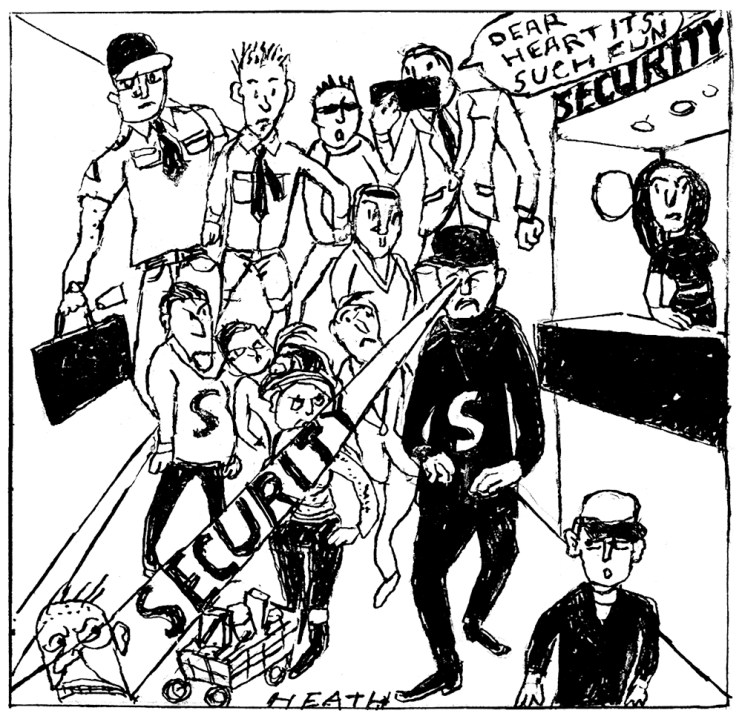
The Harrow Council ‘enforcement officers’ might have been more extreme in their language than other members of the Fake Fuzz, but their arrogance was entirely typical. Uniformed security guards are appearing everywhere. Shops, pubs, train carriages – the wannabe rozzers are there, in your face, vests bulging, walkie-talkies at the ready. They glower and loom, filling your day with bad vibes and absurd rules.
It’s unclear what started the argument in Harrow, but the member of the public whose video went viral last week was told by the two officers not to ‘butt in my business’, then ordered to come to a nearby alleyway where one of them would ‘show you what time it is’. Needless to say, the man refused the offer. The guard continued: ‘I swear, when I’m not in uniform, I’m going to knock you the fuck out and rip your teeth out.’

While most Fake Fuzz operatives are less aggressive than this, their condescending self-importance is all the more irritating for its stupidity. Retail parks often employ them, as do individual businesses. A shop in my town has an entry gate, about three yards inside the door, one of those waist-level things that open automatically. Except it doesn’t anymore, so you have to push it.
The other day it was manned by the shop’s FF. He was a classic of the genre – middle-aged, stocky, not exactly over-burdened with personality. He opened the gate for me (no smile). I thanked him (still no smile). Having discovered that the shop didn’t have what I needed, I returned to the gate. ‘You have to leave through the tills,’ said FF. This meant a detour of 40 yards.
‘But the exit’s right there,’ I said, pointing to the other side of the gate. ‘It’s store policy,’ he responded. I asked why. ‘Health and safety,’ came the inevitable answer. ‘What does that mean?’ I asked. ‘Two people have been hurt,’ said FF. ‘A child was hit in the face [presumably by the gate] and…’
At this point we were distracted by a woman approaching the gate from the other side. FF had to open it to let her in, but positioned himself to stop me walking through in the other direction. ‘You realise this is ridiculous?’ I said. FF countered that he was only saying what he’d been told to say. I asked if he’d tried telling the person who’d told him to say it that it was ridiculous. He repeated his previous statement. Realising it was pointless to waste any more time, I began walking towards the tills, telling him as I went that he sounded like an arse. ‘I’m only doing my job,’ he called after me. ‘Yes,’ I replied, ‘doing it like an arse.’
‘Right,’ he responded. ‘You’re barred. Language.’ By now I was laughing. My detour brought me to the other side of the gate, where FF was waiting. ‘Everyone has a right to do their job without abuse,’ he said as I left the shop for the last time. This has become a go-to argument of the grievance generation. Express the slightest irritation with them for being irritating and you’re the one in the wrong. Whereas any right-thinking person would realise that if it’s got to the point of someone calling you an arse, the fault might be with you and not them.
The Fake Fuzz accompany the ticket inspectors on my trains into London in gangs of three or four. OK, if a fare dodger gets violent, the inspector will need support. But what the FF never remember is that almost every passenger they encounter is an honest, pleasant person, whose money is paying their wages. A smile would be nice – or even making eye contact (not that you’d know with the ones who insist on wearing sunglasses, to really give it the full Men in Black). But the FFs obviously feel that such human touches would reduce their authority.
The wannabe rozzers glower and loom, filling your day with bad vibes and absurd rules
In this, they’re 100 per cent wrong. The very best security guards know that their strongest weapon is never having to appear strong. Humour, charm, getting someone on your side before things can turn ugly – these are their favoured tactics. Any nightclub bouncer worth his salt knows that a successful night is one where you don’t even get close to using violence. FFs, on the other hand, give the impression they’re doing you a favour by letting you be there at all.
Many pubs have taken to using Fake Fuzz. Not clubs, where things can get lairy at 2 a.m. – just bog-standard boozers. In my experience their guards tend to be slightly warmer in their welcome, more polite with their requests to (for instance) stay within a designated drinking area. But still their presence puts a dampener on proceedings.
I can see why shops need to tackle shoplifting, especially now that the real police have given up. But FFs should concentrate on the criminals. When dealing with normal customers they can ditch the Robocop routine. That shop I mentioned proudly boasts that it was established in 1895. I wonder what its founder would think of his successor’s employee? The founder knew that losing a customer was a failure. Fake Fuzz thinks that by barring me he’s had a success.






Comments