Sad songs hit harder, I find, when their meaning hangs just out of reach. Aside perhaps from the exquisite ache of Portuguese fado, there is no more desolate sound in the world than a lamentation in Scots Gaelic, sung in a language most of us can’t speak but conveying emotions we seem, atavistically, to somehow understand.
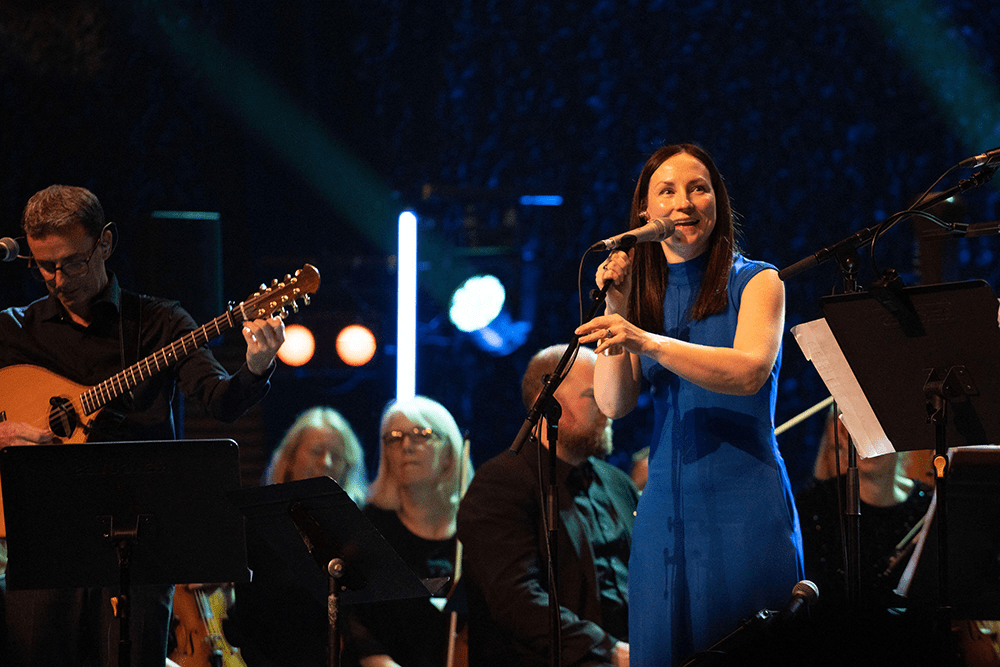
This became clear last weekend while watching Julie Fowlis, the internationally renowned singer from North Uist whose extraordinarily pure voice evokes the power, beauty and savagery of the Hebridean and Highland landscapes, but also connects to some even more profound and universal force.
Celebrating 21 years in the business with a short tour, and conducting proceedings with an air of brisk, humorous efficiency, Fowlis was performing with a gold-standard ensemble: Michael McGoldrick on flutes, Duncan Chisholm on fiddle, Tony Byrne on guitar and her husband Eamon Doorley on bouzouki; for one night only they were joined by Capercaillie’s founding member Donald Shaw, on piano, organ and accordion. Fowlis played the whistle and the shruti box, but it was her voice which became a spirit guide through the changing weather of the music, mapping out the emotional contours of each song.
Although her native tongue is Gaelic, Fowlis swims easily in the world of modern music. In 2012, she sang the theme to the Disney Pixar movie Brave, while her collaborators have included the writer Robert Macfarlane and US singer-songwriter Mary Chapin Carpenter. In Edinburgh, among songs about shape-shifting selkies, desolate swans and lovers sent away to sea, there were a couple of covers by Celtic rockers Runrig – including a too-treacly tilt at ‘Hearts Of Olden Glory’ – a sweet Gaelic reinterpretation of the Beatles’ ‘Blackbird’, and tunes from the BBC show Hebrides: Islands On The Edge. Like most trad musicians, she was excellent at setting up each piece with a brief introduction, including outlining the context of ‘Camarinas’, a meeting between the Galician and Gaelic tongues.
There were plenty of virile reels and creaky singalongs (Gaelic is not the most user-friendly language for such things), yet the highlights were the moments when the mists rolled in – as on the haunting tremors of ‘The Song Of The Seal’ and, later, on ‘Port Na h-Eala’, where Fowlis’s plaintive keen and the drone of the shruti box ululated like the wind and the waves. ‘Tha Mo Ghaol Air aird a’ Chuain’ featured a melody as old as time itself, while the hushed ‘Gradh Geal Mo Chridhe’ was dedicated to renowned Scottish accordion player, Fergie MacDonald, the ‘Ceilidh King’, who died in 2024.
As she explained, Fowlis was unable to attend his funeral and sent a recording of this song instead. The bewitching sounds that followed were wreathed in love and loss, yet it was not by any means a downbeat evening. The show took place hours before Scotland’s first world cup football fixture in almost three decades. Fowlis nodded to this momentous occasion several times but saved the clincher for the encore, when she rushed off stage and returned moments later wearing a Scotland top and blasting on the bagpipes. The back of her strip read: Fowlis 1. It was hard to argue.
Kraftwerk, too, are old masters of conjuring happy-sad emotions in a foreign tongue, albeit the medium and mode could hardly be further removed from Scottish traditional music. Formed in Düsseldorf in 1970, and with Ralf Hütter now the only original member left standing (behind a computer terminal, of course), in concert the group – ‘brand’ almost seems a more fitting word – remained an oddly heartwarming proposition, their unique form of electronic Euro-futurism as wistfully nostalgic and utterly contemporary as ever.
In this music, the ‘man’ is always at least as important as the ‘machine’
Their latest tour is a wholly immersive experience; the four musicians/technicians blending into the wider audiovisual spectacle as they stood behind their consoles. A cover of ‘Merry Christmas, Mr. Lawrence’ by Hütter’s friend and peer, Ryuichi Sakamoto, who died in 2023, emphasised the warmth and humanity lurking deep in the main frame: in this music, the ‘man’ is always at least as important as the ‘machine’.
As they revisited and recontextualised many of the tracks from their pioneering records, including the ‘The Model’ and a miraculous rendition of ‘Trans-Europe Express’, I realised why this band haven’t bothered making any new music for almost 25 years. They’re still waiting for the future they imagined half a century ago to catch up with them.





Comments