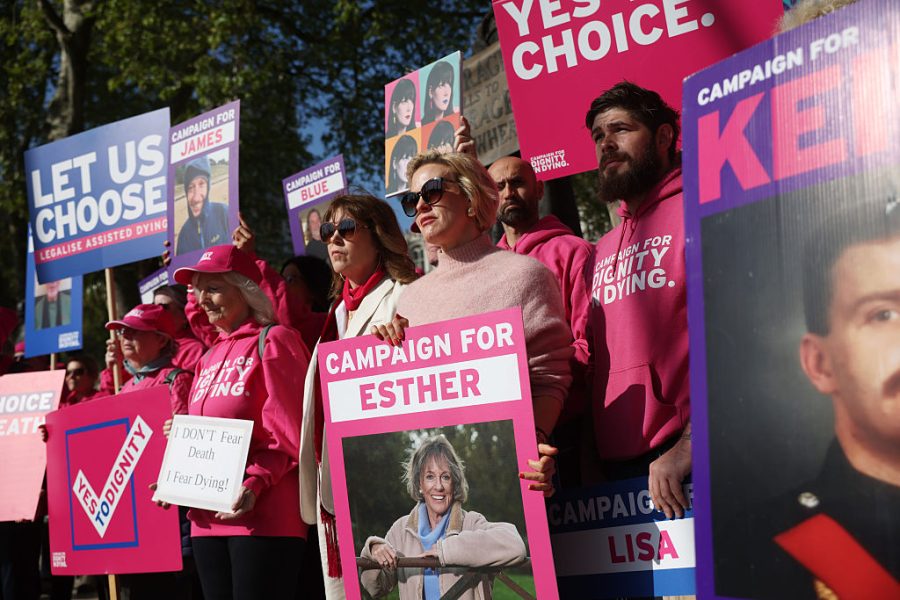
The Labour MP Lauren Edwards has confirmed she will reintroduce the assisted dying Bill in the Commons as a Private Member’s Bill (PMB). As a supporter of assisted dying, you might expect that I would be entirely in favour of this initiative. In fact, I have a number of significant concerns.
Edwards indicated that she will be introducing the same Bill (the Terminally Ill Adults (End of Life) Bill) that had previously been introduced by her colleague Kim Leadbeater in the last parliamentary session. Leadbeater’s Bill would have allowed adults over the age of 18 who were expected to die within six months to be given help to end their own lives, subject to certain safeguards.
That Bill passed the House of Commons, but it subsequently stalled in the House of Lords after a small number of peers tabled an immense number of amendments. Eventually, the Bill ran out of time and fell at the end of the session, as it could not be carried over into the next session.
With the issue of assisted dying, the essential point is to get it right, not to get it done quickly
Edwards argues that she is putting the question to MPs again on two grounds. First, whether mentally competent, terminally ill adults at the very end of their lives should be offered the choice of a dignified, pain-free death with all the protections and safeguards the Bill provides. Second, whether the decision of the elected chamber should be respected and not thwarted by the unelected House of Lords. It all sounds very reasonable, so what is the problem?
There are two interlinked issues in seeking to reintroduce the PMB in this way. The first is that the debate over the Bill in the last session exposed the fact that there were real concerns about the safeguards that had been included. While many of these may have been raised by individuals acting in bad faith (on the basis that they had principled objections to the legislation which could never be addressed by any safeguard), some issues clearly merited debate.

The original was a highly technical Bill; but because the measure was introduced through the PMB process, many of the details were left to be filled in later by the government. This is not appropriate when it is likely that the NHS would have to deliver this service and the taxpayer would have to fund it.
The Institute for Government quite reasonably highlighted the fact that the reliance on the PMB process demonstrated a lack of political leadership from the government. With a contentious and emotive issue such as assisted dying, the essential point is to get it right, not to get it done quickly.
Given that the Prime Minister is in favour of assisted dying, the better approach would have been to offer a free vote on a redrafted government Bill. This would have allowed for government-sponsored consultations and more extensive scrutiny than can be provided through the PMB process. It would also have allowed opponents to probe the government in detail on cost, delivery of the service and safeguards.
The second issue is the fact that, while Edwards has indicated that it is not her intention that the Parliament Acts should apply to the Bill, it is far from clear why she has reintroduced it in this way if this is not at least an implied threat. Notably, in her open letter, Edwards states:
There will be no need for that if peers complete their unfinished business in the normal way, but we cannot allow an unelected minority to frustrate the democratic process for a second time.
In order to benefit from the provisions of the Parliament Acts, a Bill must be passed in identical form by MPs twice in successive sessions. If this happens, and the procedure is invoked, then peers would be unable to block the Bill for a second time.
The weakness of this approach is that MPs would be unable to make any sensible new amendments to the Bill in light of the earlier debate if the Parliament Acts are to remain in play. So we would no doubt expect a lengthy period of scrutiny and debate in the Lords again.
This essentially feels like a game of chicken and, given that the Commons only backed the measure by 314 votes to 291 in June last year (a noticeable drop in the majority from when it was first debated in November 2024, from 55 votes to 23), there is no guarantee that the Bill will be passed this time around. If this happens, the consequences could be significant: it could delay the introduction of assisted dying for a generation.
This is the sort of legislation which needs to be introduced, as far as possible, through pragmatic compromise and consensus-building. It requires government involvement and concrete assurances so that those with legitimate concerns can be separated from those who have ideological objections to the very idea of assisted dying.
There is little point in simply decrying the House of Lords as being undemocratic. The scrutiny and revision of legislation is its primary job. Assisted dying did not feature in the Labour manifesto and the Bill did not benefit from the Salisbury convention (which says that the Lords should not block bills which give effect to government manifesto commitments). There was no constitutional impropriety in the approach it took.
In all likelihood, Sir Keir Starmer will be out of No. 10 before there is a resolution to this debate. But if he is looking for a legacy, he could do worse than trying to convince his Labour colleagues (particularly Andy Burnham) to throw their weight behind a free vote on a government-drafted Bill. It is the only sensible way to take this forward.






Comments