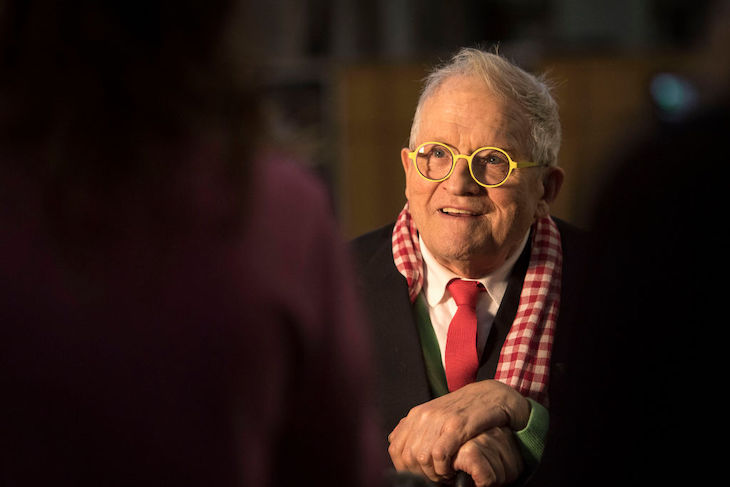
For six years, in the 1990s, I was David Hockney’s ex-pat English next-door neighbour in the Hollywood Hills. A rickety blue fence divided us as well as 18 years. I spent Christmas with him one year at his cottage in Malibu, me and twenty other men eating BBQ turkey in shorts and Speedos. We got to know each other pretty well, having some memorable adventures together in LA as mischief-making Brits who regarded the city as something of a playground. Neither of us took the Californian authorities especially seriously.
Hockney was certainly a rebel at heart. It came as little surprise when I later found out David was a Eurosceptic
My first thought on hearing of his death in London this week, aged 88, other than sadness at the loss of a friend, was not only that Britain had lost its “greatest living artist”. But two other points are worth making. David, perhaps more than any other artist, helped create the splashy pool-side dreamscape idea of Los Angeles as the new “Promised Land” in the world’s global consciousness.
He liked to say that when he arrived in the 1960s, he set out to become not a fleeting pop artist but an artist – like Canaletto in Venice, or Caravaggio in Rome – who captured Southern California’s suburban zeitgeist, its long afternoon shadows and its sexual spirit of place. He once said that when he arrived in the 1960s, he thought: “My God, this place needs its Piranesi. So here I am!”.
Hockney’s death also brings down the final curtain on the original cast members who were seduced by the post-war Californian Dream with its swimming pools, azure skies, palm trees, tanned bodies, and the promise of class, hedonism and sexual freedom, (before Aids) that had first lured so many to the US West Coast since the 1960s.

For a few decades, LA became like Paris or Berlin for European artist exiles like Christopher Isherwood, screenwriter Billy Wilder, comedian Billy Connolly (another neighbour), or English boulevardier restaurateur and art collector Peter Langan – for whom David drew art works for his restaurant. As Martin Amis’s narrator of Money, published in 1984, put it on first landing at LA’s airport: “California, land of my dreams and my longing.”
That California chapter is over. By the 1990s, LA’s ranks of ex-pat escapees included displaced British artists, aristos, screenwriters, singers, actors, Mid-Atlantic producers, Vons, Hons, pool party lizards, and other social fugitives – including many bohemian and creative gays, who craved escape from the stuffy, restricted, class fettered old-establishment world of London and Europe. Unlike old European types, this new Mid-Atlantic creative breed – often shuttling first class from LA/New York to London – travelled for the demands of their high-flying jobs.
This was the very opposite of David Hockney whose motivation to fly to California was driven by more carnal rather than career demands. He told me that a major reason for first moving to California in the 1960s was reading John Rechy’s 1963 gay hustler novel City of the Night which describes – in graphic detail – the sexual adventures of a gay hustler operating out of Downtown LA. He especially enjoyed a notorious gay bar in West Hollywood called the Red Raven, certainly not the type of place you’d find in Bridlington.
David used to talk of him being an “English Los Angeleno” and he was definitely never a Mid-Atlantic Man, or Mid-Atlantic Artist. He always proudly kept his Yorkshire accent. This was because his art was an extension of himself and he never had any doubts about who he was as an artist, nor his talent for that matter (although he was always modest and would introduce himself at dinner saying “I’m David Hockney”). He once told his close artist friend RJ Kitaj: “I’ve got Bradford; they’ll never take that from me”.
The difference between David Hockney, and say, David Frost, who also came out to America in the 1960s, was that Hockney wasn’t especially interested in money, fame, social mobility, or changing his class or status. He was always utterly down to earth and he never liked fancy power restaurants or A list Hollywood parties. He preferred to be at home, working in his huge studio close to his pool, and cuddling with his beloved dachshunds, Stanley and Boogie.
The other thing that made David different to most other ex-pat Brits in LA I knew, or at least those that I partied and hung out with as the Times’s young, twentysomething West Coast Correspondent – sharing a house next to David with Elizabeth Hurley for a while – was that David was only really obsessed with one thing: his work. He was an artist workaholic. I remember he was quite seriously ill for a while with a heart condition and his doctor had advised him to rest up. But he still used to “crawl into the studio” every day.
He lived for his art, his loves and his close friendships. He would occasionally go out for dinner with friends, and was generous in showing people around his studio, especially when he was working on the sets for various LA operas like Tristan and Isolde for the LA Opera. He kept a drinks fridge in his studio and would offer guests a cold glass of a good California Napa but he was never much of a drinker.
Smoking, however, was another subject all together. David liked to smoke and one of the reasons he left LA was because he couldn’t stand the ever-increasing nanny state of California telling people what to do health-wise. It came as no surprise to me that, towards the end of his life, David “came out” as being “bored of wellness” and launched an attack on this modern cult, describing it as “bossy” and “ridiculous”.
Part of the reason he moved back to East Yorkshire for around eight years circa 2005 was that he loathed what he called the “health police” in LA, especially in regards to smoking laws (despite his having a California Medical Marijuana Verification Card which allowed him to buy cannabis). David used to actively enjoy taking on the smoking authorities. When writer Auberon Waugh, whose daughter Daisy was living in LA at the time, came to his studio for a visit, David soon found out that Bron was as keen as smoking as David (usually Camel).
Eying up the Californian wine in David’s studio fridge, Bron asked him more about his cellar than his paintings. We then went out to dinner at a fancy restaurant on Wilshire Boulevard, which ended in us all being thrown out onto the street, with the threat of the police being called, when Bron and David both lit up and then refused to put the cigarettes out when challenged by the enraged maître d’. David found this sort of thing funny. He was certainly a rebel at heart. It came as little surprise when I later found out David was a Eurosceptic.
As neighbours, neither David or myself exactly lived in houses that fitted the usual LA healthy lifestyle retreat. Our little enclave was an ‘anti-wellness’ oasis. Cannabis and driving were not incompatible. He loved lighting up before taking me on his ‘opera trip’ of the Santa Monica Mountains – driving through Malibu Canyon – with Wagner played at near deafening volume from his convertible (David’s hearing was never good) while we enjoyed the sweeping canyon vistas in a cloud of his home-made rollie. I will play some loud Wagner and toast him.



Comments