
Matteo Giovanardi was navigating a midlife crisis amid a failed marriage and needing shelter when he moved into a medieval tower in the northern Italian city of Bologna. Rising over a small piazza, the tower topped out at 60 meters, its floors dirtied by pigeon droppings, its walls blackened with the soot of ages. Seven years passed before Giovanardi moved out. For he had found in this tower – the Torre Prendiparte – not only shelter but a salutary mission. “I needed to rinse away the pain, to imagine the rest of my life,” he tells me when I visit. “It is not only bricks. Prendiparte is a magical place.”
It was early in the 1990s when Giovanardi took up residence in the tower. Sleeping there at night, working weekdays in his family’s homeware business, he devoted weekends to what became a years-long renovation. He installed lights and sanded and painted the stairs. Centuries-old graffiti came to light as he scrubbed the walls. He consulted with engineers and architects, and hired tradesmen who rappelled like alpinists from the top of the tower to replace crumbling mortar.
What emerged is a bed and breakfast where guests know they are bedding down in the long-ago haunts of not only the eponymous Prendiparte family, which built the tower as a 12th-century urban citadel, but also other occupants brought here by the turns of history. Evident to this day, for example, is the misery scrawled on a wall during the years when the tower served as a prison: sepolcro dei viventi, meaning tomb of the living.
Prendiparte also serves as a spectacular backdrop for such events as a daredevil exercise called Bologna slackline. The line is extended from the top of Prendiparte to the bell tower of the city’s cathedral, San Pietro, 90 meters away. Walking barefoot and harnessed, one of the “trickliners” will drop onto the line, then swing himself into something like a headstand, legs skyward. Perhaps in that instant he tries to observe the cobbled pavements and gobsmacked crowds below, though he must know there are less strenuous ways to gaze upon this lovely city.

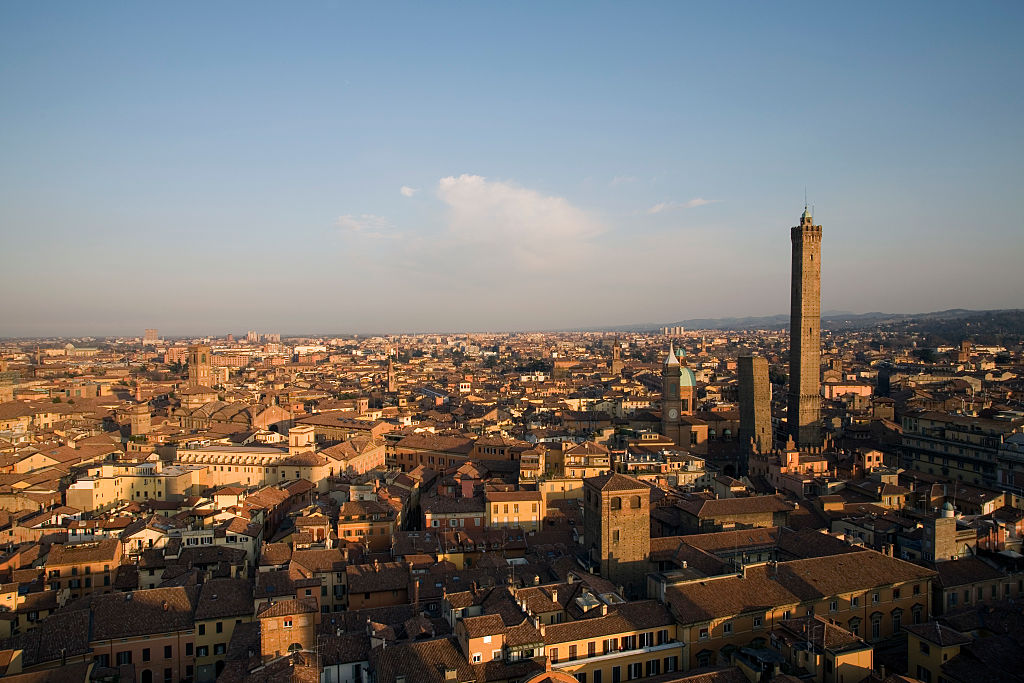
Prendiparte is a survivor of an age when Bologna was a medieval Manhattan. Some 80 towers – a conservative estimate – took shape here as wealthy families sought refuge from foreign invasions and streetfights among themselves.
The Prendiparte family were feudal landowners whose political ambitions gained them high office in Bologna and put them in alliance with the papacy during disputes with the Holy Roman Empire. After the tower lost its utility due to wars and local vendettas, the local church authorities took control and seminarians found in the recesses of Prendiparte a place for prayerful meditation. It was later that offenders of the church or the commune found there the place of their incarceration. Still other owners and occupants followed, among them two nuns, a sculptor and French troops who took the tower for themselves as Napoleon entered Bologna during his Italian campaign.
Today, only 24 towers still stand – some of them vacant, others finding use as shops and restaurants. The now-missing towers were either demolished or collapsed. The threat of another collapse is not altogether in the past. Torre Garisenda (48 meters tall) has been tilting since Dante noted it in The Divine Comedy and leans more than the Tower of Pisa. As Garisenda is an acute risk, it has been cordoned off. Complicating stabilization is the tower’s position in a busy commercial district and its adjacency to its twin, Torre Asinelli, the highest of all Bologna’s towers at 97 meters.
Long before Giovanardi made Prendiparte his home, he was surprised to find that, at the age of 18, he was its owner. The property title had immediately passed to him for tax-planning reasons when his father, Clemente, purchased it in 1972 and quipped: “It’s a tranquil place to read the newspaper without anyone being able to disturb me!” The young Matteo had his fun, too. He once held a séance inside for his friend, though at least on that night no ghosts appeared.
During my visit, Giovanardi is a genial host. He jokes that he learned English by listening to Led Zeppelin. Now and again pausing to puff on his pipe, he notes the heirloom furnishings and portraits of his stern-looking great-grandparents. Flights of stairs lead from the sitting room to a mezzanine bedroom, a kitchen and a dining nook, each on its own level. Only these lower floors of the 12 stories in the tower are for lodgings. Farther up are museum-like displays of medieval construction techniques and the Bologna skyline before most of its towers disappeared. Still higher are more stairs that eventuate in an open-air terrace at the summit.
I will not stay the night, but I would guess a quiet rest is ensured by the muratura a sacco construction: double brick walls sandwiching rubble. And yet might those ghosts – the spirits of Signor Prendiparte, the French soldiers, those wretched inmates – yet show themselves?
Who might further preserve Prendiparte, now not all that far from its second millennium? Giovanardi, aged 70 and living in the countryside outside Bologna, says his children have little interest in the project. He intends to retain his proprietorship of Prendiparte as long as he can reach the terrace under his own power. Decades ago, he and his youthful buddies would race up all 280 steps, using a stopwatch to compare their times. Now he progresses “step by step, little by little” and takes his reward in the exhilaration of those who arrive at the top alongside him. He assumes that I, too, would like to go up there. I would, though I resolutely decline an aperitif before the venture.
He leads. I follow. In its upper reaches, the stairway is open between the treads, ladder-like. The light dims. I yank on the bannister. It creaks. The trek ends as a cobalt sky explodes into view. The terrace is surrounded by a parapet resembling a crown. Hence Prendiparte’s nickname: La Coronata.
Before us stretches a panoramic view of Bologna, its towers and domes, its tiled rooftops in shifting hues of terra cotta. Hills on the southern horizon roll toward the Apennines and Florence. Vale la pena seems an apt phrase for the ascent to this moment – it’s worth the effort. Worth it indeed.
Rooms from €800 per night. For more information, go to prendiparte.it.






Comments