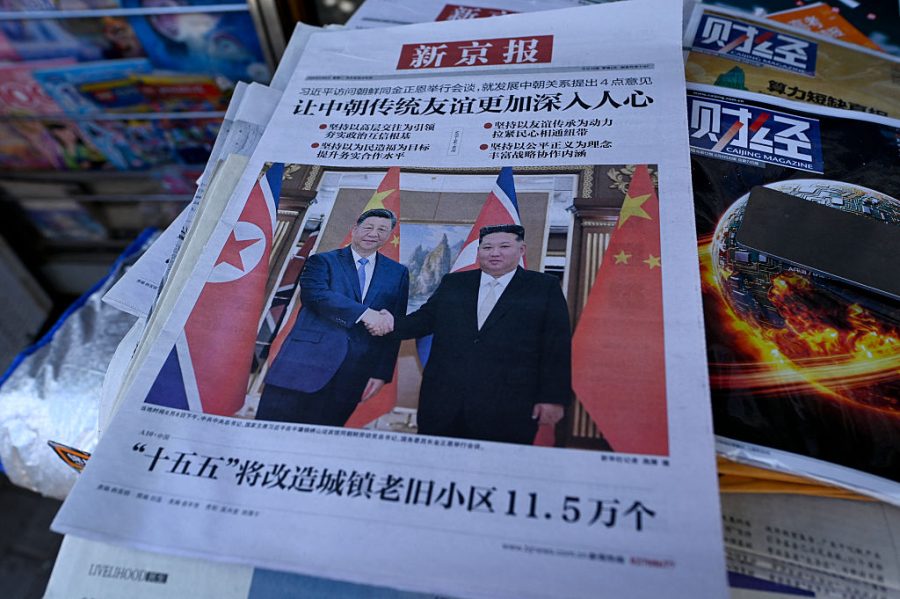
When Xi Jinping visited North Korea in June 2019 for his first state visit, he would not have expected nearly seven years later that the hermit kingdom would be in an alliance with Russia. As Xi concluded his second visit to the country yesterday, the Chinese president’s pledges to ‘strengthen strategic coordination’ and ‘uphold regional peace and development’ with his North Korean counterpart emphasized how Beijing wants to ensure that its northeastern neighbor does not cross any red lines. With Beijing having been Pyongyang’s largest economic partner for nearly two decades, Xi’s visit serves as a clear reminder to North Korea that China wants to maintain close ties and, crucially, ensure stability on the Korean Peninsula.
The streets of Pyongyang were festooned with flags of China and North Korea, banners praising the ‘eternal’ and ‘unbreakable’ friendship between the two countries, and portraits of Xi himself. Last September, Kim Jong-un invited his Chinese counterpart to Pyongyang, after the North Korean Supreme Leader visited Beijing for China’s Victory Day celebrations, where he stood watching the parade next to Xi and Vladimir Putin as if equals.
Nevertheless, Xi’s two-day sojourn to Pyongyang this week was no ordinary trip. The Chinese leader’s first overseas visit this year comes at a time when relations between North Korea and Russia have only been getting closer.
Nearly two years ago, Russia and North Korea signed a ‘comprehensive strategic partnership treaty’ which, in addition to committing to mutual defense, saw the two states commit to a fully fledged alliance and pledge to strengthen ties within and beyond the security domain. Cooperation in research and development, information technology, and even disaster management (to name but a few) were all outlined. When Russia’s Defense Minister, Andrei Belousov, announced in a visit to Pyongyang at the end of April that the Kremlin pledged to extend military cooperation with North Korea until 2031, the evolution of relations between the two would certainly not have gone unnoticed in the halls of Zhongnanhai.
Relations between China and North Korea have, historically, been anything but cordial
Relations between China and North Korea have, historically, been anything but cordial. Since diplomatic relations were established in 1949, five days after Mao Zedong declared the establishment of communist China, ties with China’s northeastern neighbor have been strained. China, akin to the Soviet Union, was an important economic patron for North Korea during the Cold War; Beijing infamously dispatched troops to aid North Korea during the Korean War. The two states also signed a mutual defense treaty in 1961, the only such treaty China holds with another country. Yet, over time, China’s frustrations with propping up a financially bankrupt regime which refused to open its economy as the Cold War ended became apparent.

This week, Xi made clear that Beijing ‘stands ready’ to ‘expand practical cooperation’ in areas including the economy and trade, agriculture, construction, science and technology. It was perhaps a not-so-subtle nod to Beijing’s slight discomfort at Pyongyang’s stubborn refusal to engage in any kind of economic reform.
In fact, Kim has only strengthened his clampdown on the social and economic opening up North Korea. Despite the resumption of rail and air travel between Pyongyang and Beijing following an almost six-year Covid-induced hiatus, Beijing – which accounts for over 90 per cent of North Korea’s trade – remains dissatisfied at its nuclear neighbor’s aversion to develop its economy even whilst retaining its North Korean characteristics.
Nevertheless, for all China’s annoyance, such irritation does not remain significant enough to warrant placing any direct pressure on North Korea to change its ways. Beijing’s uneasiness at the rapprochement between Pyongyang and Moscow has not been manifested in displays of ire.
Instead, China has continued to help North Korea evade sanctions whilst also fueling the Kremlin’s war against Ukraine through supplying dual-use technologies. Perhaps most importantly, and in contrast to Xi’s first visit to Pyongyang, this week’s trip made no mention at all of denuclearization. With expectations that Beijing would stay silent on the nuclear issue quickly materializing, China’s acceptance of North Korea’s self-declared status as a nuclear weapons state has been solidified in all but name.
Whether Xi’s visit will catalyze Kim to revive diplomacy with the United States remains to be seen. Yet, for all the trials and tribulations in the decades-long Sino-North Korean relationship, North Korea looks to continue leveraging its ties with China, Russia, and other less significant but friendly states (such as Laos and Vietnam) to reap rewards. It was perhaps telling that Kim declared that the ‘friendship’ between the two countries will remain North Korea’s ‘most important priority’, a phrase he has frequently used with respect to Pyongyang’s relations with Moscow.
Ultimately, however, it was Xi’s words which reflected the likely trajectory of Sino-North Korean ties:
No matter how the international situation changes, the firm stance of the Chinese party and government in highly valuing the traditional friendship between China and the DPRK will not change.
Beijing and Pyongyang, for all their differences, remain aligned in undermining the United States, its alliances, and the wider West. Such an alignment must not be overlooked, for if there is one thing that friends do best, it is work together in the face of a common adversary.


Comments