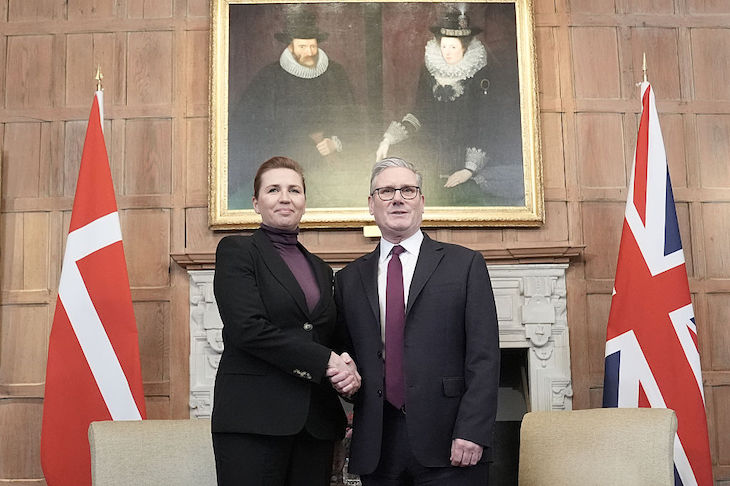
The European centre’s favourite trick, when losing voters, is to explain that democracy is under grave threat and that power must therefore remain inside the circle of “sensible” centrists who know why voters are wrong.
Starmer embodies the British variant of centrism: despite promises of real change, only managerial declinism has emerged
Denmark has now provided the latest demonstration. Almost ten weeks after the election, Mette Frederiksen has secured another government. Her Social Democrats suffered their worst result since 1903, falling to 38 seats in a parliament of 179. Yet after months of negotiations, the result is another Frederiksen-led minority government, bringing together the Social Democrats, the Social Liberals, the Green Left/SF and Lars Løkke Rasmussen’s centre-right Moderates.
Not a purely centrist government, but one shaped by the centrist instinct: manage the fragments, keep the approved circle intact and prevent a real rupture with the existing order.
So the voters moved away. The centre manoeuvred. Much the same political class stayed in charge. Responsibility was declared.
This is now the operating system of much of Europe. Keir Starmer embodies the British variant: despite promises of real change, only managerial declinism has emerged. Emmanuel Macron has turned the instinct into a presidential art form. Germany’s supposed CDU saviour, Friedrich Merz, already looks trapped by over-managed non-change, governing with the centre-left while insisting the centre-right has returned.
Everywhere, the method is similar. Once voters seek change elsewhere, parties around the centre – even yesterday’s arch-rivals – suddenly discover they are natural partners in the sacred task of keeping out the “extremists”. The word typically means parties insufficiently house-trained by those enjoying institutional power.
Yet Denmark is not the Élysée Palace with bicycles and rye bread. It is too small and too connected to reality to drift entirely into ideological fantasy. This is why Frederiksen has survived. Earlier than most European social democrats, she understood that voters did not want another lecture about openness from people insulated from its consequences. On migration, she moved harder and earlier because Denmark is small, densely populated and harder to govern from a cloud of theory. The side-effects arrived faster.

Still not a true break with the centrist mindset. It was minimum viable reformism.
Minimum viable reformism means doing just enough to slow voter desertion while leaving the deeper order intact. Address one complaint, such as migration, then use it as a toughness alibi to change little else. Spend on the noisiest interests. Announce historic breakthroughs while preserving the old set-up. Call it listening.
The new Danish agenda fits: cheaper food, free public transport for the young, dental care, pensions, defence, Greenland, tougher deportations and animal welfare reforms.
Some measures are sensible but together they look less like a governing philosophy than issue-by-issue patching: a little for the pensioner, a little for the student, a little for the green conscience, a little for the migration voter, a little for animal welfare, a little for the acute geopolitical moment.
It does not ask what Denmark should become. It asks how little must be conceded to keep the centrist order intact.
That is also why trust keeps thinning: voters are told they have been heard, only to receive the, yes, minimum concession required. The deepest flaw of the centrist mindset is not self-preservation as such but the belief that procedural cleverness can substitute for democratic legitimacy. The centre moves late and unwillingly, then congratulates itself for courage.
This brings us to Tony Blair, recently reappearing to recommend a “radical centre”. It’s another magnificent piece of Blairite spin. Having helped normalise the centrist excess voters now reject, he seeks to rescue it by dressing up retreat as advance. When even Blair starts edging away from Blairism, the centre should take the hint.
The bad news is that Denmark’s new government may prove weak, rudderless and as tediously self-righteous as centrists everywhere
Denmark’s conversion will be less theatrical. It will come in the Nordic style: late, reluctant, orderly and with everyone pretending they were never terribly attached to the old orthodoxies. These are my principles, says the centre, and if you don’t like them – to echo Groucho Marx – I have others.
The bad news is that Denmark’s new government may prove weak, rudderless and as tediously self-righteous as centrists everywhere. The good news is that weak leadership matters less in small societies, where reality has fewer hiding places. Good leaders can make an enormous difference, especially during transitions. Without them, necessary change arrives late and under a permanent cloud of anger and confusion. But in Denmark, at least, the correction rarely disappears.
That is what the centrist mind so often misses. It looks upwards and outwards for guidance – to Brussels, supranational bodies and other solemn international coordination exercises among fellow centrists – when the miracle of Denmark has always come from looking closer to home. Its strength has never been the wisdom of its political class, but the practical intelligence of a people close enough to keep that class honest. Denmark remains an amazing country because it is blessed by smallness: small enough for theory to meet life – and for the people still to lead when their leaders forget how.



Comments