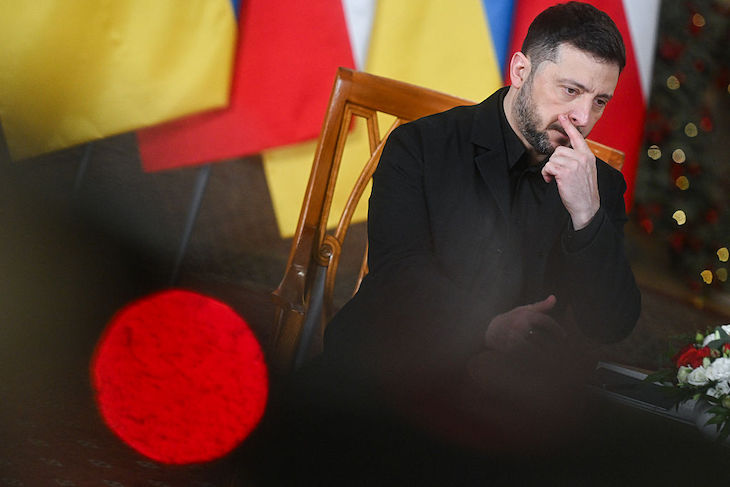
Poland’s president Karol Nawrocki has threatened to strip Volodymyr Zelenskyy of Poland’s highest state honour after the Ukrainian leader awarded a military unit the honorary title “Heroes of the UPA”.
For many Ukrainians, the massacre is one episode in a longer and more complex history
On 26 May, Zelenskyy signed a decree awarding a Ukrainian special forces unit the honorary title “Heroes of the UPA”, referring to the Ukrainian Insurgent Army, a controversial WWII-era nationalist group.
The Ukrainian leader’s decision proved contentious in Poland, where the UPA is primarily remembered for mass killings carried out in the Volhynia region and Eastern Galicia, in which as many as 100,000 Polish civilians, among them women, children, and the elderly, were murdered. In Poland, this event, commonly referred to as the Volhynia massacre, is broadly regarded as an act of genocide.
The move provoked an immediate backlash in Poland. Lech Wałęsa, the Solidarity leader, Nobel Peace Prize laureate and former president, announced that he would no longer wear a Ukrainian flag on his lapel, while Nawrocki declared his intention to strip Zelenskyy of the Order of the White Eagle, Poland’s highest state honour.
The Order of the White Eagle was conferred upon Zelenskyy on 5 April 2023 by Nawrocki’s predecessor, Andrzej Duda, in recognition of his services in strengthening relations between Poland and Ukraine, his efforts to uphold European security and his unwavering dedication to the defence of human rights.
Speaking to Polish media, Nawrocki was unsparing in his assessment. Zelenskyy had “proven that Ukraine, in terms of mentality, glorifying the bandits and murderers of the Ukrainian Insurgent Army, is not ready to be part of the European family.”
In Kyiv, Ukrainian Foreign Ministry spokesperson Heorhii Tykhyi acknowledged Poland’s response, emphasising that no offence had been intended. For Ukrainian soldiers, he said, “the struggle of the UPA symbolises strictly the opposition to Moscow’s imperial policy.”
For many Ukrainians, the massacre is one episode in a longer and more complex history. Lubomyr Luciuk, Canadian professor, told The Spectator: “The UPA emerged with a clear purpose: the liberation of Ukrainian lands from all occupying powers… this was not a movement dedicated to oppressing minorities or conquering others’ territory – it was oriented toward a single goal, Ukrainian independence and statehood.”
Ukrainian historian Yaroslav Hrytsak added that the UPA’s place in Ukrainian national memory has shifted significantly since Russia’s full-scale invasion in 2022. “The UPA has historically been the most controversial and divisive issue within Ukrainian national memory,” he told The Spectator. “But 2022 marked a turning point, with the war leading many Ukrainians to view it more positively, as a symbol of anti-Russian resistance.”
He noted that the UPA is now rarely framed within the context of Polish-Ukrainian or Jewish- Ukrainian relations; instead, it is viewed primarily through the lens of the Russian-Ukrainian conflict.
Yet for many Poles, such explanations offer little consolation. Among the most vocal voices, Leszek Miller, former prime minister and a senior figure of the Polish left, wrote on X: “This is not honouring those who fought for independence. This is honouring butchers who murdered defenceless people.”
It is a sentiment made sharper still by the scale of Poland’s commitment to Ukraine since 2022. Poland has welcomed more Ukrainian refugees than any other EU country, nearly one million according to Eurostat. Total government aid is estimated at over €6 billion (£5 billion) in military, financial and humanitarian support between 2022 and 2026, according to the Kiel Institute for the World Economy.
That commitment, however, was already under strain. A poll conducted in November 2025 by IBRiS, one of Poland’s leading research firms, found that nearly two thirds of Poles felt relations with Ukraine had worsened over the course of 2025.
A separate report published by the Mieroszewski Centre, a Polish state institution that conducts regular polling on Polish-Ukrainian relations, paints a similar picture. It found that Polish attitudes toward Ukrainians living in Poland have cooled markedly since before the full-scale invasion – with 39 per cent declaring a positive view, 35 per cent a negative one, and just 15 per cent neutral, suggesting a society increasingly polarised on the question.
Against this backdrop, the tension around Zelenskyy’s decision raises a broader concern: could diverging interpretations of the past deepen fault lines in the relationship?
Voices on both sides of the dispute have urged continued cooperation and respectful dialogue. Writing on X in the immediate aftermath, Polish prime minister Donald Tusk was pointed in his message to both capitals: “If we quarrel about the past, someone else will win the future. The president of Ukraine should finally understand this. The Polish president also. Before it is too late.” This sentiment was echoed by Ukraine’s Foreign Ministry spokesperson Heorhii Tykhyi, who reminded journalists that “our history proves that only Moscow benefits from disputes between Ukrainians and Poles.”
Whatever the interpretation of the UPA’s legacy, the view that Russia stands to gain from this dispute is widely shared among political and historical voices. Yet as Luciuk observed, history is full of nations that built functioning alliances without ever fully resolving their contested pasts. Reconciliation, he argued, does not always begin with agreed verdicts on history, but with a simpler principle: “today matters more.” When asked whether Poland and Ukraine could maintain a close strategic partnership while continuing to disagree about the UPA and the Volhynia massacre, his answer was unequivocal: “Not only can they. They must.”



Comments