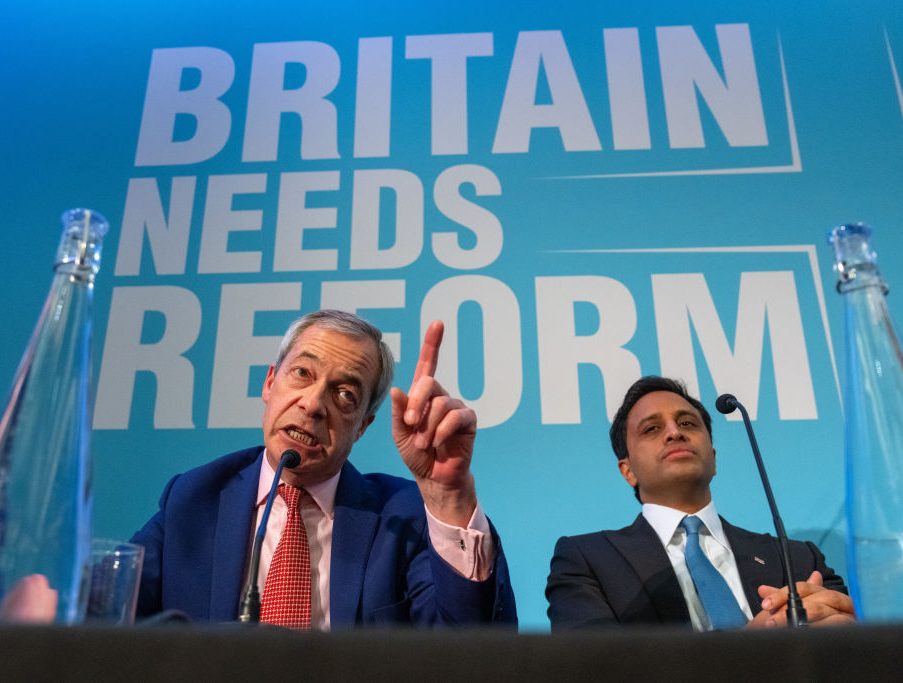
A lazy framing of British party politics portrays Reform UK playing the equivalent role on the right of British politics that the Green Party does on the left, with each outflanking the Conservatives and Labour, their respective rivals on the centre-right and centre-left. It’s lazy in that it takes far too little account of the way in which the traditional distinction between left and right – the size of the state, and how heavily regulated and taxed an economy is – is no longer the main ideological fracture between the different parties. Increasingly, it’s wrong.
Whoever gets into government after the next election will only have one shot
The evidence comes from Reform’s rapidly emrging vision. The Greens, their supposed opposite on the political spectrum, have a policy programme that would genuinely be radical and transformative: open borders without caveats, a drastic expansion of the size of the state, the expropriation of vast amounts of private wealth, an effectively unlimited welfare state and almost full legalisation of drugs. That this would be dystopian is besides the point.
By contrast, Reform are swallowing much of the prevailing orthodoxy: Gordon Brown-coded fiscal rules, the Office for Budget Responsibility, the triple lock, independence of the Bank of England and more. The people making up the party are increasingly orthodox as well – from Nadhim Zahawi to Robert Jenrick. Even on immigration, the actual policy differences between the Conservatives and Reform are small; with Labour’s immigration policy restrictive, they are no longer a radical departure from the norm. More worryingly, given Reform are currently favourites to lead the next government, is the party’s reliance on stunts and policy gimmicks.

Just look at two of the policies they’ve recently announced. Firstly, the scrapping of income tax on overtime. It is what pollsters might call good retail politics – the sort of thing that might appeal to voters in Makerfield that the party is seeking to win. That doesn’t stop it being a stupid policy – it would almost be worse to find out they had thought it through and decided it was worth the risk than if they just hadn’t stress tested it and announced it after one too many at the Westminster Arms. What are the core problems with British tax policy? That it is wildly complicated, highly distortive, contains numerous cliff edges, and long overdue radical reform, rather than futher gimmickery.
This policy makes the tax system more complicated. Why does someone who works overtime on a salaried job where they aren’t paid by the hour not able to use the tax break, but someone who is paid by the hour can use it? What else does the policy do? It makes the tax system far more distortive, and will encourage companies to manipulate pay to move as much as possible into overtime. Reform say there will be measures to prevent this. How many times have we heard that before?
Moreover, how does the policy help with cliff edges? It creates a brand new one at £75,000, meaning a construction worker, for example, who is approaching the limit, and who earns a lot from overtime, will be incentivised to turn down a promotion if they breach the salary threshold. Rather than radically reform income tax on all types of work – such as by raising income tax thresholds, and scrapping the 60p effective rate above £100,000 – it seeks to solve the problem of overtaxed work with an unworkable gimmick.
Another policy is the pledge to only build immigration detention centres in Green-voting areas. As amusing as it was to see the reaction of some parts of the liberal commentariat, it’s also a policy tailor-made to make it more difficult and more expensive to build these facilities. Green-voting areas are increasingly in dense, urban locations where land is scarce and the population hostile. It suggests that owning the progressives is a greater motivator for Reform than removing the hundreds of thousands of people who shouldn’t be here.
Rather than be the right-wing equivalent of the Greens, Reform are better thought of as the right’s equivalent of the Lib Dems. They may have a better analysis of what’s gone wrong, but with a policy platform constituted of gimmicks communicated through stunts. Pure vibes-based politics.
These recent policy announcements demonstrate that there was a wisdom to Kemi Badenoch’s approach of strategic patience to build up a serious, thought-through, bulletproof policy agenda. Lee Cain was critical of the strategy in a recent episode of Coffee House Shots. He’s certainly right it left a vacuum for Reform to fill – but are we really supposed to believe that anyone wanted to hear from the Conservatives during that period?
Whoever gets into government after the next election will only have one shot. As much as the electorate may be momentarily distracted by the energy and zeal of Reform, by the time of the election, they will hopefully care more about who has a serious programme for government – something Reform are showing that they lack.




Comments