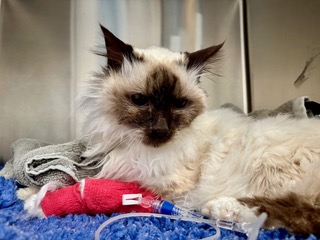
In the weeks since I relocated from London to Melbourne, I suspect my reputation among those who know me underwent a quiet but decisive shift: from seasoned, sardonic war correspondent to something closer to a deranged cat obsessive.
My 14-year-old Birman, Aero, has acquired a global following. I have woken up to messages from London, Kabul, Washington, Islamabad, Paris – people asking, not unreasonably, whether she is still alive. She very nearly wasn’t.
Soon arriving in Melbourne following a month in transit, Aero was blind, dehydrated, unable to walk and potentially carrying an untreated infection
Soon after arriving in Melbourne following a month in transit, Aero was blind, dehydrated, unable to walk and potentially carrying an untreated infection. For the first three days after I brought her home, I was certain she would die.
The company responsible for transporting her, PetAirUK, is part of IVC Evidensia, a private equity-built veterinary empire worth billions of pounds, now reportedly eyeing a London IPO.
With that in mind, Aero’s journey begins to look less like an isolated failure and more like a corporate structure designed to scale fast and answer, ultimately, to investors rather than to the people who entrust their animals to its care.
This is not just a story about one cat, or one failed journey. It is about what has happened to veterinary care in Britain as small practices have been rolled up into vast, investor-backed networks with limited transparency and accountability.
As regulators begin to scrutinise the £6.3 billion veterinary sector over rising costs and unclear pricing, far less attention has been paid to what happens when something goes seriously wrong – and who, if anyone, is responsible when it does.
In my case, the answer stretches across continents.

Aero’s journey should have been routine. There had been months of blood tests, vaccinations and certifications, designed to eliminate risk. But then her original route, on Emirates via Dubai, was cancelled when the war in the Gulf disrupted flights. It took weeks to secure another passage, this time via Colombo on SriLankan Airlines.
This is where the problem became clear. I was sent videos from Colombo showing my cat already in distress: she was lethargic, unresponsive and clearly unwell. This decline had been underway, unnoticed or unacted upon, well before she boarded the final leg to Melbourne.
By the time she landed, Australian quarantine officials – not prone to alarmism – were sufficiently concerned to advise immediate veterinary intervention. Within hours of her leaving quarantine two days later, Aero was in an ambulance, on her way to the University of Melbourne’s veterinary hospital. She was admitted to intensive care, placed on intravenous fluids, treated for infection and severe constipation.
The cost of that treatment so far is more than AUD$15,000, on top of £5,000 in compliance, PetAirUK’s fee, and a war premium to Sri Lankan Airlines.
But there are more important questions that need answering: who had assessed her as fit to fly? Who had responsibility for her condition in Colombo? And who, at any point, was accountable for the decision to put her on a plane in that state?
Aero’s journey began with a UK-based transport provider, then a corporate parent, through a transit hub in Sri Lanka, and on to an Australian endpoint left to deal with the consequences. At each stage, responsibility has been passed on to someone else.
The responses I have received from the companies involved so far follow a familiar pattern. They have expressed concern, given reassurance, and promised an internal investigation. They dispute liability, saying they identified no breach of duty in Aero’s handling or transport. (A Pet Air spokesperson said: ‘For the duration that Aero was in our care our team went above and beyond to ensure that she was comfortable and looked after… All of the records of her journey show that while Aero was thin, there was no deterioration in her clinical condition from when she first arrived in our care until she left our care, and nothing that meant Aero should not have travelled, as confirmed by an independent vet at Heathrow… Despite several requests, we have not been provided with the clinical information from after Aero left our care that would allow us to investigate further.’)
In Britain, regulators have begun to scrutinise the sector, examining whether the consolidation of veterinary services has reduced competition and limited choice.
But price is only the most visible problem with this corporate structure. As independent practices have been absorbed into large, investor-backed groups, the lines of responsibility have blurred. When something goes wrong, the question is no longer what happened, but who – if anyone – is responsible. In Aero’s case, the answer appears to have been no one.
I still do not know who assessed her in Colombo, or on what basis she was deemed fit to fly. I do not know what records exist of her condition before she boarded the final leg to Melbourne, or who, within that chain of companies and contractors, had authority to intervene – or the obligation to stop her travelling.
What I do know is the condition she arrived in.
I know that quarantine officials were sufficiently alarmed to advise urgent veterinary care. I know that she was rushed into intensive care. I know what it cost to stabilise her, and what it has taken, day by day, to bring her back.
And I know that none of it should have been necessary – if someone, at any point along that chain, had been accountable for her care.
Aero is recovering. Slowly, unevenly, but unmistakably. She can stand and walk now. She eats. Her sight is returning. The small, ordinary signs of life are returning.
The care she received in Melbourne was meticulous and humane. The vets who treated her did what the profession is supposed to do: they paid attention, they acted, and they took responsibility for the outcome.
At the level of individual practice, veterinary care remains what it has always been: skilled, committed and grounded in duty. But the corporate structure that now sits above it does not operate on those terms.
For now, the official response remains that an investigation is underway or unable to proceed. But accountability is needed. And in this case, it is still missing.





Comments