There comes a time when every man must choose how to tackle an impending midlife crisis. A Maserati? A marathon? A mistress? Lacking the wealth, stamina or sheer Italian-ness for any of the above, I’ve plumped for that most gentile of sports to feel alive again: tennis.
The problem with a new hobby, of course, is that you immediately feel more infantile than raffishly young. Picking up fresh skills means relearning how to learn, decades after university, when you actually had the appetite for self-improvement. Sure, tennis is, as studies have found, one of the most effective activities for staying healthy. It’s also infuriatingly finicky.

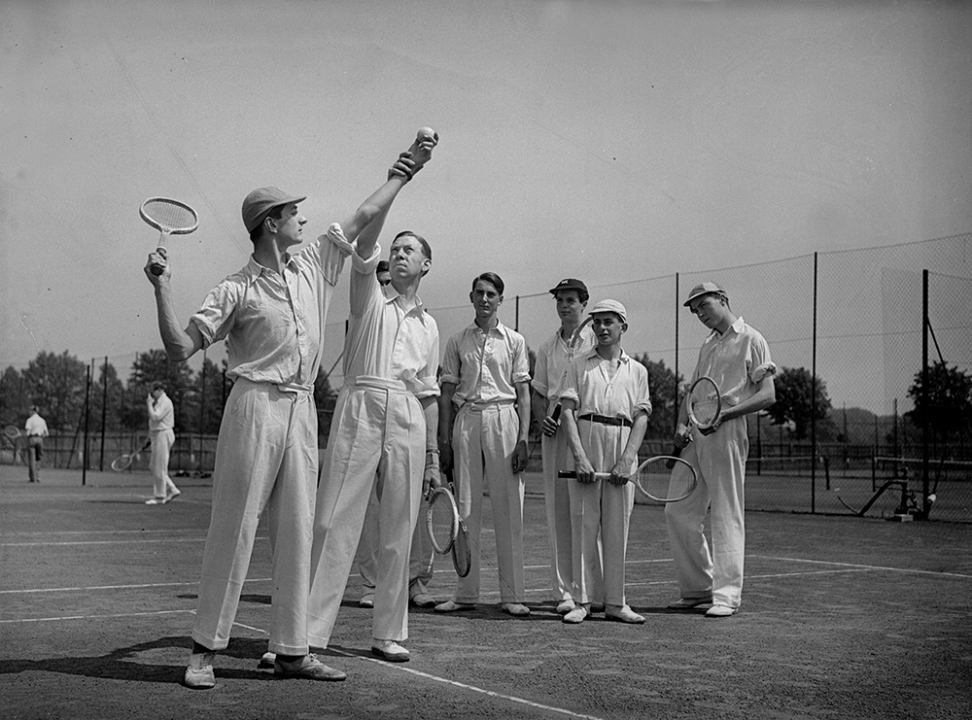
Technique-wise, I can fire off a decent groundstroke (forehand and backhand), thanks to lessons as a mopey teen. But the serve is one of the most fiendishly intricate biomechanical movements you can attempt. Toss the ball up, and a skilled player initiates a labyrinthine ‘kinetic chain’ involving every major muscle group and ending in a 130mph cannon. It percolates from the toes upward and must flow silky-smooth right down to the millisecond. Screw up and you’re left with a kittenish whisper that leaves your opponent tittering into their Gatorade.
Learning to improve felt like becoming the acolyte to a Zen monk, complete with inscrutable instructions. Most of a good serve technique feels deeply illogical. At the start, I found that the harder I ‘tried’, the more I seized up, trying to muscle my way into power.
Truly, this is ‘the sound of one hand clapping’ territory, where both body and mind must learn to bend like a reed – or rather, to be a loose whip rather than a sledge-hammer. Very Zen; and a useful lesson for life, where I similarly tend to ‘cling’ to problems when the actual solution is to practise a sense of cool-handed distance. A Taoist theory, wu wei, meaning ‘effortless action’, has helped guide me here too.
As has the awareness that you cannot learn much from observation. Scores of hours spent analysing online coaches and pro matches have helped not one iota. No matter how many times I watch clips that urge me to avoid the ‘waiter’s tray’ position (where the racquet hovers behind your head like a plate – the surest path to an asthmatic serve), I can’t seem to stop. Freud would no doubt say I’m destined to be servile.
Luckily, the act itself is a pleasure, not a chore. Loading up on balls and popping to the nearby court with the lemony sunshine on your shoulders, then hitting 200 attempts before dinner is the cheapest of therapies, like fishing. Just you and the rhythmic flow of toss-coil-rise-swing. In minutes, you enter a pleasurable flow state.
And the pleasures of getting it right are sublime. In a world where most progress, from climbing the career ladder to saving for retirement, is so ethereal or complex it feels invisible, there’s nothing like instant feedback that something has worked. The ‘pop’ of an overhead smash done right is enough to have me tingling with pride all afternoon.
Gaining skill week by week to achieve those rare pops feels like learning a new language. First you flub every syllable. But you keep plugging away. It’s a long way from fluency. But you can’t not enjoy the process, chuffed that old dogs can still teach themselves new tricks.


Comments