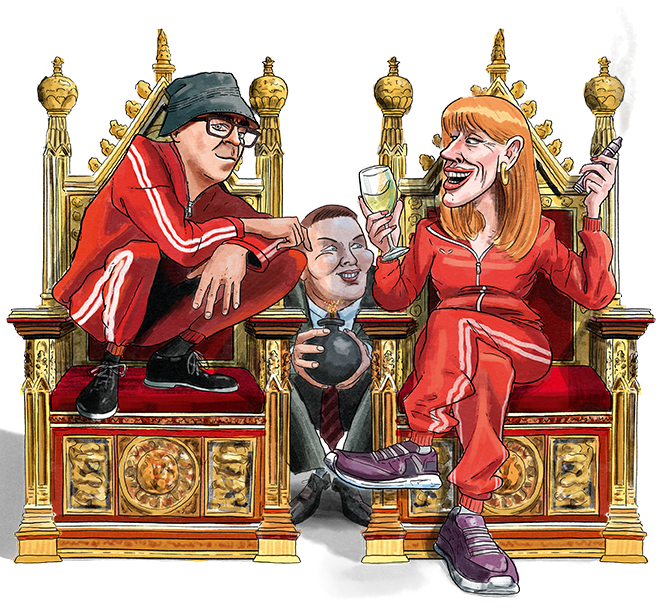

It is an old adage of leadership contests that “if you shoot for the King, you’d better not miss” – but no one expected the starting gun to be fired at Charles III. At the exact time when the monarch was reading the King’s Speech to Parliament on May 13, allies of Wes Streeting, the health secretary, put a bomb under proceedings by making it clear that he is set to challenge Keir Starmer. “Yes, it’s inevitable,” one says. Streeting resigned the following day.
The timing horrified MPs even on Streeting’s wing of the party. A cabinet minister declared: “Having failed with his kamikaze coup, Wes has now undermined every single one of his colleagues and disrespected the King.” Tom Baldwin, Starmer’s biographer, accused Streeting of “overshadowing” the government’s policy platform and “playing Westminster games.”
The day before, MPs and ministers supporting the health secretary had broken cover to call for Starmer to stand down, but the man himself seemed uncertain whether to take the plunge. Insiders say Streeting’s allies were divided. One characterized the division as “old Wes people” who questioned whether he actually had a plan to win the contest, while “the factional headbangers” from the ultra-Blairite thinktank Progress urged him to “seize the moment.” A former No. 10 aide compared him to “one of those first world war generals” who “gets his mates to go over the top while he sits in the chateau.” A cabinet minister says: “He’s like the Grand Old Duke of York marching people up the hill and back down again. You’ve got a group of ministers who I assume have resigned on the promise of jobs from him. They might be waiting quite a long time.”
But on Wednesday morning, after Streeting finally saw Starmer one-on-one for a paltry 16 minutes, he resolved to act. “Wes could never bear that it wasn’t him who saved the Labour party and won an election, but Keir and his team,” a senior Labour source says. “As soon as we got into government he started plotting, thinking everything would fall into his hands.”
An ally says: ‘The Prime Minister went into cabinet and thought: “You know what, fuck these guys”’
Streeting will not, however, have a clear run at Starmer. A No. 10 source said: “Ed is also organising.” That is Ed Miliband, the former leader and Energy Secretary, who may now have to carry the hopes of the Labour left. And Starmer himself “is going nowhere”, a close ally said.
At the start of the week it was far from certain that Starmer would still be around to resist anything. For a few moments in the cabinet room in No. 10, the portrait of Robert Walpole gazed down, waiting for his 57th successor as prime minister to appear. “Everyone is sitting around the table, but there was one empty seat, the only seat with arms,” a minister recalls. When Starmer sat down, few knew what he was going to say. “He had what I would describe as a quiet station, a steely determination.”
Starmer gave “a pretty brief address” acknowledging the local election results were terrible, but warning that, with the price of government borrowing rising, leadership turmoil would have “real economic cost for our country and for families.” He quickly moved on to Labour’s leadership rules. “The party has a process for challenging a leader and that has not been triggered,” he said. A minister says: “We all knew that was directed at one person in the room.” Eyes turned to Streeting.
Just before the meeting started, the 81st Labour MP had broken cover to call for Starmer to quit or name the date for his departure. But the rules state that for a contest to begin, 81 MPs must support a single named candidate and that threshold had not been reached. The PM’s intervention was pure Starmer – a punctilious recourse to process – but it was also an uncharacteristically bold bit of power play. Because, according to ministers and aides, Starmer came close to throwing in the towel on Monday night. His cabinet allies – Richard Hermer, the Attorney General, and Steve Reed, the Housing Secretary – believed he was planning to find a dignified way out.
“I don’t know anyone saying ‘You can fight this, you can beat this’ who was coming away from those conversations thinking he was digging in,” says a source familiar with the behind-the-scenes exchanges. “Keir was deciding how he would go, not whether he would go.” A cabinet ally of Starmer agrees: “It looked rocky.’ According to a ministerial aide: ‘He was close, but then the Praetorian Guard rallied around.”
The turning point was a briefing to the media that his senior ministers Shabana Mahmood, Yvette Cooper and John Healey had formed a delegation to No. 10 to tell him to set out a timetable for his departure. Starmer “went ballistic.” However, the account was, in key regards, incorrect.
While they weren’t optimistic about Starmer’s long-term future, Cooper and Healey were adamant that they had not called for him to set a date. The Defence Secretary urged the PM to keep leading through the immediate crisis, partly because there is a NATO summit on July 7. “All of Keir’s thinking went out the window as soon as there was the claim that his cabinet had turned on him,” a senior source says. “Because at that point it would just look like he’d been dragged out.”
Darren Jones, the chief secretary to the Prime Minister, spent the morning broadcast round saying Starmer was “listening to colleagues,” signaling that he might set out a timetable for his departure. But even as Jones toured the studios, the PM was on a conference call with his closest confidants resolving to “dig in.” An ally says: “The Prime Minister went into cabinet and thought: ‘You know what, fuck these guys. It’s not happening. I’m going to fight it.’”
Starmer’s decision to divide and rule stalled the momentum against him for several hours before the ministerial resignations began again with Jess Phillips and Alex Davies-Jones. They were followed by health minister Zubir Ahmed, an ally of Streeting. Starmer is far from safe, but his decision to divide and rule exposed the deep divisions between his enemies and demonstrated the power of initiative that lies with a proactive prime minister – something he has usually failed to exercise throughout his premiership.
The tepid caution more typical of the PM was evident when he made a “make-or-break” speech. Amid bland bromides about closer ties with Europe and steel nationalization, Starmer admitted incremental change was not enough – but did little to persuade MPs he can offer anything else. For many MPs, it was the speech that was the final straw. What followed can be best understood as three different plots happening simultaneously: “a Revolution” by the soft left of the party to seize control; “a Coup” by supporters of Streeting; and “a lone wolf attack” from the renegade MP Catherine West, who wanted the cabinet to come together to remove Starmer. West’s intervention only succeeded in infuriating both the Revolutionaries and the Coup plotters.
The Revolutionaries began two weeks before when Miliband, anticipating the disastrous local election results, went to see Starmer and told him to set out a time-table for his departure. When this failed, the Revolutionaries’ trigger was pulled when Louise Haigh, the former transport secretary and head of the soft-left Tribune Group of MPs, called for Starmer to name the date of his departure. Angela Rayner, whose support in the Commons has ebbed away, called for the party to move to the left and signaled that she was prepared to support Andy Burnham, the mayor of Manchester, in his route to power.
Miliband, Haigh and Rayner all believe Burnham would defeat either Starmer or Streeting but they know a rapid Coup would frustrate their ambitions. That is why they called for a ‘timetable’ so Burnham has time to secure a parliamentary seat. Their plan was simple, as one conspirator explains: “A-B-C: Andy By Conference”, at the end of September.
For Starmer’s aides, Miliband’s complicity in the Revolution was confirmed by the resignation of the minister Miatta Fahnbulleh “She is Ed’s representative on Earth,” a Starmer ally says. “It’s unthinkable that she would have moved without his knowledge and agreement.”
But the Revolutionaries miscalculated if they thought they could force Starmer’s hand. Richard Hermer urged Starmer to fight on, backed up by Jill Cuthbertson, the co-chief of staff who returned from maternity leave to help. The key figure was Steve Reed, who made a ruthless political argument, described by one source as “pure McSweeney strategizing.” The housing secretary pinned the blame on Miliband and said: “Ed has launched a leadership campaign without a leadership candidate.”
He outlined to the PM the four scenarios which flowed from Miliband’s demand for a resignation timetable. Reed was adamant that giving in to the demand would lead to chaos. In the first scenario, a source explains: “Ed’s camp then needs a candidate to mount a challenge – and they don’t have one.” In the second scenario, Starmer agrees to the timetable, but someone else (i.e. Streeting) challenges him. “Again, Ed needs a candidate ready, and doesn’t have one.” In the third scenario, Starmer agrees and everyone waits for Burnham, but he loses the resulting by-election. “The voters may not want to be complicit in a backroom deal. Ed still needs a candidate.” Only in the fourth scenario, where everything goes to plan, would the gambit work. “They started with a 75 per cent chance they don’t get their candidate on the ballot paper,” said a close ally of Starmer. “Why would you start a contest on that basis? Political leaders need to fight for power. That’s what they’re put into politics to do.” That’s why Starmer chose to fight.
Next, the rise in the cost of government bonds was weaponized by Downing Street to keep MPs onside. The ten-year gilt yield hit 5.1 percent, above the level that destroyed Liz Truss’s premiership. An MP who had a bond-market graph shoved in their face says: “We’re looking on with total incredulity as the markets tank and colleagues comment on a transition, with no view as to how or when this should happen.” More than 100 backbenchers were persuaded to sign a letter backing the PM.
The Starmer team’s determination not to give in to the Revolutionaries also threw Streeting’s Coup plans into disarray. At cabinet on Tuesday he seemed adrift. In the discussion which followed on the Iran war, he made a “bizarre intervention” on the need to communicate the “adverse consequences of the war” to the public, which colleagues interpreted as an effort to say something for the sake of it. Starmer made it clear he would not receive delegations of ministers but was happy to see them individually, before he scuttled away, avoiding Streeting.
Cabinet colleagues do not think Streeting can win over the party membership. Another senior Labour figure compared him to Roy Jenkins, who ducked a leadership challenge with Harold Wilson in 1968. “People are saying it’s now or never for Wes – but it might be never or never. Everyone says Jenkins didn’t become leader because he didn’t go for it, but if Jenkins had run he would have lost anyway.”
Nevertheless, Starmer is badly damaged and relations were strained with Buckingham Palace ahead of the King’s Speech. Courtiers privately asked whether Charles should proceed as planned with the state opening of Parliament, making it clear the monarch should not be used as a human shield for Starmer in a Labour civil war. There is concern that the chaos is undermining Charles’s diplomatic heroics on his state visit to the US. A royal source said: “Everybody worked really hard to get the King positioned, and he is a trouper. But this shows that Britain is flaky. We’re just now waiting for Trump to say, ‘I told you, Starmer is no Churchill.’”
Starmer is far from safe, but his decision to divide and rule exposed the divisions between his enemies
While Streeting fiddled, Burnham roamed, catching a train to London for nocturnal plotting with MPs. His arrival in the capital was greeted by some MPs as if it were Lenin arriving at the Finland Station in 1917. But despite several briefings that he has a seat lined up for a by-election, no announcement was made by the time of writing. A cabinet minister observes: “Andy emerges strengthened by doing nothing apart from get on a train.”
Burnham’s team is confident he can win a seat in central Manchester, despite surging support for the Greens and Reform. But some warn of a repeat of Patrick Gordon Walker, a minister who lost in the 1964 election and was handed a “safe” seat, only to lose the by-election. As a minister puts it: “Kings over the water still have to cross the water.”
The bigger concern some MPs have is that Burnham and his supporters are cavalier about the public finances. Clive Lewis, a key Burnham ally, outlined plans for a “productive state” which would borrow for progressive ends. Paula Barker, another Burnham backer, said, “The markets will have to fall into line” if he unveiled “progressive policies that speak to our communities.”
A former Tory Treasury minister says: “It’s completely bonkers. The left-wing version of Truss.” Some suspect Burnham will be elected on a left-wing prospectus, but he has a habit of changing with the political weather. “The exciting thing about an Andy Burnham premiership is: which Andy Burnham do we get?” says a former No. 10 operator. “Phase one, the Blairite; phase two, the Brownite; or phase three, the Corbynista? Spin the roulette wheel of Burnham and find out!”
It is hard to see how Starmer will survive for long. “A PM can’t continue without the support of his cabinet,” a Streeting ally says. For now, there is stalemate. “It’s like a Mexican standoff but no one has any guns,” a minister says. “I’m not resigning but I’m now just as angry at Keir for not seeing the writing is on the wall.”
The civil service awaits its marching orders. A Whitehall source complains: “People say Britain is ungovernable. It’s nothing of the sort. We just need people who can govern.” It is not clear if they are available.






Comments